
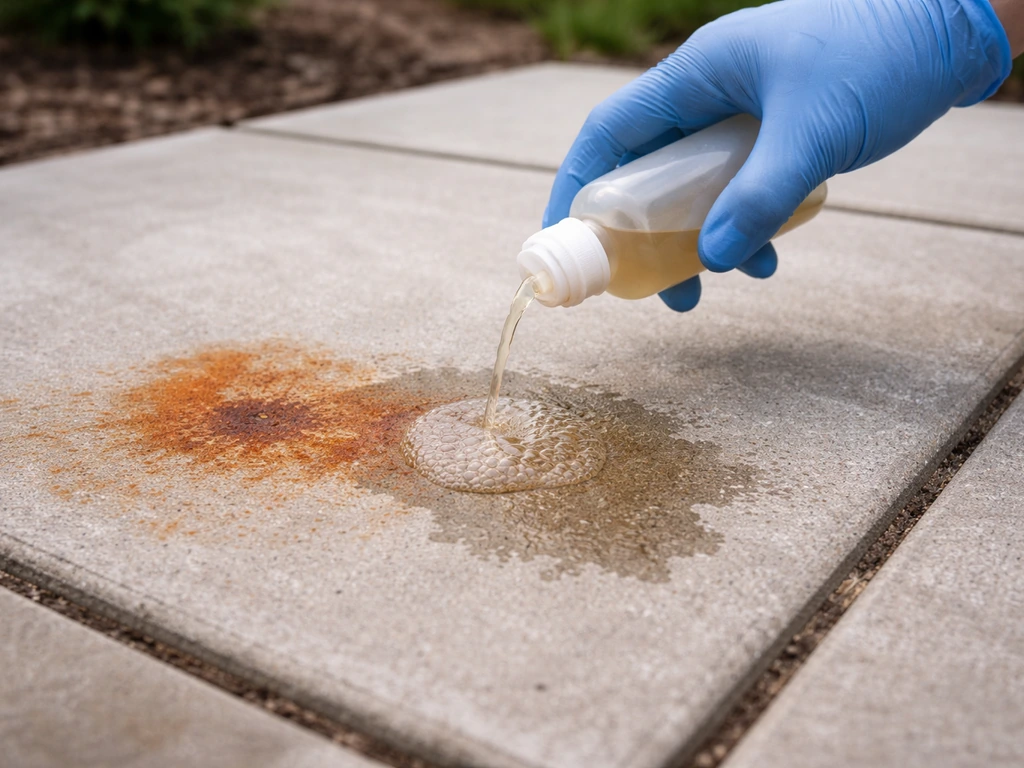
The fastest safe way to remove rust marks from a granite patio is to apply a commercial stone-safe ferrous stain remover directly to the stain, let it dwell for 10 to 30 minutes, scrub gently with a nylon brush, and rinse thoroughly with clean water. For deeper or older stains, an oxalic acid poultice left in place for 24 to 48 hours pulls the iron out of the stone's pores more effectively. Both methods work without etching or permanently dulling the granite surface, provided you avoid strong acids like muriatic acid and always test a small hidden area first.
How to Get Rust Marks Off Granite Patio: Safe Step-by-Step
Dylan Hale
8 Aug 2026
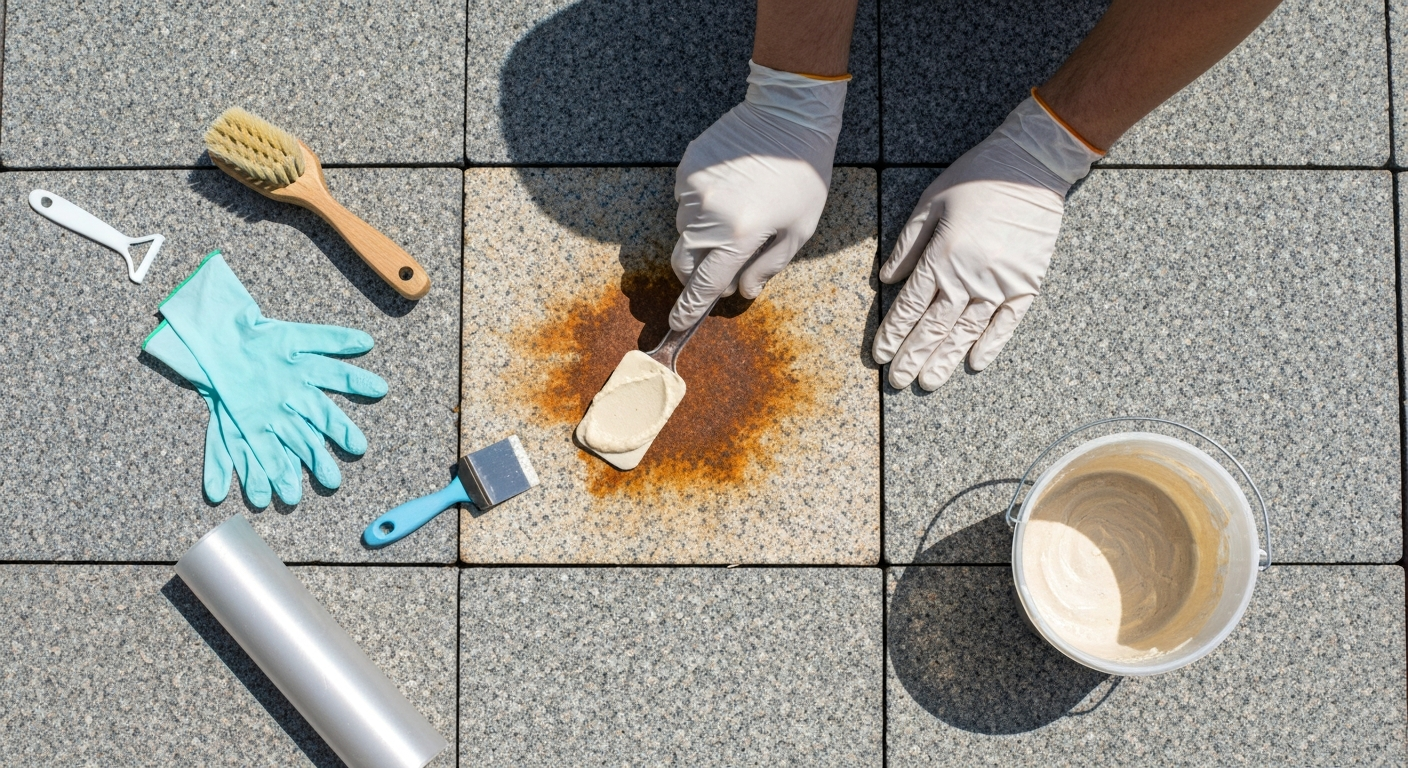
Is that really rust? How to tell rust from other patio stains
Before you reach for any product, it helps to confirm you're actually dealing with rust and not something else. I've wasted time treating tannin stains with iron removers because the color looked similar. Here's a quick guide to tell them apart.
| Stain type | Appearance | Common source | Quick field test |
|---|---|---|---|
| Rust (iron oxide) | Orange, reddish-brown, or dark brown; follows the outline of a metal object | Metal furniture legs, planters, nails, screws, iron in the stone itself | Bleach dripped on the stain does nothing; stain stays orange-brown |
| Tannin | Yellow-brown to dark brown; often irregular or spreading shape | Wet leaves, wood, bark, wine | Diluted bleach often lightens or removes it quickly |
| Oil/grease | Dark grey or black; feels slightly greasy; repels water | Barbecue drips, cooking oil, bike chain grease | Water beads on the spot; acetone or dish soap lifts it slightly |
| Mildew/algae | Black, green, or pink film; slippery underfoot; may smell musty | Shaded damp areas, poor drainage | Diluted bleach visibly lightens it within minutes |
If your stain is orange or reddish-brown and sits directly where a metal chair leg, planter, or nail has been sitting, you're almost certainly dealing with rust. Another reliable clue: the stain doesn't lighten at all when you dab diluted household bleach on it, because bleach is designed for organic stains and does nothing to iron oxides. A simple on-site approach is to dab diluted household bleach to check for organic stains and to try a 1:10 vinegar spot test for acid sensitivity on calcareous stone, see Lithofin / Stone care FAQ, granite identification & testing (acid test guidance) for additional guidance Lithofin / Stone care FAQ — granite identification & testing (acid test guidance). Once you're confident it's rust, you can move on with the right approach.
Safety first: protect yourself and your granite
Rust removal on natural stone involves acids, and both your body and your patio surface need protection. The two main risks are personal exposure to the chemicals and accidental etching or discoloration of the stone. A few minutes of preparation prevents both.
Personal protective equipment (PPE)
- Chemical-resistant gloves (nitrile or rubber): oxalic acid and commercial ferrous removers are corrosive at skin contact
- Safety goggles or glasses with side shields: eyes are the most vulnerable, especially when scrubbing or rinsing
- Long sleeves and closed-toe shoes: splashes happen, especially during rinsing
- Respirator or dust mask if mixing dry oxalic acid powder: NIOSH lists the occupational exposure limit at approximately 1 mg/m3 TWA; even in a garden setting, mixing powder outdoors with your face over the bowl is a bad idea
- Work in a well-ventilated outdoor area and keep pets and children well away until the area is fully rinsed
What can damage granite
Granite is more acid-resistant than marble or limestone, but it is not acid-proof. The big one to avoid is muriatic (hydrochloric) acid. It will etch the surface and can attack the minerals in certain granite types. I've seen people use it successfully on concrete, and it is genuinely useful there, but on granite it's a no-go unless you're a trained professional who has tested the specific stone. Similarly, undiluted vinegar applied repeatedly or left to sit can cause surface dullness over time. Even oxalic acid, which is your friend for rust on granite, needs to be rinsed off completely and not left for longer than recommended, because it can produce residues in some situations. Always rinse with plenty of clean water after any chemical treatment.
What you'll need: materials, tools, and products
You don't need a van full of professional gear. Most of what works best for granite rust removal is available at hardware stores or online. Here's what I keep on hand for this job.
- Oxalic acid powder (available at hardware stores and online): the active chemistry behind most stone-safe rust treatments; forms iron-oxalate complexes that lift iron from stone pores
- Absorbent poultice carrier: diatomaceous earth, kaolin clay, talc, or even plain white paper towels work; these carry the acid into the stone and draw the dissolved iron back out
- Commercial stone-safe ferrous stain remover (e.g., PROSOCO Sure-Klean Ferrous/Iron Stain Remover or equivalent): pre-formulated, takes the guesswork out of mixing, generally safer to handle than raw acid powder
- Nylon scrub brush (stiff): essential for surface stains; avoid metal wire brushes which can leave iron particles that create new rust spots
- Plastic scraper or spatula: for removing dried poultice without scratching the stone
- Plastic wrap or polyethylene sheeting: covers the poultice to slow evaporation and improve penetration
- Garden hose with good pressure or pressure washer (up to about 1,500 PSI for granite): rinsing is one of the most important steps
- Bucket and measuring cup: for mixing solutions accurately
- pH-neutral stone cleaner: for pre-cleaning and final rinse to restore neutral pH
- Household white vinegar (optional, for very light surface stains only): diluted 1:4 with water; use cautiously and rinse immediately
Test a small area first, always
Every conservation authority I've read, from the Natural Stone Institute to the National Park Service, recommends testing an inconspicuous area before full treatment. I can tell you from experience that this step has saved me from ruining visible sections of stone. Granite varies: some polished slabs are very sensitive to surface chemistry changes, while others tolerate mild acids without any visible effect.
- Choose a hidden spot: under a bench, behind a pot, or in a corner that furniture normally covers
- Apply your chosen product or solution to roughly a 2-inch square area using a cotton swab or small brush
- Allow it to dwell for the full time you plan to use in the main treatment
- Rinse thoroughly and let the area dry completely (at least 30 minutes in sun, longer in shade)
- Inspect in good light: look for color change, surface dullness, etching (a slightly matte or roughened texture), or any white residue
- If the surface looks identical to the surrounding stone, you're good to proceed; if there's any change, try a more diluted solution or switch to a different product
One practical note: if you're using oxalic acid powder and mixing it yourself, test that specific concentration. A 5% solution in water behaves very differently from a 10% solution, and granite with a polished finish is more likely to show any micro-etching than a textured or flamed surface.
Step 1 (gentle first): water rinse and dilute vinegar for very light stains
If the rust mark is fresh and light, meaning it appeared recently and hasn't had months to penetrate, it's worth trying the gentlest approach before mixing chemicals. I always start here because it sometimes works and saves you the hassle of a full poultice treatment.
- Remove the rust source first: lift the metal furniture leg, pot, or object causing the stain and set it aside or fit felt or rubber pads to the bottom
- Rinse the stain with a strong stream of clean water from a hose to remove surface dirt and any loose material
- Mix white vinegar with water at a 1: 4 ratio (one part vinegar to four parts water) — do not use undiluted vinegar on granite
- Apply the diluted vinegar to the stain with a cloth or sponge and let it sit for no more than 5 minutes
- Scrub gently with a nylon brush using circular motions
- Rinse immediately and thoroughly with clean water — this step matters; residual acid is what causes surface damage over time
- Dry the area and assess: if the stain has lightened noticeably, repeat once or twice; if there's little to no change after two attempts, move on to the oxalic acid poultice
Be honest with yourself here. Dilute vinegar is acetic acid, and it's a weak acid at household concentrations. The NIOSH Pocket Guide, Acetic acid (notes on concentrations and hazards) states household vinegar is typically about 3–5% acetic acid and advises that even weak acetic solutions can irritate or damage surfaces and should be used cautiously NIOSH Pocket Guide — Acetic acid (notes on concentrations and hazards). It can shift very light, surface-level iron deposits, but it won't pull iron that has penetrated into the stone. If the stain has been there for more than a few weeks, skip straight to the oxalic acid method. Prolonged vinegar treatments trying to force results on a deep stain will do more harm to the surface than good.
Step 2 (most effective for deep stains): oxalic acid poultice method
This is the method I rely on for any rust stain that's been sitting for more than a couple of weeks. The poultice works by dissolving iron oxides through chelation: oxalic acid forms iron-oxalate complexes that detach the iron from the stone's mineral matrix, and the absorbent carrier then draws that dissolved iron up and out of the pores as it dries. It's the same chemistry professional conservators use on heritage stone, just scaled down for a patio.
Mixing the poultice
- In a plastic bucket, dissolve oxalic acid powder in warm water to make a 5 to 10% solution: roughly 1 to 2 tablespoons of powder per cup of water; stir until fully dissolved
- Add your absorbent carrier (diatomaceous earth, kaolin clay, or talc) gradually, stirring as you go, until the mixture reaches a thick peanut-butter consistency — it should hold its shape when scooped but not be crumbly
- Mix only what you'll use in one session; discard any leftover poultice rather than storing it
Applying and covering the poultice
- Clean the stained area first with a pH-neutral cleaner and rinse, then let it dry slightly — a damp surface is fine but standing water dilutes the treatment
- Apply the poultice paste in a layer about 1/4 to 1/2 inch thick, extending at least 1 inch beyond the visible edges of the stain in all directions
- Cover immediately with plastic wrap or polyethylene sheeting and tape down the edges with painter's tape to slow evaporation — this keeps the poultice active longer and gives the chemistry more contact time with the stone
- Leave in place for 24 to 48 hours; the GSA and Natural Stone Institute both recommend limiting dwell time to 24 hours as a starting point and repeating if needed, rather than leaving it indefinitely
Removal and rinsing
- After the dwell time, remove the plastic wrap — the poultice should be dry or nearly dry; a still-wet poultice may need another few hours uncovered to dry before removal
- Use a plastic scraper or spatula to lift the dried poultice off the stone; avoid metal scrapers which can scratch the surface
- Rinse the area thoroughly with clean water; use a garden hose or pressure washer at 1,000 to 1,500 PSI if available
- Inspect the stain: it should be significantly lighter or gone; if a faint shadow remains, allow the stone to dry fully and apply a second poultice treatment
- Once satisfied, rinse a final time with a pH-neutral stone cleaner solution to neutralize any residual acid, then rinse again with plain water
- Allow the area to dry completely before walking on it or replacing furniture
A realistic expectation: fresh, light stains often disappear completely after one treatment. Stains that have been present for several months may take two or three applications, and deeply penetrated rust, especially in more porous granite, may lighten but not fully disappear. The Natural Stone Institute is candid that very deep-seated rust can be permanent. If you've done three rounds of poultice treatment and you're still seeing significant staining, that's the point to consider calling a stone restoration professional.
Step 3: using commercial stone-safe rust removers
If you'd rather not mix chemicals from scratch, or if you're dealing with a large stained area, a commercial stone-safe ferrous stain remover is a practical and reliable alternative. For recommendations on the best rust remover for patio slabs, see our comparison guide. For step-by-step instructions and product recommendations tailored to patios, see our guide on how to get rust off patio. Products like PROSOCO's ferrous/iron stain remover are specifically formulated for use on masonry and stone, come with clear application instructions, and are generally easier to handle than raw oxalic acid powder. For step-by-step instructions, see our guide on how to remove rust from stone patio. They're worth the extra cost if you want a straightforward process.
Choosing the right product
Look for products that explicitly state they are safe for natural stone, granite, or masonry. The label or product data sheet (PDS) should confirm it's suitable for non-calcareous stone like granite. Avoid any rust remover that contains hydrochloric or muriatic acid as the active ingredient, as these are designed for concrete and tile, not for granite. If you're also dealing with rust stains on adjacent concrete or patio pavers, you may need a separate product for each surface type, because the chemistry that's safe on granite can differ from what works on concrete.
Application tips for granite slabs
- Read the full product data sheet before starting — dwell times, dilution ratios, and neutralization steps vary by product
- Pre-wet the granite surface with clean water: this prevents the product from soaking in unevenly and reduces the risk of surface staining from the cleaner itself
- Apply the product at low pressure (sprayer, brush, or sponge) directly to the stain, working it gently into the surface
- Allow the recommended dwell time, typically 10 to 30 minutes for surface stains; do not let the product dry on the surface
- Scrub with a nylon brush to agitate the loosened iron
- Rinse thoroughly with clean water, starting from the outer edges and working inward to avoid spreading dissolved iron to clean areas
- Protect adjacent surfaces like lawns, garden beds, or drains during both application and rinsing: many commercial iron removers are not plant-safe and should be rinsed away from vegetation
A note on granite vs. other nearby patio surfaces
If your patio combines granite with other materials, you need to be aware that not every product is cross-compatible. Muriatic acid is commonly used and effective on concrete and cement surfaces, but it should not touch granite. For guidance on how to get rust off of cement patio, consult our concrete rust removal guide covering muriatic acid use and safer alternatives. If you're also removing rust from concrete sections of the same patio, use separate products for each surface and mask off the granite before treating the concrete. For step-by-step guidance specific to concrete surfaces, see our guide on how to get rust off of concrete patio. For rust stains on pavers, tiles, or stone slabs nearby, the same oxalic acid-based and ferrous remover principles apply, though each material has its own tolerances. For step-by-step instructions specifically for pavers, see our guide on how to get rust stains off patio pavers. For step-by-step instructions and product recommendations, see our guide on how to remove rust marks from patio slabs. For specific guidance on treating rust on tiled patios, see our guide on how to get rust off patio tiles. The key rule: always check that the product is listed as safe for that specific surface before applying.
After removal: sealing and preventing rust from coming back
Once the stain is gone and the granite is dry, this is the best time to apply a penetrating granite sealer. Sealing doesn't make granite stain-proof, but it reduces porosity and gives you a window of time to catch and clean spills before they penetrate. Use an impregnating or penetrating sealer designed for natural stone rather than a topical coating, and reapply according to the manufacturer's schedule (typically every one to three years depending on traffic and weather).
Prevention matters more than any cleaning method. Here's what actually stops rust stains from forming in the first place:
- Fit rubber, felt, or silicone pads to the bottom of all metal patio furniture legs — this is the single most effective prevention step
- Use plastic, composite, or powder-coated steel furniture rather than bare cast iron or uncoated steel if rust is a recurring problem
- Move metal planters and decorative objects periodically and check underneath them for moisture build-up
- After rain, dry any standing water from around metal contact points if practical
- Clean the granite surface with a pH-neutral cleaner every few months to remove mineral deposits before they work their way into the stone
- Inspect and re-seal the granite every one to three years, or when water stops beading on the surface
When to call a professional
Most granite rust stains respond to the methods above, but there are situations where a stone restoration professional is the right call. If the stain covers a large area (several square feet or more), if it has been there for years and multiple poultice treatments have had minimal effect, or if previous DIY attempts have left visible etching or discoloration, a professional has access to industrial-strength formulations, poultice systems, and grinding and polishing equipment that can restore the surface without making things worse. The Natural Stone Institute maintains a directory of certified stone restoration professionals if you need a referral.
FAQ
Quick fix — what's the fastest safe way to remove fresh rust marks from a granite patio?
For fresh, surface-only rust: remove the metal source, sweep loose debris, wet the area, and try a gentle cleaner first — sponge with pH‑neutral stone cleaner and warm water and scrub with a soft nylon brush. If still visible, apply a commercial stone-safe ferrous (iron) stain remover following label directions (short dwell time), then rinse thoroughly and dry. Always test an inconspicuous spot first.
How can I tell if a stain is rust (iron) versus something else?
Rust is typically orange‑brown, follows the shape of metal contact (chairs, planters, nails), and won’t bleach out with mild cleaners. Quick checks: (1) Visual: orange/brown color and origin near metal. (2) Bleach test: apply diluted household bleach to a tiny area — if it lightens, it may be organic/mildew. (3) If a mild acidic spot (diluted vinegar) etches or dulls surface, you may have calcareous stone reaction; always test first.
Why test a small area first?
Granite and other natural stones vary. Some treatments can change surface sheen, color, or leave residues. Testing confirms effectiveness and safety for your specific slab before treating the whole stain.
Stepwise, material‑specific methods for granite — what should I try, in order?
1) Remove the metal source and loose debris; sweep and rinse. 2) Clean with pH‑neutral stone cleaner and a soft nylon brush. 3) For light surface rust try diluted white vinegar or 3% hydrogen peroxide on a test patch (short contact, rinse immediately) — avoid if unsure about stone type. 4) If step 2–3 fail, use a commercial stone-safe ferrous (iron) stain remover per label. 5) For deeper stains, prepare a poultice: mix the chosen rust-removal solution (commercial ferrous remover or dilute oxalic‑acid solution where safe) with an absorbent (diatomaceous earth, kaolin, or paper pulp) to a peanut‑butter consistency, apply 1/4–1/2
How do I prepare and apply an oxalic‑acid poultice on granite (step‑by‑step)?
1) Test a small hidden area. 2) Remove metal and clean surface dirt. 3) Mix oxalic‑acid solution per product instructions (or a commercial iron remover) with an absorbent (diatomaceous earth, kaolin, or paper pulp) to a peanut‑butter paste. 4) Spread 1/4–1/2
What PPE and safety steps should I follow when using oxalic acid or commercial rust removers?
Wear chemical‑resistant gloves (nitrile or neoprene), safety goggles, and long sleeves; work outdoors or ensure good ventilation. Read the product SDS and label. Avoid inhaling dust or mist; use a respirator if product instructions require. Keep children and pets away. Rinse treated areas thoroughly and neutralize per product guidance (usually with water). If skin or eye contact occurs, follow SDS first‑aid.
Next Articles
How to Get Rust Stains Off Patio Pavers Step by Step
Step-by-step methods to remove rust stains from concrete, brick, and stone pavers using safe chemicals, scrubbing, and p
How to Remove Rust Marks From Patio Slabs Safely
Step-by-step safe rust stain removal from patio slabs, with prep, dwell times, scrubbing, rinsing, and prevention tips.
Best Rust Remover for Patio Slabs: Step-by-Step Guide
Choose the best rust remover for patio slabs with safe chemical or vinegar steps for concrete, brick, stone and pavers.