
Grease stains on a slate patio come out best with a two-stage approach: blot up the excess immediately, cover the area with baking soda or fuller's earth for 20 to 30 minutes to pull out surface oil, then follow up with a pH-neutral stone cleaner and a stiff nylon brush. For older, set-in stains you'll need a poultice, an absorbent paste left in contact with the stone for 24 to 48 hours. What you should never use on slate is muriatic acid or any strong acid-based degreaser; slate is a siliceous stone and while it won't dissolve the way limestone does, acids can react with iron minerals in some slates and create new staining. Historic England / Practical Building Conservation lists hydrochloric (muriatic) and hydrofluoric acids and strong caustics as unsuitable for slate and advises specialist testing before using acid or caustic cleaners Historic England / Practical Building Conservation lists hydrochloric (muriatic) and hydrofluoric acids and strong caustics as unsuitable for slate and advises specialist testing before using acid or caustic cleaners..
How to Remove Grease Stains from Slate Patio and Pavers - DIY Guide
Why grease behaves differently on slate, stone, concrete, and pavers
Slate is a metamorphic rock, compressed and cleaved shale, and its porosity varies considerably depending on which quarry it came from and how the surface was finished. A riven (split-face) slate patio has an open, slightly rough surface that absorbs oil faster than a honed or polished slab. Because the pores pull grease inward by capillary action, a stain you leave for even an hour can already be sitting a few millimetres below the surface. That's why blotting fast and using an absorbent powder straight away makes such a difference.
Concrete is a very different beast. It's alkaline, highly porous, and rough-textured, so it soaks up grease deeply and quickly, but it also tolerates more aggressive cleaning methods, including degreasers that would be risky on stone. Concrete and unsealed patio slabs are more forgiving of scrubbing and higher pressure washing. Natural stone pavers, sandstone, flagstone, travertine, vary widely; calcareous stones like travertine are acid-sensitive in a way that slate is not, but all porous stone shares the same core challenge: oil goes in fast and doesn't come back out without some effort. The methods in this article are built around slate and non-acid-sensitive stone, with notes throughout on where the approach shifts for concrete or pavers. For tailored steps on concrete and stone pavers, see our guide on how to remove grease stains from patio pavers. For detailed, concrete-specific instructions on how to get grease out of concrete patio, see the dedicated guide on that topic.
Act fast: emergency steps for a fresh grease spill
The first five minutes after a grease spill matter more than anything else you'll do later. I've watched a fresh cooking oil splash that took under two minutes to treat come away almost completely with just baking soda and soapy water. Leave it for an hour and you're into poultice territory.
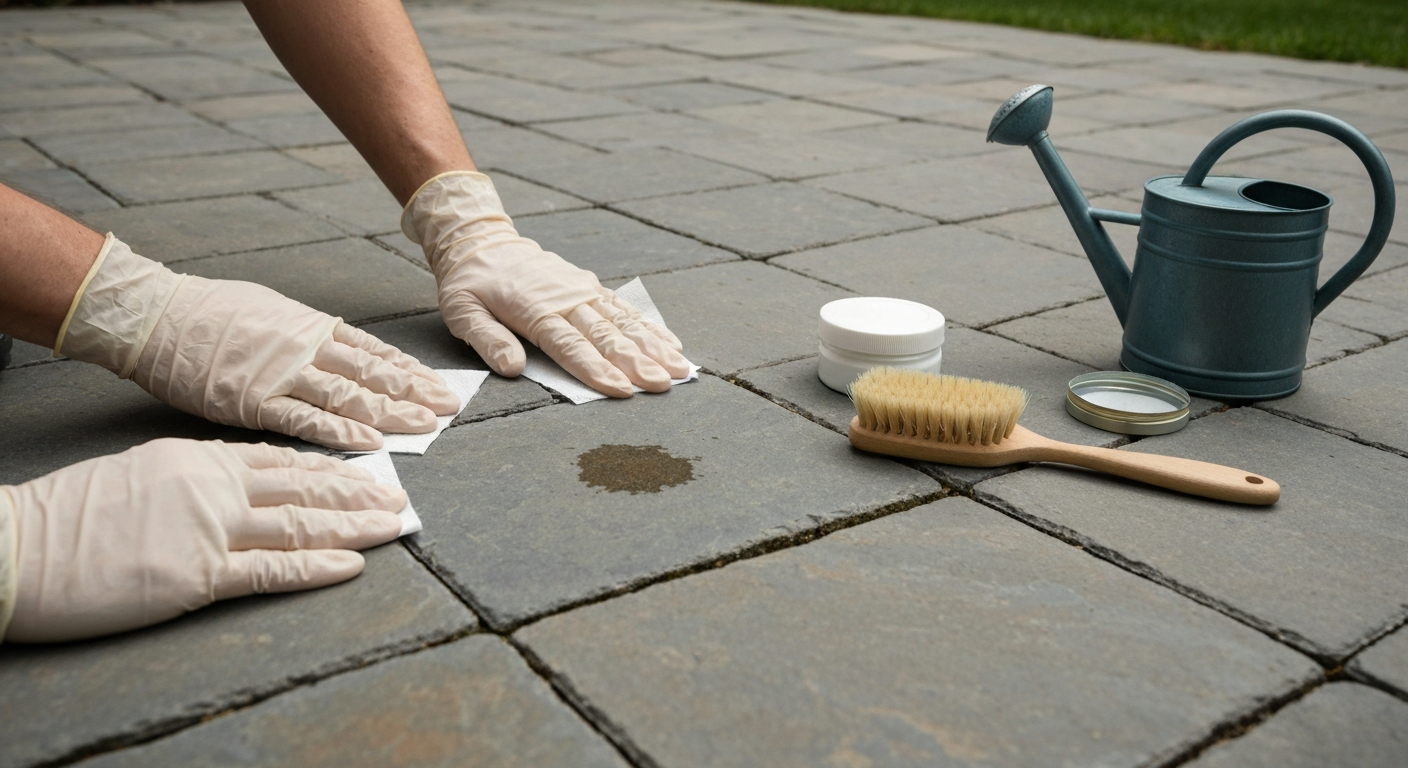
- Blot — do not rub. Lay paper towels or an old cloth over the spill and press down. Rubbing spreads the oil and pushes it further into the pores. Lift, replace, and repeat until you've absorbed as much surface grease as possible.
- Cover the area generously with an absorbent powder: baking soda, talc, fuller's earth, diatomaceous earth, or even plain cornstarch. Pour a layer roughly 5mm to 1cm deep over the whole stain.
- Leave it for at least 20 to 30 minutes. The powder pulls the remaining surface oil out of the top layer of pores. For a large spill, 45 minutes is better.
- Sweep or vacuum the powder away — a dustpan and brush or a wet/dry shop vac both work. Avoid blowing it around as it will carry oil residue with it.
- Apply a small amount of pH-neutral stone cleaner (or a drop of mild dish soap in warm water) to the area and work it in gently with a soft nylon brush using circular strokes.
- Rinse with clean water and blot dry. Assess in good light. If a faint shadow remains, move to the light-stain method in the step-by-step section below.
For concrete or unsealed patio slabs, the same blot-and-absorb steps apply, but you can follow up with a stronger commercial degreaser or even a small amount of dish soap worked in more vigorously. For step-by-step guidance specifically for concrete or unsealed patio slabs, see how do you get grease off patio slabs. On pavers, check whether they're natural stone or concrete; if they're concrete pavers, treat them the same way as concrete. If they're stone pavers, sandstone, slate, or similar, stick to the stone-safe approach above.
Is it actually grease? How to tell grease from other stains
Before you commit to a cleaning method, it's worth confirming you're actually dealing with grease. I've seen people reach for degreasers on what turned out to be rust runs from a metal table leg, or a tannin stain from a pot of tea. Using the wrong treatment wastes time and can make things worse.
| Stain type | Appearance | Quick test | What works |
|---|---|---|---|
| Grease / cooking oil | Dark, slightly translucent patch; may have a greasy sheen; darkens the stone without a sharp edge | A drop of mineral spirits on the stain: oil stains dissolve or lighten in non-polar solvents | Absorbent powder, pH-neutral degreaser, solvent-based poultice |
| Rust | Orange-brown or reddish-brown; often tracks from a metal object; has a distinct orange hue | Stays dark with mineral spirits; a small drop of rust remover (stone-safe chelator) will lighten it quickly | Stone-safe iron chelator; rust poultice (not acid on slate) |
| Mildew / algae | Grey-green or black; often in shaded areas; may have a slightly fuzzy or flat film texture | Scrape a tiny amount — it will come off in thin layers or smear green/black | Dilute oxygen bleach or pH-neutral biocide; soft brush |
| Food / organic (tea, wine, berries) | Brown, purple, or reddish; defined edges; no greasy feel | Hydrogen peroxide on a cotton swab will lighten organic stains | Hydrogen peroxide poultice (kaolin + 3–12% H2O2) |
| Efflorescence (mineral salts) | White powdery crust on surface, often in patches | Brushes away when dry; reappears after rain | Dry brushing; pH-neutral salt remover; improve drainage |
The fastest field test for grease is the mineral spirits spot test: dab a tiny amount of low-odor mineral spirits (white spirit) on an inconspicuous corner of the stain using a cotton swab. If the dark mark lightens or the swab picks up an oily residue, you're dealing with grease or oil. Always do this test somewhere you won't mind seeing a small temporary mark, and ventilate the area well.
Tools, products, and eco-friendly alternatives
You don't need specialist equipment to clean grease from slate. Here's what I keep on hand, plus some notes on what to skip.
What you'll want to have ready
- Absorbent powders: baking soda, talc, fuller's earth, or diatomaceous earth — all work well and are inexpensive
- Plastic or wooden scraper — never metal, which can scratch slate or leave iron deposits
- Stiff nylon scrubbing brush (not wire or brass bristles)
- Microfiber cloths and old towels for blotting
- pH-neutral stone cleaner (products like STONETECH Stone & Tile Cleaner are widely available; a small bottle goes a long way)
- Kaolin (china clay) or fuller's earth for making poultices — available at garden centres and pharmacies
- Low-odor mineral spirits or acetone for solvent tests and solvent-based poultices (only after spot testing)
- Plastic sheeting and tape to cover poultices and slow evaporation
- Nitrile gloves, safety glasses, and good ventilation for any solvent work
- Wet/dry shop vacuum to pick up dried poultice residue
Eco-friendly options that actually work
Baking soda is genuinely useful on fresh grease and works both as an absorbent and as a mild mechanical scrub when made into a paste with water. Unscented Castile soap (or any pH-neutral dish soap) in warm water is safe on slate and effective for light surface grease. Enzyme-based degreasers, which use lipase enzymes to break down fats, are sold for outdoor use and are worth trying on moderately set stains, I'd test one in a hidden corner first, since some leave a slight residue. These are slower than solvents but genuinely lower-risk, especially if you have pets or children using the patio.
What to avoid on slate
- Muriatic acid (hydrochloric acid) and any acid-based patio cleaner: these can react with iron minerals in slate and produce rust-like staining; they are fine on concrete but not on natural stone
- Hydrofluoric acid products: extremely hazardous and unsuitable for slate
- Concentrated caustic soda (sodium hydroxide): damages sealers and can bleach or etch some stone surfaces
- Wire brushes or metal scrapers: scratch the surface and can leave iron particles that later rust
- Bleach (sodium hypochlorite) applied undiluted or left on porous stone: can cause bleaching and sealer damage; if you use it at all on mildew, dilute heavily and rinse thoroughly
Before you start: spot testing, prep, and safety
Every time I try a new cleaner on a stone patio, I test it first. This isn't being overly cautious, it's the step that prevents you from creating a bleached patch that's more visible than the original stain. Pick a spot under a planter or in a corner that's not easily seen. Apply a small amount of your chosen cleaner, leave it for the full intended dwell time, rinse, let it dry fully, and check in good light. Stone looks different wet versus dry, so always evaluate after it's completely dry.
The water-drop test tells you a lot about your slate: drop a few drops of plain water onto an unaffected area. If the water beads up, the surface is either naturally dense or already sealed and will be less absorbent. If it soaks in within 30 seconds, your slate is porous and will absorb cleaning chemicals quickly too, which means you need to rinse more thoroughly and the stain will have penetrated deeper. This also tells you whether sealing is worth doing once you've finished cleaning.
For safety: wear nitrile gloves when handling any cleaner, solvent, or absorbent powder. If you're using mineral spirits or acetone, work outdoors or in a well-ventilated area, both are flammable and the fumes build up quickly in enclosed patios with walls. Keep children and pets off the area until the surface is fully rinsed and dry. Collect used solvent-soaked materials (poultice waste, paper towels with mineral spirits) in a sealed bag and take them to your local household hazardous waste facility; don't put them in regular bins.
Step-by-step: cleaning light or fresh grease from slate and stone
This method works well for stains that are less than a day or two old, or for lighter surface grease that hasn't fully penetrated. It uses no solvents and is safe for sealed and unsealed slate. For a full step-by-step guide on how to get grease off stone patio, see our detailed guide.
- Clear the area. Move furniture, pots, and anything else off the stained section. Rinse the slate lightly with plain water — this helps the stone absorb the cleaning solution rather than surface dust.
- Apply your absorbent powder (baking soda works well here) directly over the stain in a generous layer. Press down lightly with a cloth so it makes contact with the pores. Leave for 20 to 30 minutes.
- Sweep or vacuum the powder away. Examine the stain — if it's visibly lighter already, the powder pulled out a good amount of oil.
- Mix a small amount of pH-neutral stone cleaner with warm water according to the product label, or use a teaspoon of unscented Castile soap in about 500ml of warm water.
- Pour a small amount directly onto the stain and work it in using your nylon brush in small circular strokes. Don't scrub so hard that you're grinding in grit from the surface; firm, consistent pressure is what you want.
- Leave the soapy solution to dwell for 5 to 10 minutes.
- Rinse thoroughly with clean water. For a single stain this can be done with a watering can or a garden hose on a low-pressure setting. Avoid letting soapy water run off into drains without dilution.
- Blot dry with a microfiber cloth and allow the slate to air dry completely (at least a couple of hours in warm weather). Evaluate the result only once it's fully dry.
For concrete patio slabs or concrete pavers, this same method works but you can be more aggressive at step 5: a stiffer brush, more soap, and a stronger commercial degreaser are all fine. Concrete doesn't require the same caution around acidity or gentle abrasion. If you're working on stone pavers of various types, the guidance in the dedicated patio pavers article covers material-specific adjustments in more detail. For step-by-step advice specific to different patio surfaces, see our guide on how to get grease off a patio.
Tackling set-in or older grease stains: deep-clean methods
A grease stain that's been sitting on slate for a week or longer has typically wicked down into the pores. Surface scrubbing alone won't shift it because you're only cleaning the top layer. The goal with older stains is to draw the oil back out rather than just pushing it around.
Start with a solvent spot test
Before making a poultice, dip a cotton swab in low-odor mineral spirits and press it gently onto an edge of the stain for about 30 seconds. If the stain lightens or the swab comes away with a greasy residue, mineral spirits is the right solvent for your poultice. If the stain doesn't respond, try acetone the same way. One of these two will almost always work on a true grease or cooking-oil stain. Do this test first so you're not committing to a full poultice with the wrong liquid. NPS Preservation Brief 38 (gentle → stronger methods; poulticing for deep stains) and museum conservation manuals provide stepwise guidance on solvent spot‑testing and poultice workflows to escalate safely from mild to stronger treatments NPS Preservation Brief 38 (gentle → stronger methods; poulticing for deep stains) and museum conservation manual for solvent/poultice workflow..
Manual scrubbing for partially set stains
For stains that are a few days old but not deeply embedded, a baking soda paste applied over the stain and left for a couple of hours can help before you escalate to a poultice. Mix baking soda with just enough water to make a thick paste, spread it over the stain to a depth of about 5mm, cover loosely with plastic film, and leave it for 2 to 3 hours. Scrub with the nylon brush, rinse well, and assess. This works well on stone patios and is a safe first step before reaching for solvents. On concrete or pavers, you can also try a commercial enzyme-based degreaser at this stage, apply according to the product instructions, scrub with a stiff brush, and rinse.
Material-specific adjustments
- Slate (riven or honed): use only pH-neutral or solvent-based methods; avoid acid cleaners entirely; be patient — multiple poultice applications are normal for deep stains
- Sandstone or flagstone pavers: treat similarly to slate, but note that some sandstones are more porous and may need two or three poultice cycles
- Concrete pavers or slabs: you can use commercial alkaline or enzyme degreasers without the same caution; oxygen bleach (sodium percarbonate) mixed with water and scrubbed in is also effective here
- Travertine or calcareous stone: never use acids; pH-neutral cleaners only; for grease, a mild solvent-based poultice is the safest route — the same as for slate
Poultice recipes and how to apply them
A poultice is the most effective tool for a deep grease stain on slate or any natural stone. The concept is simple: you mix an absorbent powder with a liquid that dissolves the stain, apply it as a thick paste, then cover it so it dries slowly. As it dries it pulls the dissolved grease out of the pores and into the powder. When you remove the dried paste, the grease comes with it. It often takes more than one application, and that's normal.
Poultice recipe for grease and oil (slate, stone, pavers)
- Measure out your absorbent carrier: kaolin (china clay), fuller's earth, or diatomaceous earth are all good options. You need enough to cover the stain about 6mm (roughly a quarter of an inch) deep. A large stain might need a cup or more of powder.
- Add your chosen solvent slowly, stirring as you go, until you reach a thick peanut-butter consistency. For grease: use low-odor mineral spirits (white spirit) or acetone — whichever your spot test showed worked. The mixture should hold its shape when spread; if it's too runny it will drain before pulling out the stain.
- Wet the stained area lightly with water (just a mist), then apply the poultice paste to a depth of about 6mm, extending a centimetre or two beyond the edges of the stain.
- Cover the paste with a sheet of plastic (cling film or a small plastic bag cut flat works well) and tape the edges down. This slows evaporation and gives the poultice time to work by staying moist longer.
- Leave for 24 to 48 hours. Longer is generally better for deep stains.
- Remove the plastic and allow the poultice to finish drying if it hasn't already. Dried poultice will be firm and slightly crumbly.
- Scrape off the dried paste using a plastic scraper. Collect all the waste in a bag for disposal (it contains oil residue and, if you used a solvent, hydrocarbon waste).
- Rinse the area thoroughly with clean water and a soft brush. Allow to dry fully before assessing.
- If a shadow remains, repeat the whole process. Most deep stains need two to three applications.
Water-based poultice for partially set stains (no solvents)
If you prefer to avoid solvents entirely, which I understand if you have pets or children around, try a water-based version first: mix kaolin or baking soda with a pH-neutral stone cleaner diluted in warm water to make a thick paste. This won't be as effective as a solvent-based poultice on deep grease, but it can work well on stains that are only partially embedded. Apply, cover, and follow the same steps above. Commercial options like STONETECH Oil Stain Remover are pre-formulated as oil-drawing pastes and include safety guidance on the product datasheet, these are worth considering if you don't want to mix your own.
Poultice for organic stains (food, tea, coffee, not grease)
If you identified an organic stain (tannin, fruit juice, coffee) rather than oil grease, swap the solvent: mix diatomaceous earth or kaolin with 3 to 6% hydrogen peroxide (standard brown-bottle pharmacy grade) to form your paste. Apply, cover, and follow the same process. Do not use hydrogen peroxide on dark or coloured slate without testing first, as it can lighten the stone.
Heavy-duty approaches without acid: enzyme degreasers, oxygen bleach, and mechanical help
Sometimes a stain has been there long enough, or is large enough, that you need more firepower, but you still don't want to reach for muriatic acid on slate. There are genuinely effective heavy-duty options that are acid-free.
Enzyme-based degreasers
Enzyme degreasers contain lipase enzymes that break down fat and oil molecules. They're available in outdoor and patio formulations, work at room temperature, and are lower-toxicity than solvents. I've found them most effective when the area is warm (above 15°C or so) and you give them a decent dwell time, 15 to 30 minutes before scrubbing. Test first for any colour change, and rinse thoroughly; some enzyme products leave a slight residue if not fully rinsed. They're a particularly good option if you want to avoid solvent fumes and you're dealing with a grease stain that isn't too old or too deep.
Oxygen bleach (sodium percarbonate)
Oxygen bleach, sold as powder for laundry or patio use, is effective on organic marks and some grease residue. Mix it with warm water to the product's recommended dilution, apply to the stain, let it fizz for 10 to 20 minutes, then scrub and rinse. It's considerably safer for the environment and for surrounding plants than chlorine bleach, and it won't damage sealed slate the way strong caustic cleaners might. That said, it's most powerful on the organic component of a mixed stain (food grease with a food residue component) and less effective on pure cooking oil stains compared to a solvent poultice.
Scrapers and mechanical methods
A plastic scraper or a stiff plastic-bristle brush can help break up thick, surface-level grease deposits before you apply any chemical treatment. This is especially useful if the grease has partially solidified (think congealed fat from a barbecue drip tray). Scrape from the outside of the stain inward to avoid spreading it. Never use a metal scraper or a wire brush on slate, metal scratches the surface and can leave iron particles behind that later oxidise and create new rust-coloured stains. For concrete, a metal scraper is fine, but for any natural stone, keep it plastic or wooden.
Pressure washing: when and how
Pressure washing is useful as a rinse step after manual treatment, not as the primary cleaning method for grease. Water alone doesn't emulsify oil, so blasting a grease stain with a pressure washer mostly just spreads it. Used after a degreaser or poultice treatment, though, it's very effective at rinsing away the loosened material. For slate and natural stone, keep the pressure between 800 and 1,200 PSI and use a wide-angle fan tip (25 to 40 degrees). Hold the nozzle at least 30cm (about 12 inches) from the surface. Don't exceed 1,500 to 2,000 PSI on slate, high pressure can open joints, erode the stone surface, and blast out jointing sand or polymeric sand from paver joints. Always test a small area first. For concrete, you have more latitude: 2,000 to 3,000 PSI is commonly used, though a wider fan tip still protects the surface from etching.
| Surface | Recommended PSI range | Nozzle angle | Key caution |
|---|---|---|---|
| Slate patio | 800–1,500 PSI | 25–40 degree fan tip | Do not concentrate on joints; test first |
| Natural stone pavers (sandstone, flagstone) | 800–1,500 PSI | 25–40 degree fan tip | More porous stones erode faster; keep distance |
| Concrete pavers | 1,500–2,500 PSI | 15–25 degree fan tip | Protect polymeric sand in joints |
| Concrete slabs | 2,000–3,000 PSI | 15–25 degree fan tip | Start lower on older, weathered concrete |
Disposal, safety, and environmental precautions
Cleaning a grease stain generates waste that shouldn't just go down the drain or into the household bin. Used poultice that was mixed with mineral spirits or acetone contains hydrocarbon waste. Used paper towels saturated with solvent are flammable. Collect all solvent-containing waste in a sealable bag or container and take it to your local household hazardous waste collection point, most councils run these regularly, and many DIY stores have drop-off schemes.
For rinse water: if you used only pH-neutral soap or baking soda, the rinse water is generally safe to run into a garden drain. If you used any solvent, enzyme product, or commercial degreaser, try to contain the rinse water in a bucket and dispose of it at a hazardous waste point, or at minimum dilute it heavily and allow it to soak into an area well away from waterways or storm drains. Check your local authority's guidance if you're unsure. This takes longer but is worth doing, especially on patios near gardens where runoff can reach planting beds.
Sealing your slate patio to prevent future stains
Once your slate is clean and fully dry (allow at least 48 to 72 hours of dry weather after cleaning before sealing), applying a penetrating impregnator sealer is one of the best things you can do to prevent the next grease spill from becoming a problem. Penetrating sealers soak into the stone's pores rather than sitting on top, reducing the rate at which liquids are absorbed without significantly changing the appearance of the surface. Look for sealers specifically labelled for natural stone or slate, avoid topical or film-forming sealers, which can peel and trap moisture.
Reapply the sealer every one to three years depending on traffic and the product's guidance. Before reapplying, do the water-drop test again: if water soaks in within 30 seconds, it's time to reseal. Practical daily prevention is also simple: wipe up cooking oil, barbecue grease, and food spills promptly. A small mat or tray under the barbecue catches drips. For heavy outdoor cooking setups, a sacrificial rubber mat under the grill area is the single most effective long-term solution I've come across.
When to call a professional
Most grease stains on slate respond to the methods in this article if you're patient and willing to repeat the poultice a couple of times. There are situations, though, where DIY has reached its limits and a professional stone restoration specialist makes more sense.
- The stain has been there for months or years and multiple poultice applications haven't moved it — a professional may use stronger extraction methods or vapour cleaning
- The stone surface has been damaged by a previous cleaning attempt (etching, bleaching, or a white hazy deposit has appeared) — surface restoration involves grinding and honing that requires professional equipment
- You have a large area of staining across a significant portion of the patio — large-scale poultice work is time-consuming and a professional can treat it more efficiently
- You're not sure what type of stone you have and the stain is not responding to gentle methods — misidentifying an acid-sensitive stone and treating it incorrectly can cause permanent damage
- The slate is historic, listed, or part of a heritage property — conservation-grade work requires a specialist who understands the specific constraints
A good stone restoration specialist will assess the stain type and stone, test their approach in an inconspicuous area, and use commercial-grade poultice systems or vapour extraction that genuinely outperform DIY options on stubborn stains. The cost is often reasonable compared to full slab replacement, which is the alternative if a stain or cleaning damage is left too long.
FAQ
What should I do immediately after a fresh grease or oil spill on a slate patio?
Blot up liquid—do not rub—with paper towels or clean rags to remove excess. Sprinkle an absorbent (baking soda, cornstarch, talc, or diatomaceous/fullers earth) over the spot and let sit 10–30 minutes to lift surface oil, then brush or vacuum it up. Avoid aggressive scrubbing (which can push oil deeper). If you plan to use a solvent, test it on an inconspicuous area first, wear gloves/eye protection, ensure ventilation, and capture any rinse or solid waste for proper disposal.
How can I tell if a stain is grease/oil versus something else (rust, organic, paint)?
Do simple diagnostic tests: water‑drop test—if water beads the surface it's likely sealed/less absorbent; if it soaks in the stain may be deep. Solvent‑spot test (tiny swab of acetone or mineral spirits): if the stain dissolves or smears with the non‑polar solvent it’s likely oil/grease. Peroxide (3%) or diluted alkaline cleaners that lighten a stain suggest organic (food, tea). Rust is not removed by solvents and usually needs chelators. Always test in an inconspicuous spot first.
What stone‑safe tools and products should I have on hand (including greener options)?
Essentials: baking soda, cornstarch, or fullers/diatomaceous earth (absorbents); kaolin or fuller’s earth for poultices; pH‑neutral stone cleaner or unscented Castile soap; non‑polar solvent (mineral spirits/white spirit or acetone) for stubborn oil—used only after testing; enzyme/lipase degreaser (eco option) tested first; soft/medium nylon brushes, microfiber towels, plastic/wood scraper (no metal), disposable nitrile gloves, plastic sheeting & tape for poultices, wet/dry vacuum or dustpan & brush. Prefer non‑acidic, pH‑neutral products and biodegradable enzyme degreasers for greener cleaning.
What is a safe step‑by‑step method for light or fresh grease on slate (DIY)?
1) Blot excess with paper towels. 2) Cover the stain with an absorbent (baking soda or cornstarch) for 10–30 minutes; brush or vacuum it off. 3) Mix a few drops of pH‑neutral stone cleaner or Castile soap in warm water; gently scrub with a nylon brush. 4) Rinse with clean water and blot dry. 5) Repeat once if needed and allow to fully dry before judging results. If residue remains, progress to a poultice or solvent‑tested approach.
How do I treat partially set or older grease stains without using harsh chemicals?
Make a mild poultice: mix kaolin/fullers earth (or baking soda for small stains) with enough water or pH‑neutral stone cleaner to form a paste. Apply 6mm–¼" thick over the stain, cover with plastic (taped at edges) to slow evaporation, and leave 24–48 hours. Remove dried poultice with a plastic scraper and rinse. Repeat 1–2 times as needed. For eco alternatives, use an enzyme degreaser applied per label then follow with a poultice if residues persist. Always test first in an inconspicuous area.
What poultice recipes and liquids are recommended for deep or set‑in oil stains?
Common professional recipes: - Oil/grease: absorbent powder (kaolin or fullers earth) mixed with a non‑polar solvent (mineral spirits/white spirit or acetone) to a peanut‑butter consistency. - Organic food stains: kaolin/diatomaceous earth with 3%–12% hydrogen peroxide (use with care). Apply 6mm–¼" thick, cover with plastic, leave 24–48 hours, then remove and rinse. Repeat if needed. Match carrier fineness to stone pore size and always spot‑test solvents for color changes and compatibility.
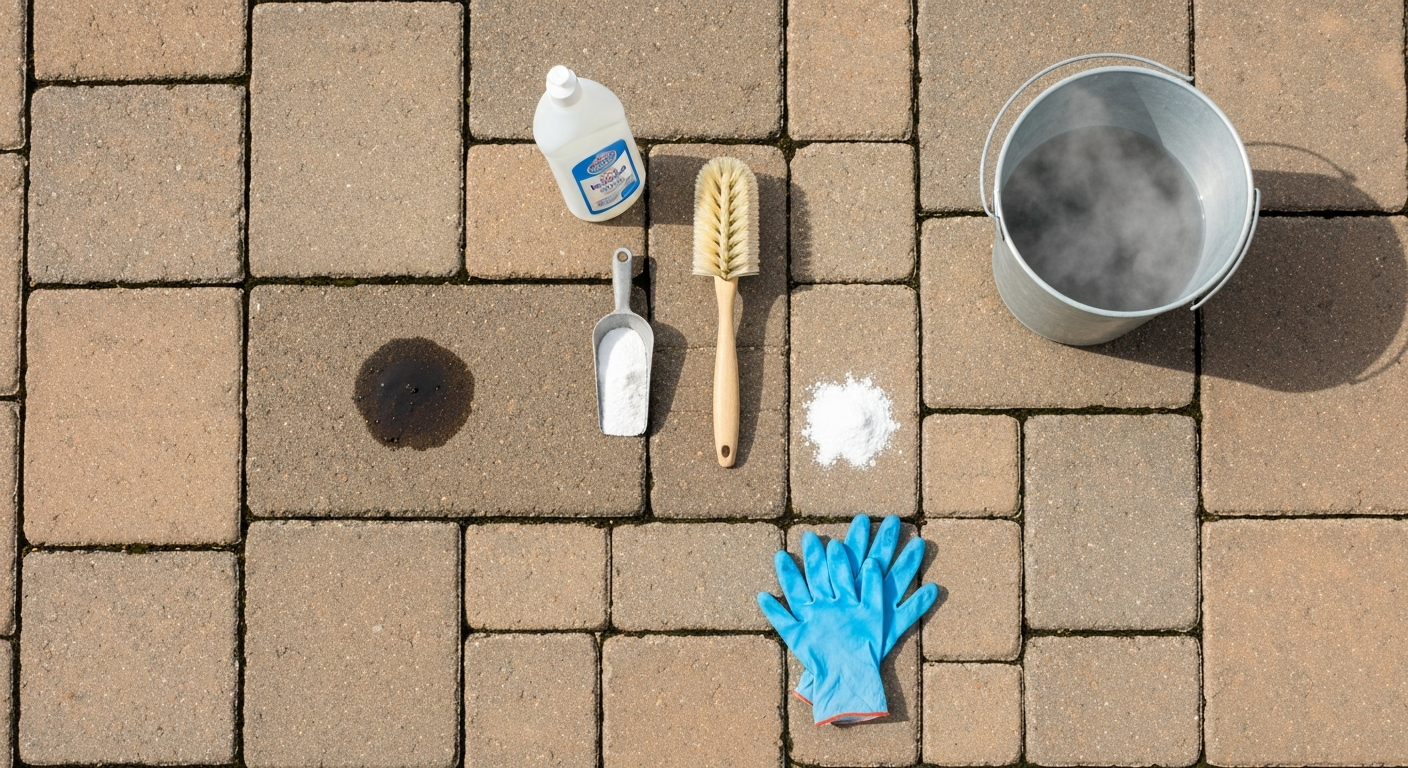
Remove grease from patio slabs: emergency fixes, DIY recipes, safe chemicals, pressure-washing & prevention
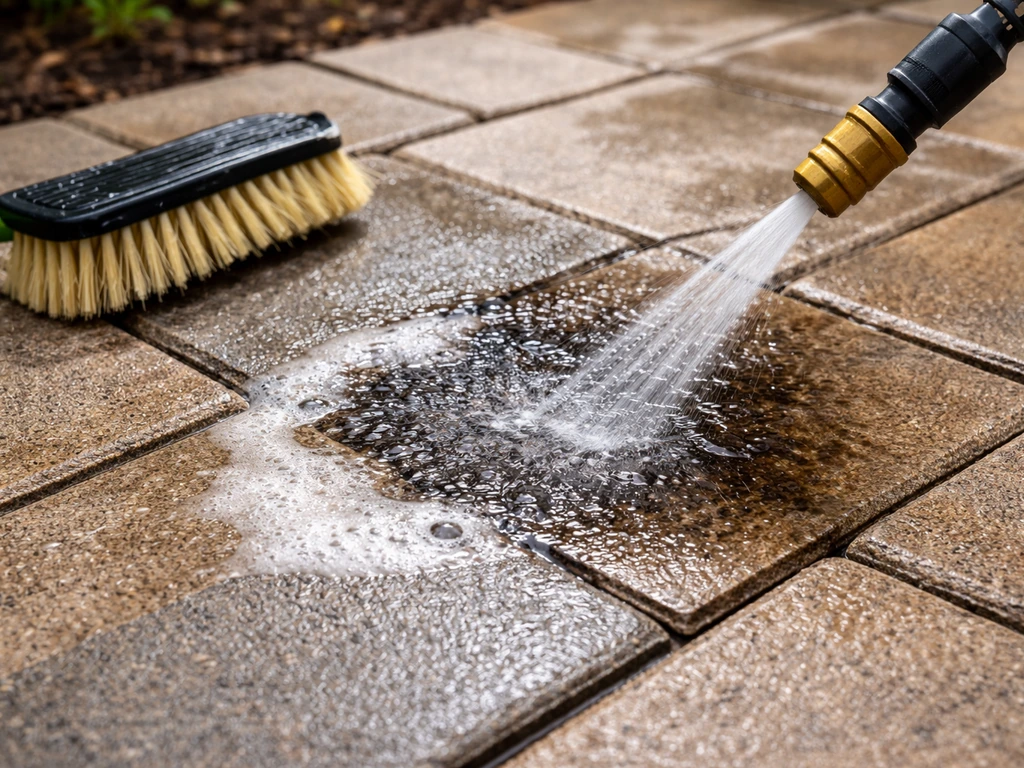
Step-by-step how to remove grease stains from patio pavers, choose cleaners by material, use safe pressure washing, and
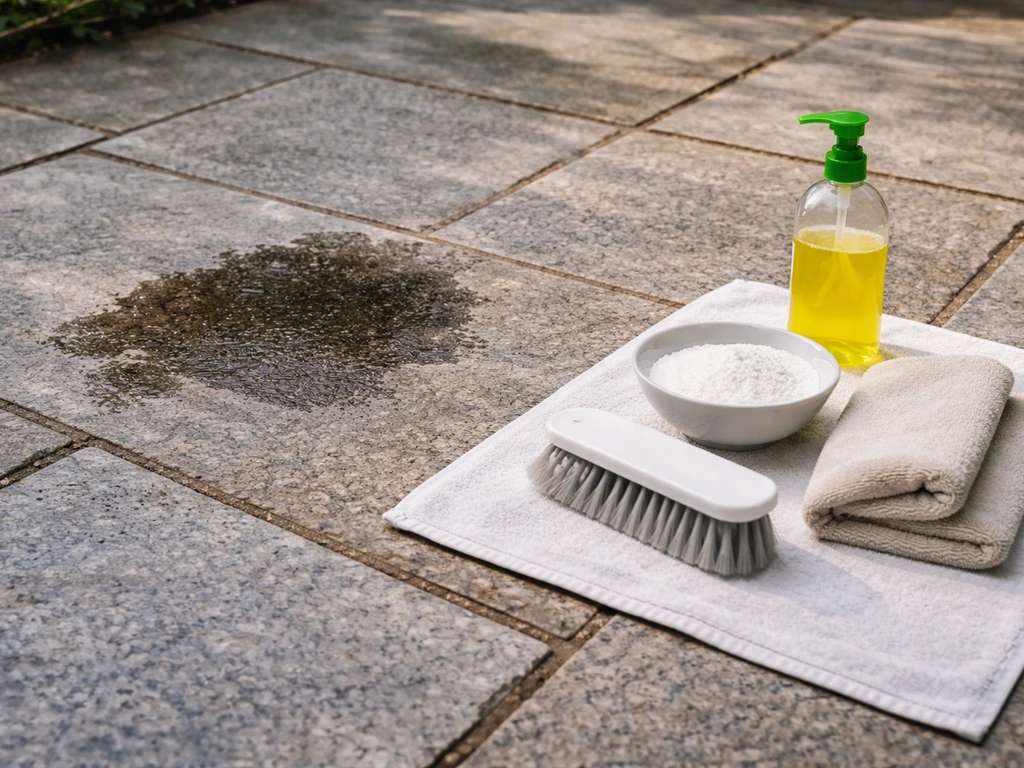
Step-by-step ways to remove fresh and set-in grease stains from stone patio, safely for natural stone like granite.