To get grease off patio slabs, absorb as much oil as possible first (cat litter, baking soda, or cornstarch for 30 to 120 minutes), then scrub with hot water and dish soap using a stiff nylon brush, rinse thoroughly, and repeat if needed. For older, set-in stains, a poultice or a commercial degreaser will do the heavy lifting. The right approach depends on how fresh the stain is, how porous your slab is, and what material you are dealing with, concrete and brick can handle stronger treatments, while natural stone like slate, travertine, and flagstone needs a gentler touch.
How Do You Get Grease Off Patio Slabs: Safe DIY Steps
Dylan Hale
12 Jul 2026
Act fast: emergency steps for a fresh grease spill
Speed matters more than anything else with a fresh grease spill. The longer oil sits on porous masonry, the deeper it soaks in and the harder it is to pull back out. I have seen people reach straight for a hose, but rinsing before absorbing just spreads the oil wider. Do these steps first.
- Blot (do not rub) the excess grease immediately with paper towels or an old cloth, working from the outside of the spill inward so you do not enlarge the stain.
- Pour a thick layer of an absorbent powder over the entire stain. Cat litter (non-clumping granular), baking soda, cornstarch, or diatomaceous earth all work well here.
- Leave the absorbent in place for at least 30 minutes for a fresh spill. For a larger or thicker spill, let it sit for up to 2 hours.
- Sweep or vacuum the saturated powder off the slab. Do not wash it away yet — scoop it into a bag for disposal.
- Repeat the absorbent layer if a dark, oily spot is still visible. A second application often lifts another round of free oil before you move to washing.
- Once free oil is absorbed, proceed to the dish soap scrub or your chosen degreasing method below.
These emergency steps genuinely change how much scrubbing you will need later. I treated a cooking oil spill on a concrete slab using two rounds of cat litter followed by dish soap, and the stain was gone with minimal effort. Skipping the absorption step on a similar spill meant scrubbing for three times as long and still getting a faint ghost mark.
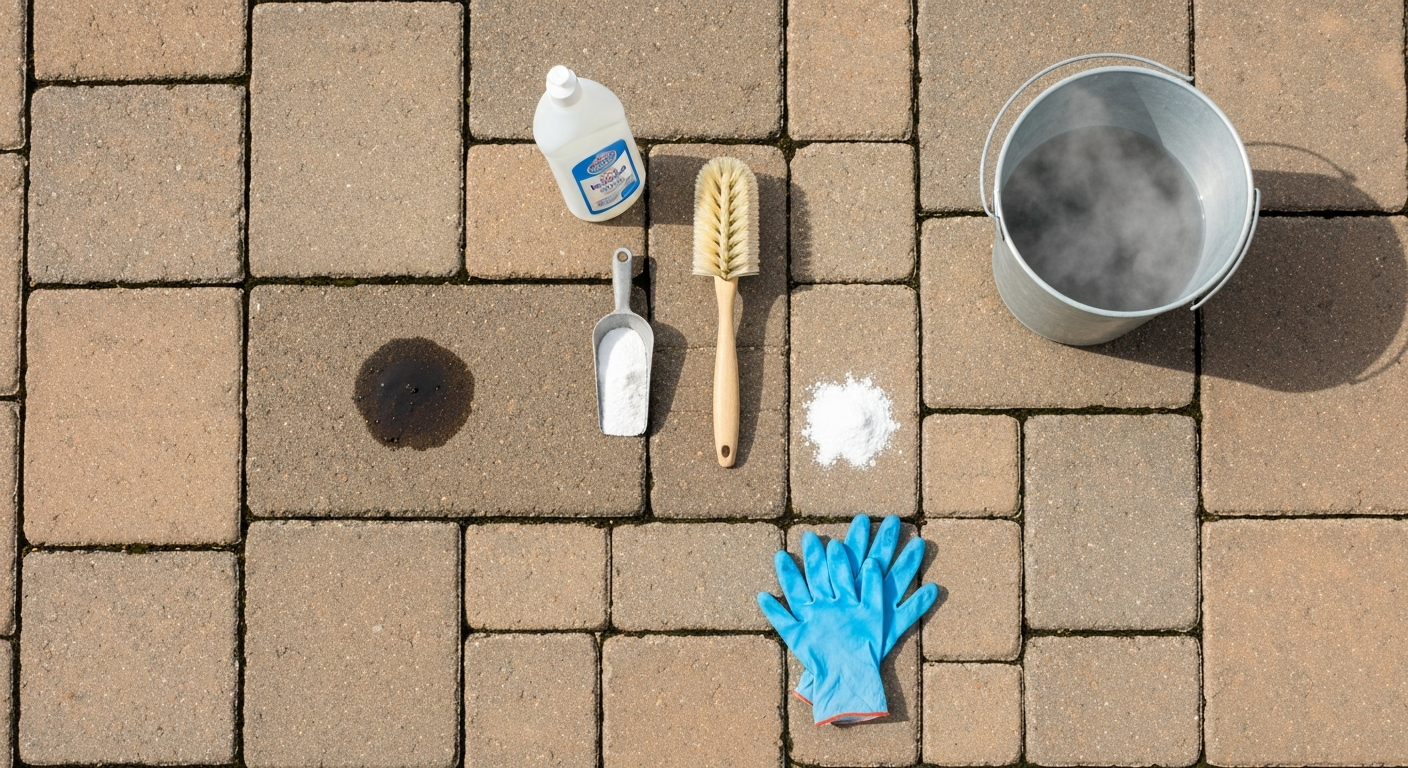
Tools and supplies to have on hand
You do not need professional equipment to remove grease from patio slabs, but having the right items ready before you start saves a lot of back-and-forth. Here is a practical checklist covering everything from basic DIY methods up to solvent work.
Personal protective equipment (PPE)
- Nitrile gloves for general degreaser and dish soap work; neoprene or butyl rubber gloves for solvents, acids, or concentrated alkaline cleaners (check your product's SDS for the correct glove material)
- Safety glasses or splash goggles, especially when using commercial degreasers, acids, or solvents
- NIOSH-approved organic-vapor respirator if using acetone, mineral spirits, or other solvents in enclosed or low-airflow areas
- Old clothes or an apron you do not mind staining
Brushes and application tools
- Stiff-bristle nylon scrubbing brush (avoid wire/metal brushes on brick, stone, or sealed surfaces — they scratch)
- Old toothbrush or detail brush for joints and tight corners
- Flat plastic scraper or wooden paint stirrer for removing poultice (never metal on stone)
- Spray bottle for applying diluted solutions
Absorbents and poultice ingredients
- Cat litter (non-clumping, granular clay type)
- Baking soda (sodium bicarbonate)
- Cornstarch
- Diatomaceous earth, kaolin, or Fuller's earth (available at hardware or garden stores — excellent poultice carriers)
- Acetone or mineral spirits for oil-specific poultices (see solvent section for safety notes)
- Plastic wrap or a polyethylene sheet to cover a poultice while it dries
Cleaners
- Dish soap (Dawn or equivalent concentrated degreasing formula)
- Commercial alkaline degreaser (e.g., Simple Green, Zep Driveway and Concrete Cleaner, or a dedicated masonry degreaser)
- Optional: citrus-based solvent degreaser for a gentler solvent option
Disposal gear
- Heavy-duty bin bags for used absorbent powder (oily cat litter and diatomaceous earth should go in the general waste bin, not poured down a drain)
- Bucket for mixing solutions and catching rinse water if you are working near a drain
- Access to a garden hose or a bucket of clean water for rinsing
Always spot test first
Before applying any cleaner to a visible stain, test it in a small, hidden area first, a corner behind a planter or beneath patio furniture works well. This is non-negotiable on natural stone. I once watched someone pour a commercial alkaline degreaser straight onto a travertine patio without testing, and it left a dull, bleached patch that was far more obvious than the original grease mark.
To spot test: apply a small amount of your chosen cleaner to a 10 cm square area, leave it for the recommended dwell time, then rinse and let it dry completely. Check for color change, etching, pitting, or surface dulling once dry, not while still wet. If the test area looks unchanged, you are good to proceed. If you see any discoloration, choose a gentler method or try a different product.
Also note whether your slab is sealed. A sealed surface will usually bead water, and many solvents and strong degreasers can strip or cloud an existing sealer. If yours is sealed, lean toward neutral pH or mild alkaline cleaners and avoid solvents unless you plan to re-seal afterward.
Dish soap and hot water: the go-to first method
For fresh stains or lightly set grease on concrete, brick, or pavers, this is where I always start. For step-by-step instructions tailored to concrete surfaces, see how to get grease out of concrete patio. It is cheap, safe for almost every material, and effective enough that you often do not need to go further. For detailed, step-by-step guidance on how to remove grease stains from patio pavers, see our full guide.
- Boil or heat water to as hot as you can manage — around 60 to 70°C is ideal. Cold water is noticeably less effective at lifting grease.
- Apply dish soap directly to the stain, either undiluted from the bottle or mixed into your hot water at roughly 1 to 2 tablespoons per litre. For a stubborn stain, undiluted soap applied directly and left for 5 minutes before scrubbing works better.
- Scrub firmly with your stiff nylon brush using circular motions. Work the soap into the surface for at least 2 to 3 minutes — do not just do a quick pass.
- Pour hot water over the area and continue scrubbing to emulsify the grease as you rinse.
- Rinse the area thoroughly with clean water, working the rinse water away from drains if possible.
- Let the area dry fully, then assess. If a faint mark remains, repeat the process or move to the poultice or commercial degreaser methods below.
- Expect to repeat 2 to 3 times for stains that have been sitting for more than a day or two.
What success looks like: the slab surface should have no visible oil sheen and the area should dry evenly without a dark patch. If it is lighter when wet but reappears as a faint stain once dry, the grease has penetrated into the pores and you will need a poultice or a commercial degreaser to draw it back out.
Baking soda, cornstarch, and cat litter for fresh spills
These dry absorbents are most useful in the emergency phase described above, but they can also do a second round of work after an initial scrub if the stain is still slightly oily. The principle is simple: the fine particles physically wick free oil out of the surface pores.
- Apply a generous layer — at least 5 to 10 mm thick — over the affected area.
- For baking soda or cornstarch, leave for a minimum of 30 minutes on fresh spills and up to 2 hours for thicker deposits.
- For cat litter (granular), leave for 1 to 2 hours and lightly press the granules down into contact with the slab to improve absorption.
- Sweep or vacuum up the powder without grinding it into the surface.
- Repeat the application cycle if the swept-up powder looks visibly dark or oily — this tells you it is still pulling oil out.
- Once repeated cycles stop producing oily absorbent, move to a wet scrubbing method to clean the residue.
Baking soda has a slight advantage over plain cornstarch because its mild alkalinity helps break down fatty acids at the same time as it absorbs. Cat litter tends to work well on larger spills because you can pour it generously without waste. None of these are a complete fix for a deep or set stain on their own, but as a first and second pass they meaningfully reduce how much chemical work you need to do afterward.
Making and using a poultice for set grease stains
A poultice is the best tool for grease that has already soaked into the slab. It works by drawing the oil out of the pores as it dries rather than pushing it further in. This is the method I use on older stains that soap and scrubbing cannot shift, and it is also the safest method for sensitive natural stone like slate, travertine, and flagstone.
Basic water-based poultice recipe (milder option, safe on most materials)
- Mix baking soda, cornstarch, or diatomaceous earth with enough dish soap and warm water to form a thick paste — roughly the consistency of peanut butter.
- Add approximately 1 tablespoon of dish soap per cup of dry powder for extra degreasing action.
- Apply the paste over the stain in a layer at least 6 to 12 mm (about a quarter to half an inch) thick, extending a couple of centimetres beyond the stain edges.
- Cover the poultice with plastic wrap and tape down the edges to slow evaporation and keep it moist longer — this allows more contact time with the stain.
- Leave for 24 to 48 hours. The longer you leave it, the more oil it draws out.
- Once dry, lift and scrape off the poultice with a plastic scraper or wooden tool. Do not use metal on stone.
- Rinse thoroughly with clean water and let the area dry completely before assessing.
- Repeat the process if a shadow of the stain remains — two or three applications are normal for a well-set stain.
Solvent-based poultice recipe (for deeply set oil on concrete or brick)
- Use diatomaceous earth, kaolin, or Fuller's earth as your carrier powder — these are more inert and absorptive than baking soda.
- Mix the powder with acetone (faster evaporating, suited to natural stone if needed) or mineral spirits (slower, suited to concrete and brick) until you reach a thick, spreadable paste.
- Wear nitrile or neoprene gloves and safety glasses, and ensure you are working outdoors or in a very well-ventilated area.
- Apply 6 to 12 mm thick over the stain and cover with plastic wrap to slow the solvent evaporation.
- Leave for 24 to 72 hours. The solvent dissolves the oil while the carrier powder absorbs it as it evaporates.
- Scrape off and dispose of the spent poultice in a sealed bag in general waste (do not pour solvent-soaked material down drains).
- Rinse the area thoroughly with water and allow to dry fully.
- Repeat if necessary — the NPS recommends multiple applications for deep oil contamination in masonry.
If you would rather use a ready-made product, commercial stone poultice products like PROSOCO Oil and Grease Stain Remover are formulated specifically for this job and come with tested dwell times and instructions on their technical data sheets. For natural stone in particular, these are worth the extra cost because they have been balanced to avoid damaging the surface.
Commercial degreasers: types, dilutions, and how to apply them
Commercial alkaline degreasers are the fastest route to a clean slab when DIY methods are not cutting through the stain. Products like Simple Green Crystal and Zep Driveway and Concrete Cleaner use combinations of alkaline builders (sodium carbonate, sodium hydroxide), surfactants, and emulsifiers to break down grease at a chemical level. They are genuinely effective, but you need to match the dilution to your situation and the product to your slab material.
| Product type | Best for | Typical dilution | Dwell time | Material cautions |
|---|---|---|---|---|
| Alkaline masonry degreaser (e.g., Zep Driveway Cleaner) | Concrete, brick, pavers | 4:1 to 10:1 with water for general use; undiluted for heavy stains | 5 to 15 minutes | Avoid on calcareous stone (travertine, limestone, marble) — alkalinity can cause etching and discoloration |
| Neutral-pH degreasing surfactant (e.g., Simple Green Crystal) | Concrete, brick, stone, pavers | 10:1 to 30:1 for light stains; 4:1 for heavy stains | 3 to 10 minutes | Much safer on natural stone than strongly alkaline products; still spot test first |
| Citrus-based solvent degreaser | Concrete, brick, pavers, some stone | Often used undiluted or 2:1 to 5:1 | 5 to 20 minutes | Check solvent content before using on sealed surfaces; can strip sealers |
| Oxidizing degreaser (peroxide-based) | Concrete, light-colored pavers | Per manufacturer TDS | 10 to 20 minutes | Can bleach color-sensitive materials; test patch mandatory |
Always read the product's SDS and technical data sheet before you apply any commercial degreaser. The dilution ratios above are representative ranges, not universal rules, the same product may have different recommended ratios for spray application versus pressure washing versus paste work.
Step-by-step application for a commercial degreaser
- Pre-wet the slab with water first. Most alkaline degreasers work better on a damp surface and pre-wetting stops the cleaner from soaking in unevenly.
- Apply your diluted degreaser and spread it to cover the entire stain plus a few centimetres beyond.
- Allow to dwell for the time specified on the product label — do not let it dry on the surface, especially in hot or windy conditions. Re-wet if necessary.
- Scrub firmly with a stiff nylon brush.
- Rinse thoroughly with plenty of water. Multiple rinses are better than one heavy one.
- Let dry and inspect. Repeat if a shadow remains.
Solvent options: mineral spirits, acetone, and citrus solvents
Solvents dissolve grease directly rather than emulsifying it, which makes them effective on stubborn, deeply set oil stains. However, they come with real risks and material restrictions. I only reach for solvents when soap and commercial degreasers have not worked, or when I am making a poultice as described above.
When and how to use each solvent
| Solvent | Best use case | How to apply | Material restrictions | Key PPE |
|---|---|---|---|---|
| Mineral spirits (white spirit) | Set oil/grease on concrete and brick; poultice carrier for porous masonry | Apply to stain, let dwell 5 to 15 minutes, blot and scrub, rinse thoroughly | Avoid on sealed surfaces (strips sealers); avoid on colored pavers (may bleed pigment); not recommended for travertine or marble | Nitrile or neoprene gloves, safety glasses, organic vapor respirator if in enclosed space |
| Acetone | Oil poultices for natural stone and concrete; fast-evaporating, leaves little residue | Use as poultice carrier (see above); can apply direct on concrete for light stains — dwell 5 minutes, blot, rinse | Will strip sealers; avoid on colored sealants or painted surfaces; flammable — no open flames nearby | Neoprene gloves, safety goggles, organic vapor respirator, work outdoors |
| Citrus solvent (d-limonene based) | Lighter grease on most patio materials including natural stone; gentler than acetone or mineral spirits | Apply undiluted or 2:1 with water, dwell 10 to 20 minutes, scrub, rinse well | Can soften some sealers; test patch on polished or finished stone first | Nitrile gloves, safety glasses |
A key point on PPE for solvents: OSHA and NIOSH guidance is clear that organic vapor respirators (with the correct cartridge type) are required when working with acetone or mineral spirits in any space without good airflow. See the blank" rel="noopener noreferrer">OSHA Respirator Selection eTool for guidance on choosing NIOSH‑approved respirators and cartridges (organic‑vapor and P100 options) and for program requirements under 29 CFR 1910.134. A dust mask is not sufficient. Outdoors with a breeze, you may be fine without respiratory protection for a small application, but when in doubt, wear the respirator. For gloves, nitrile is acceptable for short-contact general work, but neoprene or butyl rubber provides much better resistance to prolonged solvent exposure. blank" rel="noopener noreferrer">CCOHS: Chemical Protective Clothing & Glove Selection notes that nitrile or neoprene gloves are generally advised for solvent/contact tasks, with neoprene or butyl providing superior resistance to many organic solvents and concentrated acids, and recommends consulting glove manufacturer chemical‑resistance charts for the specific chemical and exposure time.
One important restriction that often catches people out: do not use mineral spirits or acetone on calcareous natural stones like travertine, marble, or limestone without testing first. While solvents themselves do not etch stone the way acids do, they can alter the appearance of polished or honed surfaces. Always do a spot test in an inconspicuous area and let it dry fully before proceeding.
Material-specific guidance: concrete, brick, pavers, and natural stone
Different slab materials need different treatment levels. Concrete is the most forgiving; natural stone needs the most caution. Here is a quick breakdown of what works and what to avoid for each common patio material.
| Material | Safe methods | Methods to use cautiously | Avoid entirely |
|---|---|---|---|
| Concrete | Dish soap + hot water, baking soda, cat litter, commercial alkaline degreasers, poultice, mineral spirits, acetone, muriatic acid (diluted, with neutralization) | Strong alkaline degreasers at full strength | Nothing is completely off-limits, but always test strong acids first |
| Brick | Dish soap + hot water, cat litter, baking soda, neutral or mild alkaline degreasers, citrus solvents, poultice | Muriatic acid (low dilution only; rinse and neutralize thoroughly) | High-pressure washing on old or soft mortar joints; wire brushes |
| Concrete pavers | Dish soap, baking soda, cat litter, commercial degreasers (check for pigment compatibility), poultice | Solvents — test first as they may bleed pigment in colored pavers | Strong bleach solutions on colored pavers (bleaches pigment) |
| Slate, flagstone | Dish soap + warm water, baking soda poultice with water, citrus solvent, neutral pH commercial cleaner | Acetone poultice (test first); mineral spirits (test first) | Muriatic acid, strong alkaline degreasers, sodium hypochlorite bleach |
| Travertine, limestone, marble | Dish soap + warm water only, pH-neutral stone cleaner, water-based poultice with neutral carrier | Citrus solvent (test patch required) | Muriatic acid, any acid-based cleaner, sodium hypochlorite, strong alkaline degreasers |
The critical rule: calcareous stones (travertine, limestone, marble) react chemically with acids. Muriatic acid and acidic cleaners will etch and dissolve the surface. Bleach (sodium hypochlorite) can bleach color, leave salt deposits, and cause surface damage over time on these materials. For detailed guidance on natural stone specifically, the methods for slate and flagstone follow slightly different logic than for travertine and limestone, so it is worth treating those as separate cases when planning your approach. For detailed, step-by-step guidance on how to get grease off stone patio, see the dedicated stone-patio cleaning section.
Stronger chemical options: bleach, muriatic acid, and when (not) to use them
I want to be direct here: for grease removal, bleach and muriatic acid are not the best tools, and on many materials they will do more harm than good. They are more relevant for biological stains (moss, algae, lichen) than for oil. That said, here is what you need to know if you are considering them.
Sodium hypochlorite (household bleach)
Bleach does not dissolve grease effectively. It is an oxidizer and disinfectant, not a degreaser. Using it on an oil stain may bleach the surface color without removing the grease underneath, leaving you with a pale mark instead of a dark one. On concrete, a very dilute bleach solution (no more than 1 part bleach to 10 parts water) can help with any accompanying biological growth around the stain, but keep contact time short and rinse thoroughly. Never use bleach on travertine, marble, limestone, or color-sensitive pavers. Conservators who need to neutralize residual bleach after necessary treatments use sodium thiosulfate as an anti-chlor rinse.
Muriatic acid (hydrochloric acid)
Similarly, muriatic acid is not a grease remover. Its job is dissolving mineral deposits, efflorescence, and concrete residue. For grease stains it adds risk without adding much benefit. If you are treating concrete and decide to use muriatic acid for another purpose (like efflorescence removal in the same area), dilute to 1 part acid in 10 parts water or weaker, wear full PPE including acid-resistant gloves and eye protection, work in good ventilation, and neutralize any residual acid afterward by washing the surface with a baking soda solution (roughly 1 cup baking soda in 4 litres of water). Never use muriatic acid on brick with soft mortar, on pavers, or on any natural stone.
Pressure washing: safe PSI ranges and nozzle guidance
A pressure washer is a helpful finishing step after a degreaser has done its work, but it should not be your first move on a grease stain, high pressure without a degreaser mostly just pushes the oil around. If you have one, here is how to use it safely on patio slabs.
- Concrete: 1500 to 3000 PSI is safe; use a 25-degree wide fan nozzle for general cleaning and a 40-degree nozzle for more delicate surfaces or around edges.
- Brick: 1200 to 1500 PSI maximum; use a 25 to 40-degree nozzle and keep the wand at least 30 cm from the surface to protect mortar joints.
- Pavers: 1200 to 2000 PSI with a 25 or 40-degree nozzle; avoid a zero-degree or 15-degree pencil jet, which can dislodge jointing sand and damage paver edges.
- Natural stone (slate, flagstone, travertine): 1000 to 1500 PSI maximum; 40-degree nozzle and keep distance; soft or flaky stones may surface-etch even at moderate pressure.
- Apply your commercial degreaser, allow the full dwell time, then use the pressure washer to rinse — this combination is far more effective than pressure alone.
If you do not have a pressure washer, a garden hose on a high-pressure jet setting combined with thorough brush scrubbing achieves very similar results for most domestic grease stains. Do not feel that renting a pressure washer is mandatory, I have cleared some serious cooking oil stains from concrete slabs with nothing more than a hose, a bucket of hot soapy water, and a stiff brush.
Environmental and disposal considerations
Grease-laden rinse water and spent absorbents carry environmental responsibility. Used cat litter, diatomaceous earth, or poultice material soaked with oil or solvent should go into sealed bin bags in general household waste, not poured onto soil or washed down a drain. Solvent-soaked materials are classed as hazardous waste in most areas and should be disposed of accordingly at a local hazardous waste facility rather than in regular bins.
When rinsing away soapy degreaser water, try to direct it onto grass or soil rather than straight into a storm drain if you can, particularly with commercial alkaline degreasers. A small amount of diluted dish soap is unlikely to cause harm, but concentrated commercial degreasers in waterways are a problem. If you are using solvents outdoors, keep the area well away from surface drains and do not apply on a day with rain forecast within a few hours.
Preventing future grease stains: sealing and simple habits
A penetrating impregnating sealer applied to your patio slabs is by far the best long-term protection against grease and oil stains. A good sealer does not change the appearance of the stone but fills the surface pores, meaning oil sits on top rather than soaking in immediately. This gives you precious extra time to absorb and clean a fresh spill before it becomes a problem. For concrete, an acrylic or polyurethane topcoat sealer also works well. For natural stone, choose a sealer specifically rated for the stone type (limestone and travertine need a different product than slate or granite). For step-by-step instructions and product recommendations, see our guide on how to get grease off patio.
- Reseal your patio every 1 to 3 years depending on traffic and weather exposure; the water-bead test tells you when it is time (if water no longer beads on the surface, the sealer is wearing out).
- Place absorbent mats or drip trays under BBQs and outdoor cookers to catch fat and grease before it reaches the slab.
- Keep a small bag of cat litter or baking soda near your outdoor cooking area so you can respond immediately to a spill.
- Clean up cooking grease within the first hour whenever possible — the difference in removal effort between a 30-minute-old spill and a 24-hour-old one is significant.
When to call a professional
Most grease stains on patio slabs are DIY-fixable, but there are situations where calling a professional stone or masonry cleaner is the right call. If you have repeated the poultice process three or more times without meaningful improvement on a deep-set stain, a professional with industrial-strength equipment and commercial poultice products may achieve what you cannot. Similarly, if your patio is made of expensive or historically significant natural stone (polished travertine, antique limestone flags, hand-cut slate), the cost of professional cleaning is easily justified by avoiding irreversible damage. Any stain covering a large area or a situation involving contamination from vehicle fuel or motor oil, which penetrates much deeper than cooking grease, is also worth getting a professional assessment. They can also advise on sealing and surface restoration after cleaning.
FAQ
What immediate steps should I take for a fresh grease spill on patio slabs?
Act fast: blot up pooled oil with paper towels or rags (do not wipe, which spreads it). Cover the spot with an absorbent (cat litter, baking soda, cornstarch, or diatomaceous earth) and leave 30–120 minutes to soak free oil. Sweep or vacuum up the absorbent, then proceed with cleaning (dish soap scrub or poultice) before the stain sets. Dispose of used absorbent and towels according to local hazardous‑waste or municipal guidance.
What basic tools and supplies should I have on hand before starting?
Checklist: stiff nylon brush or push broom, hard‑bristle hand brush, plastic scraper or putty knife, absorbent (clay cat litter, baking soda/cornstarch, diatomaceous earth), dish detergent (degreasing type like Dawn), hot water, bucket, garden hose or pressure washer (optional), poultice materials (baking soda, diatomaceous earth, kaolin/Fuller’s earth), acetone or mineral spirits (for stubborn oil; optional), nitrile or neoprene gloves, eye protection, respirator (organic‑vapor cartridges if using solvents), plastic sheeting and tape (to cover poultice), plastic scoop, wet/dry vacuum (optional), and trash bags for disposal.
How do I use dish soap and hot water to remove grease from concrete, pavers, or stone?
For fresh or mild stains: pour hot (not boiling) water over the stain, apply undiluted dish detergent directly to the stain, work into a lather with a stiff nylon brush for 5–10 minutes, let sit 10–20 minutes, then rinse thoroughly with a strong stream of water. Repeat 1–3 times for set‑in stains. For porous surfaces, allow detergent to penetrate between scrubs. Wear gloves and avoid strong scrubbing on soft stones (see material cautions).
What DIY absorbent/poultice recipes work for set‑in oil and how do I apply them?
Simple poultice (water‑based): mix baking soda or cornstarch with enough water to make a peanut‑butter‑thick paste. Oil‑solvent poultice: mix diatomaceous earth, kaolin, or Fuller's earth with acetone or mineral spirits to the same consistency (use solvents only when safe for material). Apply 6–12 mm (¼–½ in) thick over the stain, cover with polyethylene and tape edges to slow evaporation, allow to dry 24–72 hours, then remove with a plastic scraper and rinse. Repeat until stain is reduced. For fresh heavy spills use loose absorbent (cat litter) first before poulticing.
When should I use commercial degreasers and how do I choose one?
Choose a product labeled for masonry or stone and read the TDS/SDS for dilution and substrate compatibility. Use alkaline/surfactant degreasers for greasy driveway/patio stains; many are safe for concrete and pavers. Follow manufacturer dilution (spot treatments often use full strength; pressure‑washer applications may be diluted 4:1 to 30:1). Test in an inconspicuous area first. Wear PPE per product SDS and rinse thoroughly after dwell time. Avoid degreasers containing strong acids on calcareous stone.
Can I use a pressure washer to remove grease? What PSI and nozzle are safe?
Yes for many masonry surfaces. Use a pressure washer at 1500–2500 PSI for most concrete and pavers; start at lower pressure. Use a fan nozzle (25° or 40°) for cleaning; avoid narrow 0° nozzles that can etch or chip. Keep the tip 12–24 inches from the surface and angle the spray to avoid driving oil deeper. For natural stone (slate, travertine, flagstone) use lower pressure (under 1500 PSI) and gentle nozzles to prevent surface damage. Always test first and avoid pressure washing polished or delicate stone.
Next Articles
How to Remove Grease Stains from Patio Pavers
Step-by-step how to remove grease stains from patio pavers, choose cleaners by material, use safe pressure washing, and
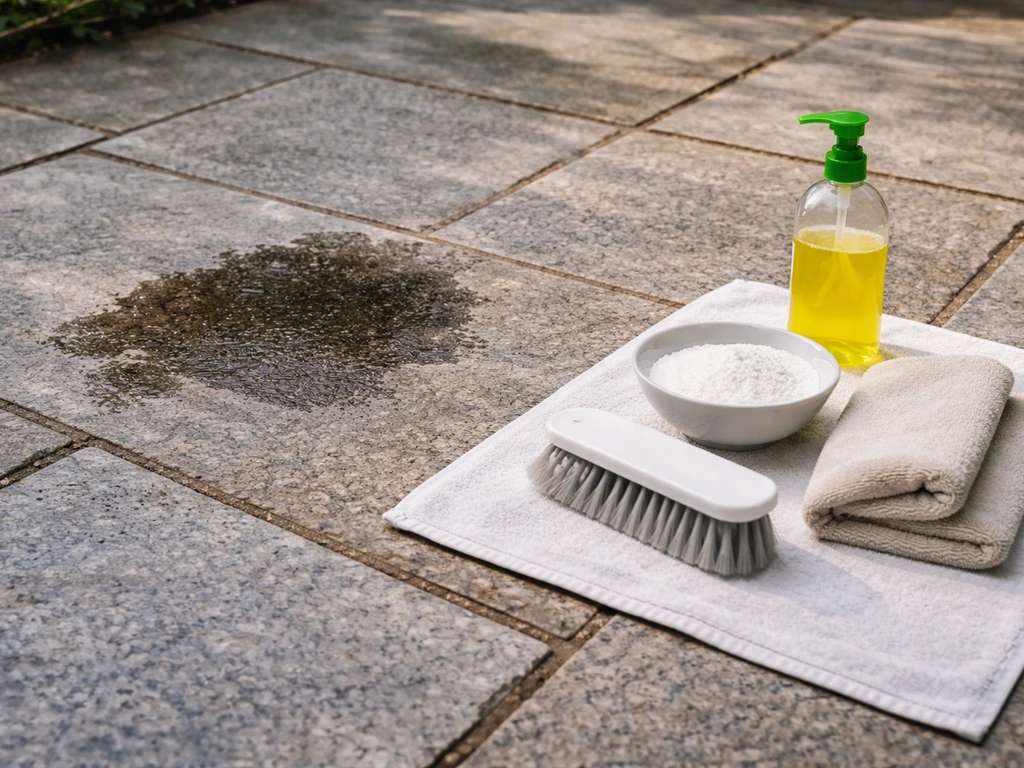
How to Get Grease Off Stone Patio: Step-by-Step Guide
Step-by-step ways to remove fresh and set-in grease stains from stone patio, safely for natural stone like granite.
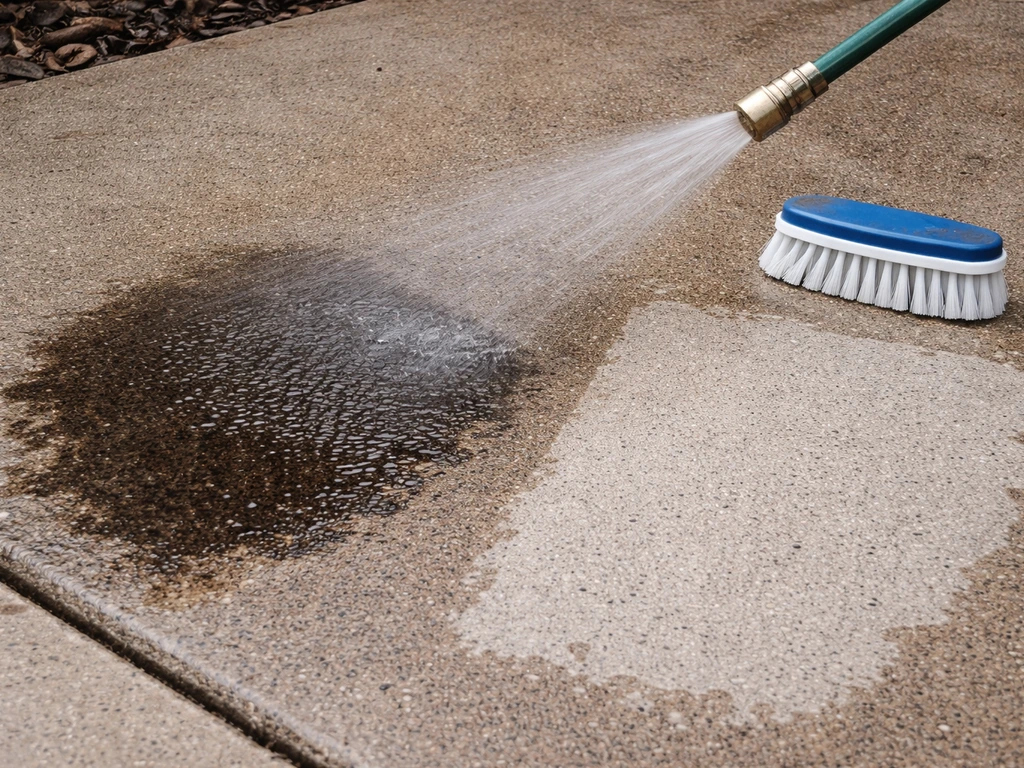
How to Get Grease Out of a Concrete Patio Step by Step
Step-by-step methods to remove fresh and set-in grill grease and oil stains from a concrete patio safely.