
WD-40 on patio slabs leaves behind a petroleum-based oil film that resists plain water and gets worse if you scrub it dry. The fastest fix for a fresh spill is to dump a thick layer of cat litter or baking soda on it immediately, let it sit for at least 30 minutes, sweep it up, then scrub with neat dish soap and hot water. For older, set-in stains you'll need to escalate to an alkaline degreaser or a poultice, depending on your surface. Example: Zep Driveway, Concrete & Masonry Cleaner, product page (Home Depot / manufacturer directions summarized) is an alkaline cleaner labeled for oil/grease removal with manufacturer dilution guidance (light soils ≈6 oz/gal, heavy soils ≈12 oz/gal), short dwell times (do not allow to dry; typically ≤10 minutes), and a warning to avoid use on alkaline‑sensitive surfaces such as aluminum, brass, and some coatings Zep Driveway, Concrete & Masonry Cleaner — product page (Home Depot / manufacturer directions summarized). This guide walks you through every step, from a five-minute first response to a full poultice treatment for stains that have been sitting for weeks.
How to Get WD40 Off Patio Slabs: Step-by-Step Cleaning
What this guide covers and who it's for
I wrote this for anyone who has sprayed WD-40 near a patio and watched it drip onto the slabs, or who has discovered a dark oil patch and is not sure what it is or how to treat it. That includes renters who can't pressure-wash, homeowners tackling a full driveway edge or patio clean, and DIYers who want to know exactly which products are safe on their specific surface type. The methods here cover concrete, brick, block pavers, natural stone (travertine and flagstone), and factory-sealed surfaces. You'll find quick fixes, renter-friendly hand-scrub methods, chemical options, and a poultice recipe for stubborn stains. There's also guidance on safety gear, disposal, resealing, and when a professional is honestly the better call.
Safety, PPE, and what to do with the runoff
WD-40's Safety Data Sheet classifies the product as an aliphatic hydrocarbon solvent with aspiration and inhalation hazards, so it's worth treating spills with a bit of respect. For accidental releases the WD‑40 SDS specifically directs: eliminate ignition sources, ventilate the area, contain and collect liquid with an inert absorbent (e.g., clay absorbent) and place in an appropriate container for disposal; leaking aerosol cans should be placed in a plastic bag or open pail until pressure dissipates. (Section 6 Containment/Cleanup) The WD‑40 Multi‑Use Product Safety Data Sheet (WD‑40 Company) instructs that for accidental releases you should eliminate ignition sources, ventilate the area, contain and collect liquid with an inert absorbent and place it in an appropriate container; leaking aerosol cans should be placed in a plastic bag or open pail until pressure dissipates.. You don't need a hazmat suit for a small patio stain, but a few basics matter a lot, especially when you move up to commercial degreasers.
- Gloves: nitrile or chemical-resistant rubber gloves for all cleaning steps. Dish-soap scrubbing is fine bare-handed, but alkaline degreasers (especially those containing sodium hydroxide) are severely corrosive and need chemical-resistant gloves and eye protection.
- Eye protection: safety glasses for general scrubbing; chemical splash goggles when mixing or applying concentrated alkaline degreasers or solvent-based poultice liquids.
- Ventilation: work outdoors in moving air. If you're using mineral spirits, d-limonene citrus solvents, or concentrated alkaline products in an enclosed corner (under a pergola, against a wall), position yourself upwind.
- Skin contact: if WD-40 or a degreaser gets on skin, wash immediately with soap and water. For eye contact, flush continuously with water for at least 15 minutes and get medical advice if irritation continues.
- Runoff containment: before hosing down, check where the water drains. Oily or chemical-laden runoff going straight into a storm drain or lawn is an environmental problem. Block the nearest drain with a drain plug or folded sandbag before rinsing, then collect the first rinse water in a bucket if possible. Dilute soap-and-water rinse in small volumes is generally low risk, but solvent waste or concentrated degreaser must be contained and disposed of per your local household hazardous waste rules.
- Absorbent disposal: used cat litter or clay absorbent contaminated with WD-40 is oily waste. Double-bag it and check with your local waste authority, as many councils class it as household hazardous waste rather than general rubbish.
How to diagnose what you're actually dealing with
Before you pick a product, spend two minutes identifying the stain. Getting this wrong is the main reason people make a small stain permanent. Here's my quick field diagnosis process.
Identify the contaminant
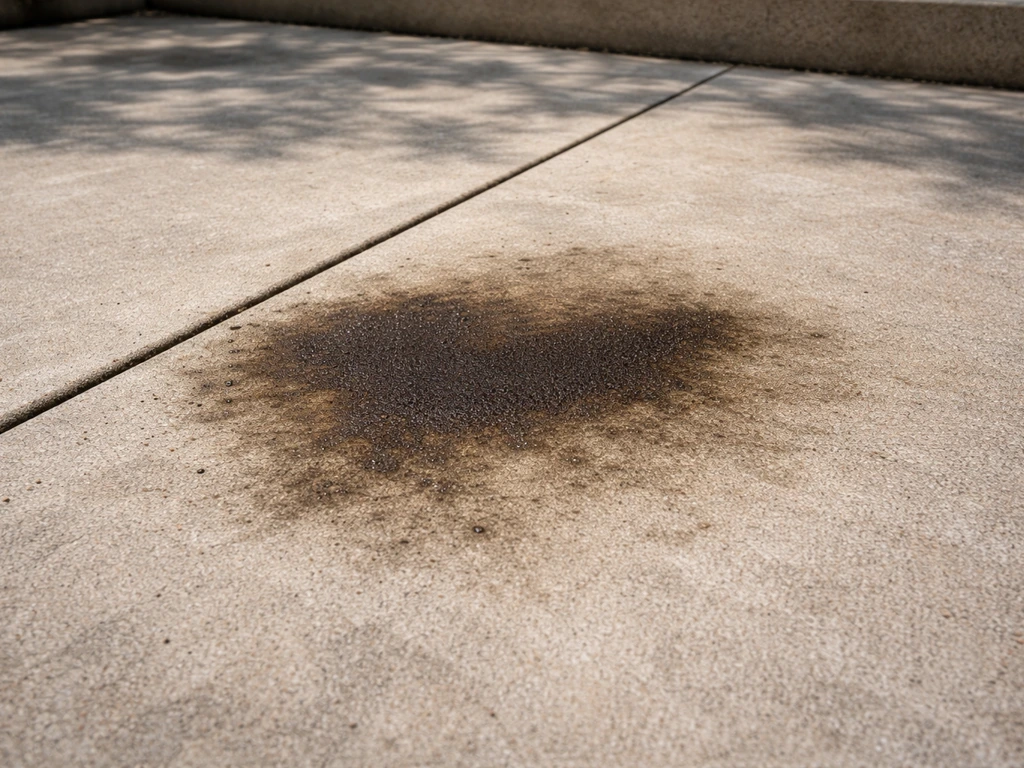
WD-40 leaves a mid-to-dark grey translucent oil stain with a faint petroleum smell if it's fresh. It usually fans out from a central point (spray drift) or drips in a line. BBQ oil and cooking grease tend to be darker, almost black, with a food smell. Sunscreen leaves a pale, slightly waxy smear that may have a white cast on dark stone. Teak oil is a deep amber-brown penetrating stain, often with hard edges. If you need detailed steps specific to teak oil, see my guide on how to remove teak oil from a patio. If you're not sure whether the stain is WD-40 or something similar, the cleaning approach is broadly the same (degrease, lift, rinse) but the escalation path differs slightly for each one, which I cover in the next section.
Check the age and how deep it's gone
A fresh stain (under an hour) is still sitting on or just below the surface. A stain that's a day or two old has begun wicking into the pores. Anything older than a week has almost certainly penetrated the full depth of unsealed concrete or stone and will need a poultice to draw it back out. On sealed surfaces, even old stains are usually sitting above the sealer film, which makes them much easier to remove.
Test surface porosity
Drip a few drops of plain water onto a clean patch near the stain. If it beads up, the surface is sealed or has low natural porosity. If it soaks in within 30 seconds, you're dealing with an open, porous surface. Porous surfaces absorb stains faster and deeper, but they also absorb cleaning products faster, which is relevant when you're choosing dwell times.
Always do a test spot
For any product stronger than dish soap, test it on a hidden area first. Apply a small amount, wait the full dwell time, rinse, and check for color change, etching (a dull or pitted surface), or white residue. Natural stone especially can react unexpectedly to acidic or strongly alkaline products, so I never skip this step.
WD-40 vs BBQ oil vs sunscreen vs teak oil: what makes each one different
These stains share a common thread (they're all oil-based or waxy) but they respond differently because of how they're composed and how deeply they penetrate. Knowing the difference helps you pick the right product the first time.
| Contaminant | Composition | Typical penetration depth | Key cleaning difference | Special caution |
|---|---|---|---|---|
| WD-40 | Aliphatic hydrocarbons 40-50%, petroleum base oils up to 30% | Moderate — wicks into porous concrete quickly | Responds well to alkaline degreasers and absorbent poultices | Flammable; avoid open flames near fresh spill; do not use on travertine with acid-based cleaners |
| BBQ oil / cooking grease | Heavy vegetable or animal fats, often with carbon deposits from heat | Deep — high-temperature fat bonds into concrete pores | Often needs a stronger alkaline degreaser or repeat treatments; carbon residue may need a dedicated cleaner | Scorched residue can resist standard degreasers; may need TSP or similar |
| Sunscreen | Zinc oxide, titanium dioxide, emollients, UV filters — often zinc-heavy | Shallow — mainly surface film | Zinc residue can leave a white stain that needs a dedicated zinc remover or dilute acid on concrete only | Never use acid on travertine or limestone; zinc staining can be persistent on pale stone |
| Teak oil | Penetrating linseed/tung oil blend, often with driers and UV inhibitors | Very deep on unsealed wood-adjacent stone or concrete | Poultice almost always required for set-in teak oil; surface scrubbing rarely sufficient | Can polymerize (harden) over time, making solvent removal less effective; early treatment critical |
For a deeper look at removing BBQ oil, sunscreen, or teak oil specifically, those contaminants each have their own dedicated guides on this site. The focus here is WD-40, but the methods in this article translate directly for fresh BBQ oil spills and light sunscreen marks.
Tools and materials checklist
You won't need all of these for every stain. The checklist is organized by stage so you can pull what you need for your specific situation.
Household basics (most people have these)
- Clay cat litter (clumping or non-clumping) or commercial floor-dry absorbent
- Baking soda or cornstarch (backup absorbents)
- Concentrated dish soap (e.g., Dawn, Fairy, or similar; generic works fine)
- Stiff-bristle nylon scrubbing brush or deck brush
- Soft natural or soft nylon brush (for travertine, marble, polished stone)
- Hot water and a bucket
- Old rags or paper towels for initial blotting
- Plastic sheeting or cling film (for covering a poultice)
- Plastic scraper or old credit card (to lift dried poultice)
- Nitrile gloves and safety glasses
Step-up cleaning products
- Commercial alkaline concrete degreaser (e.g., Zep Driveway and Concrete Cleaner, Betz Laboratories, or similar); available at DIY stores
- Enzyme cleaner (e.g., Simple Green, Bio-Zyme, or similar biodegradable enzyme-based degreaser) — gentler and renter-friendly
- Mineral spirits / white spirit (for poultice solvent, well-ventilated use only)
- D-limonene citrus degreaser — effective on hydrocarbons but not safe on calcareous stone
- Powdered laundry detergent or trisodium phosphate (TSP) for heavy set-in stains on concrete
Poultice ingredients
- Fuller's earth, diatomaceous earth, or kaolin clay (dry absorbent base)
- Paper pulp (torn unprinted kitchen paper, soaked and squeezed) — useful for large areas
- Mineral spirits or a diluted alkaline degreaser (liquid component mixed into the poultice)
PPE
- Chemical-resistant rubber gloves (for alkaline degreasers and solvent poultices)
- Chemical splash goggles
- Old clothes or a plastic apron
- Organic vapor respirator mask if working in a confined area with mineral spirits
Quick fixes for fresh spills: act within the first hour
Speed is everything here. The longer WD-40 sits, the deeper it wicks. If the spill happened in the last hour, follow these steps exactly in order. For a step-by-step walkthrough specifically on how to remove WD-40 from patio surfaces, see the guide titled how to remove WD-40 from patio.
- Do not wipe or smear. Blot the wet area with paper towels or an old rag using straight downward pressure. Wiping spreads the stain.
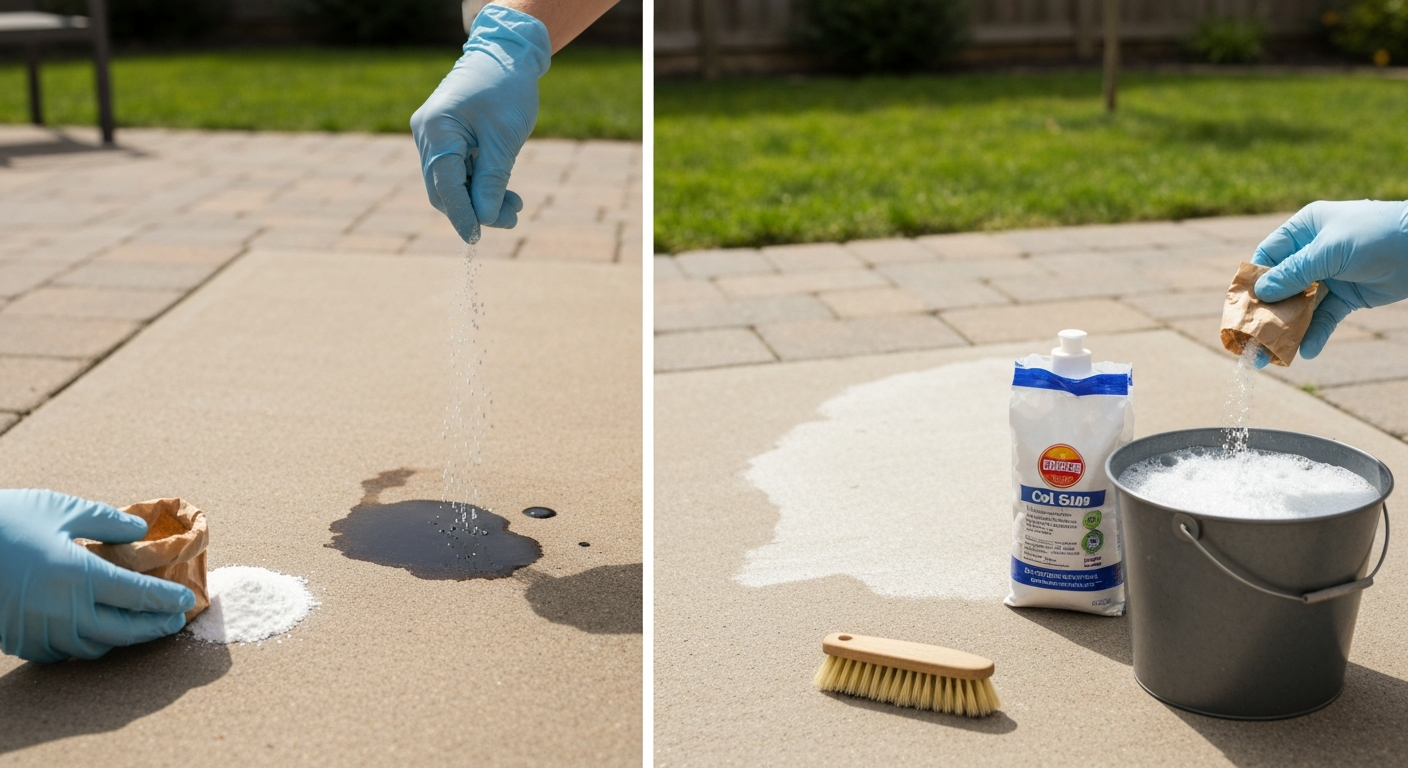
- Cover generously with absorbent. Pour cat litter, baking soda, or cornstarch over the wet stain until it's fully covered with a layer at least 5mm thick. For a large spill, use a whole cup or more.
- Work it in. Use your foot, a dry brush, or a wooden block to press and grind the absorbent into the surface. This increases contact and draws oil up into the absorbent.
- Wait at least 30 minutes. For bigger or wetter spills, leave it for several hours or overnight. The longer the better.
- Sweep up completely. Collect the contaminated absorbent in a bag for disposal. Do not hose it into a drain.
- Apply neat dish soap directly to the damp stain. Squirt a generous amount (2-3 tablespoons for a 30cm stain) directly onto the residue. Do not dilute it yet.
- Scrub with a stiff nylon brush and hot water. Add a splash of hot water to create a lather and scrub in overlapping circular passes for 2-3 minutes. The goal is a thick foam lifting the residue.
- Rinse with hot water. Use a bucket rather than a hose at full pressure, pouring controlled amounts. Check the result. You should see the stain significantly lighter or gone. A faint ghost mark is normal and often disappears as the slab dries.
- Repeat once if needed. A second dish-soap scrub on a fresh stain usually finishes the job.
What success looks like: the slab should match the surrounding surface when dry. A slight damp shadow that disappears as the slab dries is fine. A persistent dark patch means some oil is still present and you'll need to move to the degreaser or poultice stage below.
Renter-friendly methods: no pressure washer needed
These methods use hand scrubbing, household products, and enzyme cleaners. They work on fresh-to-moderately-old stains (up to a week or two) and are safe for renters who want to avoid damage claims. I've used these successfully on both concrete and brick pavers.
Method 1: baking soda paste scrub
- Mix baking soda with just enough water to make a thick paste (roughly the consistency of peanut butter).
- Spread a generous layer over the stain and work it in with a stiff nylon brush.
- Leave the paste on the stain for 15-20 minutes.
- Scrub again firmly with the brush before it dries out.
- Rinse well with hot water. The paste should carry away the loosened oil.
- Repeat up to three times. Each pass lifts a bit more oil from porous surfaces.
Method 2: powdered laundry detergent paste
Powdered laundry detergent (not liquid) works similarly to baking soda but has stronger surfactants. Mix to the same thick paste consistency, apply, leave 20 minutes, scrub, and rinse. It's more aggressive than baking soda and I'd recommend it as a step-up when the baking soda method hasn't fully cleared the stain.
Method 3: enzyme cleaner soak
Enzyme cleaners (Simple Green, Bio-Zyme, and similar) use biological enzymes to break down hydrocarbon chains. They are slower than alkaline degreasers but safer for pets, plants, and more delicate surfaces. Apply the product at the dilution recommended on the label for heavy grease (often a 1:5 to 1:10 ratio with water), saturate the stain, cover with a damp cloth or plastic sheeting to stop it drying out, and leave for 30-60 minutes. Then scrub with a nylon brush and rinse. These cleaners work best at slightly warm temperatures, so if you're cleaning in cool weather, a soak of a couple of hours will improve results. They're particularly useful on brick pavers where aggressive alkaline products can discolor the mortar joints.
Material-specific notes for renter methods
- Concrete and block pavers: all three methods above work well. Use a stiff deck brush confidently.
- Brick: stick to dish soap, baking soda paste, or enzyme cleaners. Alkaline degreasers can affect old mortar and brick glaze. Scrub gently across the face, not into mortar joints.
- Travertine and flagstone: use only dish soap or an enzyme cleaner diluted to the mildest ratio on the label. Do NOT use citrus-based degreasers, vinegar, or any acidic product on travertine or limestone — they etch the surface permanently. Use a soft brush only.
- Sealed surfaces: all renter methods are safe. Sealed surfaces are the easiest to clean because the oil sits above the sealer film. Dish soap and hot water usually clear a fresh WD-40 spill completely.
When to escalate: a graded cleaning strategy
Not every stain needs a commercial degreaser, and not every degreaser is safe on every surface. Use this decision framework to choose the right level of intervention.
The escalation flowchart in summary
- Fresh spill (under 1 hour): absorbent plus dish soap and hot water. Stop here if the stain clears.
- Light stain, up to a few days old: baking soda paste or enzyme cleaner. Repeat up to 3 times before escalating.
- Moderate stain, up to 2 weeks old on concrete or pavers: commercial alkaline degreaser at the light-soil dilution (approximately 6oz per gallon of water). Test spot first. If stain lifts, finish with a thorough rinse.
- Heavy or set-in stain, older than 2 weeks, on porous unsealed concrete or stone: alkaline degreaser at heavy-soil dilution (approximately 12oz per gallon) OR proceed directly to a poultice.
- Stain that has not responded to two full degreaser treatments: poultice method (see below).
- Stain on travertine, marble, or polished natural stone that has not responded to dish soap and enzyme cleaner: use a purpose-formulated stone oil stain remover (e.g., STONETECH Oil Stain Remover, which uses d-limonene as its active solvent). Do not use general alkaline concrete degreasers on these surfaces.
- Stain that is still visible after two full poultice treatments: consider calling a professional stone or concrete restoration company.
Using a commercial alkaline degreaser (concrete and pavers only)
- Pre-wet the surface with plain water. This slows the degreaser from soaking in too fast and helps it stay in contact with the stain.
- Mix at the correct dilution: light soils approximately 6oz per gallon; heavy soils approximately 12oz per gallon. Follow your specific product label exactly.
- Apply the solution to the stain and scrub with a stiff nylon brush.
- Do not let it dry on the surface. Dwell time is typically no more than 10 minutes. If it starts drying, add a little water to keep it active.
- Rinse thoroughly and completely. Alkaline residue left on concrete can attract dirt and affect any sealer you apply later.
- Neutralize if needed: for very strong alkaline products, a dilute rinse of white vinegar and water (1:10) can help neutralize residue on concrete only. Do NOT use vinegar on natural stone.
Poultice method for set-in WD-40 stains
A poultice works by drawing oil out of porous material as the wet poultice dries. This is the technique conservators use on historic stone and it's genuinely effective on stains that won't shift any other way. I've found it takes patience but it works where everything else fails.
- Choose your liquid component. For concrete and pavers, use a diluted alkaline degreaser or mineral spirits. For natural stone (travertine, flagstone), use mineral spirits only, in a well-ventilated area, after a test spot confirms no surface reaction.
- Mix the poultice. Combine your dry absorbent (fuller's earth, diatomaceous earth, or kaolin clay) with the liquid to a thick, spreadable paste — roughly the texture of cream cheese. For a large stain, paper pulp made from soaked unprinted kitchen roll also works as the base.
- Pre-wet the stain area with plain water. This helps draw the poultice liquid down rather than letting it stay at the surface.
- Apply a layer at least 6-10mm thick over the stain, extending 2-3cm beyond the stain edge.
- Cover immediately with plastic sheeting and tape the edges down. This slows drying and forces the liquid to work longer.
- Leave for 8-24 hours. Check at 8 hours. The poultice should be pulling the oil up as it dries. You'll often see an oil stain appearing on the surface of the poultice itself, which is exactly what you want.
- Remove the plastic, allow the poultice to finish drying completely, then scrape it off gently with a plastic scraper.
- Rinse the area thoroughly and check the result. Repeat with a fresh poultice after 24 hours if the stain is still visible. Stubborn stains sometimes need two to three cycles.
Cleaning method quick-reference by material and stain severity
| Surface | Fresh stain | Moderate stain (days to 2 weeks) | Set-in stain (2+ weeks) | Avoid |
|---|---|---|---|---|
| Concrete (unsealed) | Absorbent + dish soap + hot water | Alkaline degreaser (6oz/gal) or baking soda paste x3 | Alkaline degreaser (12oz/gal) or poultice with mineral spirits | Vinegar (long contact); acid-based cleaners |
| Block pavers (unsealed) | Absorbent + dish soap + hot water | Enzyme cleaner or alkaline degreaser (light dilution) | Poultice with degreaser or mineral spirits | High-pressure on jointing sand; strong acids |
| Brick | Dish soap + stiff brush + hot water | Enzyme cleaner; baking soda paste | Repeat enzyme cleaner; poultice with water-based degreaser | Alkaline degreasers in mortar joints; acid cleaners |
| Travertine / limestone (natural stone) | Dish soap (soft brush) + warm water only | Enzyme cleaner at mild dilution; stone-specific oil remover | Purpose-formulated stone oil stain remover; mineral spirits poultice after test spot | All acidic cleaners including vinegar and citrus degreasers; strong alkaline degreasers; bleach |
| Flagstone / sandstone | Dish soap + soft brush + warm water | Enzyme cleaner; baking soda paste (gentle) | Mineral spirits poultice after test spot | Strong alkalis; acids; pressure washing at high angle |
| Sealed surface (any material) | Dish soap + warm water | Dish soap + hot water; enzyme cleaner | Alkaline degreaser (test spot on sealer first); re-seal after cleaning if sealer is damaged | Products that strip sealers (some solvents, strong TSP) |
Pressure washing: settings and technique
A pressure washer helps rinse degreaser and loosened oil away efficiently, but it won't remove set-in oil on its own and it can damage soft stone, open mortar joints, and factory-sealed surfaces if used incorrectly. If you have one, use it as a rinse tool after your cleaning product has done its job, not as the primary cleaning force.
- Concrete and dense pavers: up to 2500-3000 PSI with a 25-degree fan nozzle is safe. Keep the nozzle at least 30cm from the surface.
- Brick: 1200-1500 PSI maximum, wide fan nozzle (40 degrees), 45cm distance. Higher pressure removes mortar.
- Travertine, sandstone, and soft flagstone: 1000-1200 PSI maximum with a wide fan. Keep the nozzle at 45cm or more. Honestly, a strong garden hose and bucket is safer and often sufficient.
- Sealed surfaces: 1500 PSI or less. High pressure can strip or bubble sealers.
- Direction: always rinse parallel to grout or mortar joints, not directly at them, to avoid blasting out jointing material.
Drying, resealing, and preventing recurrence
After any oil stain removal, allow the slab to dry completely before resealing. For concrete, that typically means at least 48-72 hours of dry weather. Sealing is the single most effective prevention measure: a quality penetrating sealer (silane-siloxane type for concrete and stone) fills the pores so future oil spills sit on the surface rather than wicking in. This makes the next clean-up a five-minute dish-soap job instead of a weekend project. If you're on a sealed surface and the cleaning process has damaged or stripped the sealer (visible as water no longer beading), you'll need to reapply before the surface is considered protected again. For natural stone, always use a sealer specifically rated for that stone type.
For practical prevention: place a drip tray under machinery when working on the patio, wipe up WD-40 overspray immediately with a rag before it hits the ground, and keep a small container of cat litter in the shed so you can respond within minutes of a spill.
When to call a professional
Most WD-40 stains on concrete and pavers respond to the methods above within one to three cleaning sessions. You should seriously consider a professional concrete or stone restoration company if: the stain covers a large area (more than 1-2 square metres) and has been present for months; you're working with high-value natural stone (particularly polished travertine or marble) where any mistake causes permanent etching; two full poultice cycles have not shifted the stain; or the stain is combined with existing surface damage like spalling, cracking, or sealer delamination. A professional has industrial degreasers, hot-water extraction equipment, and grinding or honing tools that can restore a surface that is beyond DIY treatment.
FAQ
Quick fix: what should I do immediately after a fresh WD‑40 (or similar oil) spill on patio slabs?
Act fast: eliminate ignition sources and ventilate if in a semi‑enclosed area. Contain liquid with an inert absorbent (clumping clay cat litter, commercial 'floor‑dry', or sawdust). Work the absorbent into the wet film with a gloved hand or broom; leave 30 minutes to several hours (overnight for large spills), then sweep or shovel into a plastic/metal container for disposal per local regs. After absorbing, scrub the area with hot water and a degreasing dish soap (e.g., concentrated Dawn) using a stiff brush on concrete/brick/pavers or soft nylon brush on natural stone; rinse thoroughly. If the product splashed on skin, wash with soap and water; for eye contact, flush with water and seek medical attention if irritation persists. (Follow WD‑40 SDS immediate‑response guidance.)
How do I diagnose the stain before choosing a cleaning method?
Identify: (1) material — concrete, brick, paver, travertine/flagstone, or sealed surface; (2) stain age — wet/fresh vs. set‑in (days/weeks) vs. long‑embedded (months/years); (3) porosity — highly porous (unsealed concrete, some pavers, travertine) vs. low‑porosity (sealed surfaces, dense natural stone). Perform a small test: apply a few drops of water — if it soaks in quickly the surface is porous. Also visually inspect: dark glossy film suggests fresh oil; dull brown/black penetration suggests set‑in. Use this diagnosis to choose gentler or stronger methods and to test any chemical on an inconspicuous area first.
What tools, materials and PPE do I need?
Tools & supplies: clumping cat litter or floor‑dry absorbent, baking soda/cornstarch, powdered laundry detergent, concentrated dish soap, stiff nylon brush (concrete/brick/pavers), soft nylon or natural‑fiber brush (natural stone), scrapers/plastic putty knife, bucket, hot water, garden hose or pressure washer, poultice materials (fuller’s earth/kaolin/diatomaceous earth or paper pulp), citrus degreaser or mineral spirits (if needed), commercial alkaline concrete degreaser (optional). PPE: chemical‑resistant gloves (nitrile or neoprene), safety goggles/face shield, long sleeves, chemical apron when using caustic cleaners, NIOSH‑approved respirator if using solvents in confined spaces, eye wash nearby for strong chemicals. Safe‑use notes: read product SDS/labels (WD‑40 SDS recommends eliminating ignition sources and absorbing spills); keep solvents away from open flames; work in well‑ventilated area and contain runoff.
Step‑by‑step renter‑friendly method for light/fresh stains (all materials): absorbent → soap scrub
1) Contain and absorb with clay cat litter or floor‑dry; work in and leave 30 min–overnight. 2) Sweep/vacuum up absorbent and dispose in sealed bag/container. 3) Mix hot water and a generous squirt of concentrated dish soap (start with 1:10 soap:water by volume for localized scrubs). 4) Apply, agitate with appropriate brush (stiff nylon for concrete/brick/pavers; soft nylon for natural stone/sealed surfaces). 5) Rinse thoroughly with garden hose or bucket; blot remaining residue. 6) Repeat once if needed. Test stone surfaces first. This is the least risky and often effective for fresh/light stains.
Graded cleaning for moderate to set‑in stains on concrete, brick and pavers (step‑by‑step)
1) Absorb loose oil first (cat litter). 2) Make a cleaning paste: powdered laundry detergent or baking soda + water to form a scrub paste; spread on stain and scrub with stiff nylon brush. 3) Rinse. 4) If stain remains, apply a commercial concrete degreaser per label (dilutions vary; light soils ~6 oz/gal; heavy soils ~12 oz/gal). Use PPE (gloves, goggles), do not let degreaser dry on surface, agitate for 5–10 minutes, then rinse thoroughly. 5) For stubborn stains, use a solvent wipe: dampen a rag with mineral spirits and blot the stain (test first, avoid on sealed surfaces or solvent‑sensitive materials). 6) If still persistent, use a clay/kaolin poultice (see separate poultice recipe).
Safe step‑by‑step for natural stone (travertine, flagstone) and sealed surfaces
1) Test in an inconspicuous area. 2) Start with absorbent + dish soap scrub using soft nylon brush and plenty of water. 3) If not removed, switch to a mild poultice (kaolin or paper pulp + non‑acidic liquid—use water or a stone‑safe degreaser like a commercial stone oil remover with d‑limonene only if the product is labeled stone‑safe). 4) Apply poultice (10–12 mm thick), cover with plastic, allow to draw oil for 8–24 hours, then remove, rinse and neutralize. 5) Avoid acids (vinegar, lemon) and harsh alkaline caustics on calcareous stone (travertine, limestone, marble) — they can etch. 6) For solvent use (mineral spirits or citrus solvents), use minimal quantity, excellent ventilation, gloves and respirator and test — solvents can affect sealers and finishes.
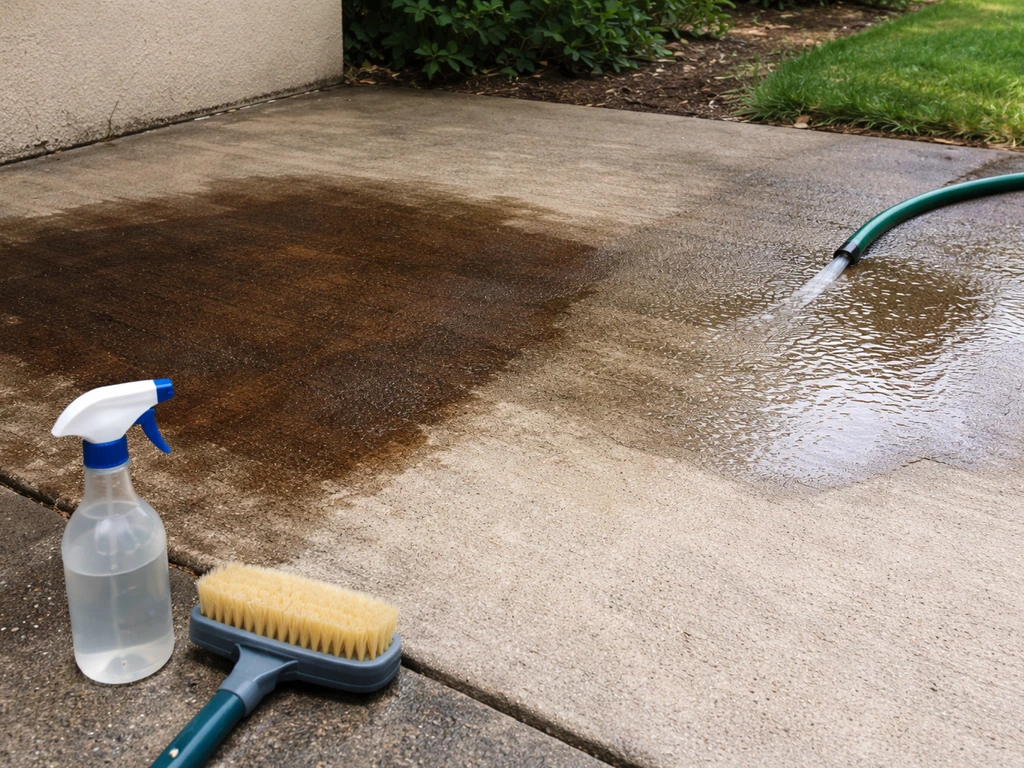
Step-by-step guide to remove teak oil stains from concrete, pavers, stone, and brick with safe degreasers and rinse step
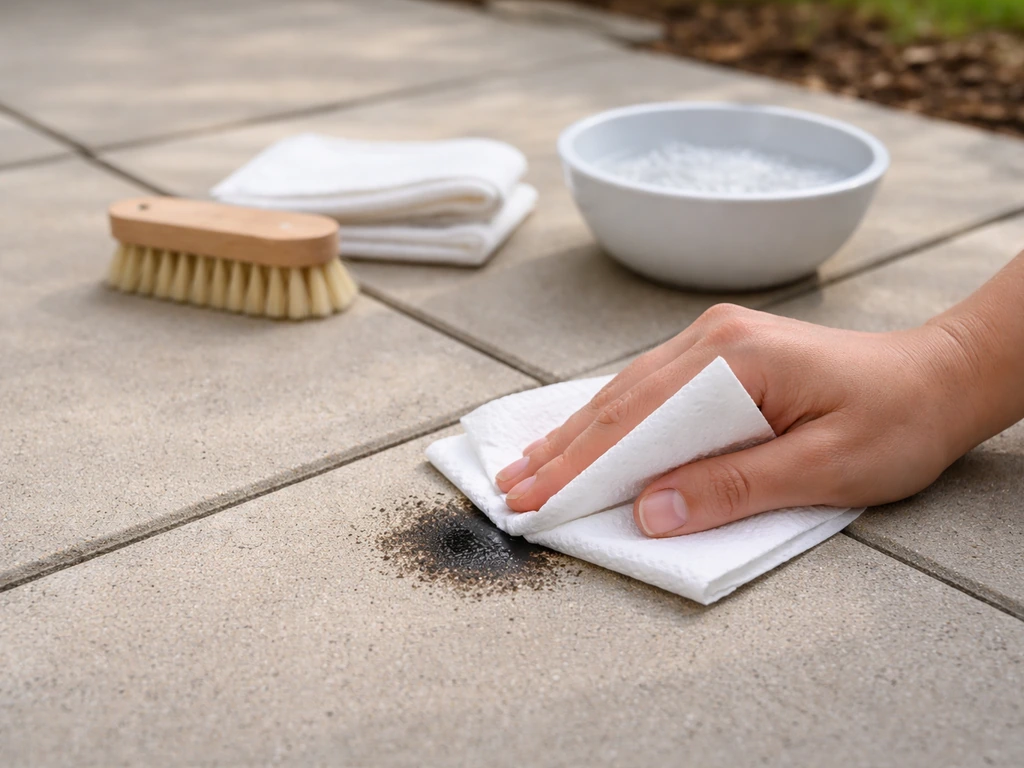
Learn how to remove WD-40 from patio surfaces with safe, surface-specific steps for concrete, pavers, brick, stone
Step-by-step ways to remove bbq oil and grease from concrete, brick, stone, pavers, and travertine safely fast.