Blot up as much pooled oil as you can with paper towels (press, don't wipe), then immediately pour a thick layer of clay cat litter, baking soda, or cornstarch over the whole wet area. That combination of quick blotting and an absorbent left on for at least 30 minutes handles the majority of fresh cooking oil or motor oil spills on pavers before they have a chance to soak deep into the pore structure. For stains that are already dry and set in, you'll need a degreaser scrub, a poultice, or both, but the process is still very manageable without professional equipment. For step-by-step guidance on removing oil from outdoor surfaces, see our guide on how to get oil off a patio.
How to Get Oil Out of Patio Pavers: Step-by-Step Guide
Dylan Hale
14 Jul 2026
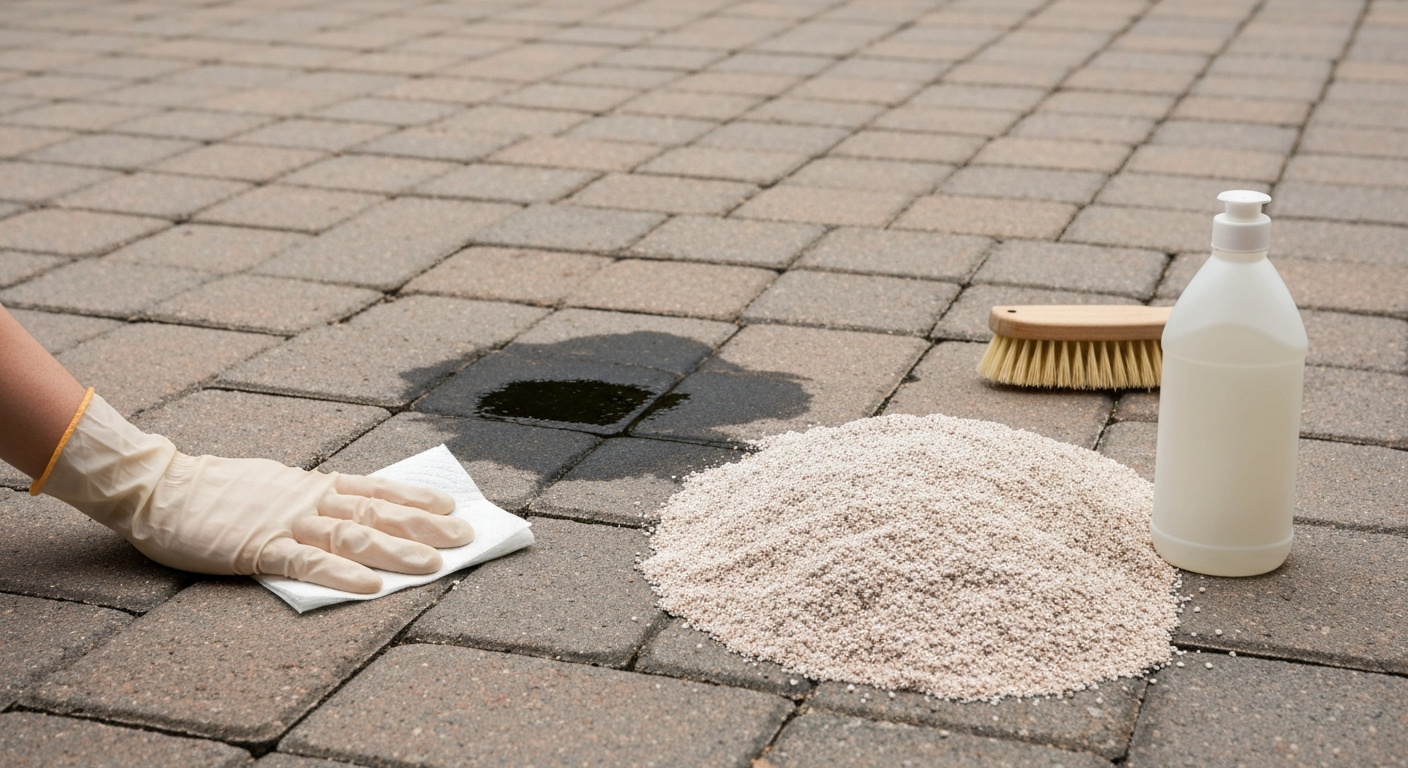
Quick emergency plan for fresh oil spills
The first 30 minutes matter more than anything else you'll do. Fresh oil sits mostly on the surface and in the top layer of pores before it wicks down, so speed limits the damage. Here's the order of operations I follow every time.
- Stop the source: cap the bottle, move the grill, pull the leaking vehicle off the pavers.
- Blot, don't spread: press paper towels or old rags flat onto pooled oil and lift straight up. Wiping smears it into a wider area.
- Pour absorbent generously: cover the entire stain with clay (non-clumping) cat litter, baking soda, cornstarch, or sawdust. Use more than you think you need — a full inch of depth is fine.
- Tamp it in: step on the absorbent and twist slightly, or rub it in with a spare paver. You want physical contact with the pores, not just surface coverage.
- Wait: at least 30 minutes for small drips, several hours for larger spills, overnight for anything bigger than a dinner plate.
- Sweep and discard: bag the used absorbent and check below for disposal rules. If a faint stain remains, move directly to the degreaser or poultice steps.
For very small fresh spills (a few tablespoons of cooking oil, for example), skipping straight to warm water plus dish soap after blotting can prevent a permanent stain entirely, as long as you act within the first hour or two. On anything porous like sandstone or unsealed brick, though, I'd still use the absorbent step first because those surfaces drink oil faster than concrete pavers. For step-by-step guidance specific to sandstone patios, see how to remove oil stains from sandstone patio.
Tools and products you'll need
You don't need a truck full of specialist gear. Most of what works is already in a kitchen or garage. Below is a full list organized by category so you can check off what you have and buy only what's missing.
Absorbents
- Clay (non-clumping) cat litter — cheapest and most effective for motor oil; oleophilic and easy to sweep
- Baking soda — works well on cooking oil, doubles as a mild scrubbing agent
- Cornstarch — gentler option; good for natural stone where grit is a concern
- Sawdust — high absorption ratio (up to 15x its weight in oil); dispose carefully per local rules
Cleaning agents
- Dish soap (Dawn or equivalent) — first-line degreaser for fresh and light stains
- Baking soda (as a paste) — mild abrasive degreaser, safe on most surfaces
- White vinegar — limited effectiveness on oil but useful for cutting residue after primary cleaning (see limitations in the degreaser section)
- Commercial degreaser: alkaline/surfactant type (Simple Green Concrete & Driveway, Zep Heavy-Duty Citrus Degreaser)
- Mineral spirits — solvent for dissolving set-in oil in a poultice; handle outdoors with gloves
- Poultice powder: kaolin clay, fuller's earth, diatomaceous earth, whiting, or talc
Brushes and applicators
- Stiff nylon scrub brush — safe on most pavers including sealed surfaces
- Natural-bristle deck brush on a long handle — good for large areas
- Old toothbrush — joint scrubbing and detail work
- Plastic putty knife or stiff card — for removing dried poultice
- Plastic sheeting and painter's tape — poultice covering
PPE and optional equipment
- Nitrile or rubber gloves — required for all chemical degreasers and mineral spirits
- Safety glasses — especially when pressure washing or mixing concentrates
- Old clothes or an apron — commercial degreasers and mineral spirits stain fabric
- Garden hose with adjustable spray nozzle — adequate for most rinsing
- Pressure washer (optional) — useful for large areas or stubborn set-in stains; 1,200–1,800 PSI for standard concrete pavers
Safety, testing and runoff/disposal
Spot testing
Always test any cleaner on a small, inconspicuous area first, particularly on natural stone, brick, or colored/sealed pavers. Apply a small amount, wait the full dwell time, rinse, and check for discoloration, surface etching, or seal damage before committing to the whole stain. I test in the corner under a patio chair or behind a planter where any lightening won't be visible. This is especially important with vinegar on limestone, travertine, or sandstone (it etches those surfaces) and with heavy commercial degreasers on lightly sealed pavers.
Personal protective equipment
Nitrile gloves and safety glasses are non-negotiable when using commercial degreasers, mineral spirits, or any solvent-based poultice material. Skin and eye contact with mineral spirits causes irritation, and concentrated alkaline degreasers can cause chemical burns with prolonged contact. Work in a well-ventilated area: outdoors is typically fine, but avoid working in an enclosed courtyard with no airflow when using solvents.
Containing runoff and disposing of waste
Used absorbent materials (cat litter, sawdust) that have soaked up motor oil are classified as contaminated waste in most jurisdictions and cannot go in regular trash or recycling. Check your local household hazardous waste (HHW) program for drop-off options. Rinse water containing heavy degreasers or solvents should not be directed toward storm drains. For a small cleanup, rinsing into a lawn area (away from vegetable gardens) is often acceptable for biodegradable soap-based degreasers, but check your local codes. Mineral spirits and solvent-soaked rags must be stored in a sealed metal container and taken to an HHW facility.
Step 1: Absorbents for fresh spills
This method works best when the oil is still wet or was spilled within the last few hours. For a step-by-step guide with product recommendations and photos, see my article on how to remove oil stains from patio slabs. It's the safest option for every paver type including natural stone, sealed pavers, brick, and sandstone, because you're not introducing any chemicals that could damage the surface. For practical, step-by-step guidance on using absorbents, blank" rel="noopener noreferrer">spread a generous layer, tamp or grind it into the pores, leave for hours to overnight, then sweep or shovel away, see How to Remove Oil Stains From Concrete (2026 Guide) - HomeGuide.
- Blot up all pooled liquid with paper towels or rags, pressing firmly and lifting straight up. Discard immediately.
- Pour a generous layer (at least 1/2 inch deep) of clay cat litter, baking soda, cornstarch, or sawdust directly over the stained area. For motor oil, clay cat litter is my top pick because it's cheap, very oleophilic, and rinses away easily.
- Tamp the absorbent into the surface: step on it and grind it in gently, or press it with your foot in a twisting motion. The goal is to force contact between the absorbent and the oil inside the pores.
- Leave it alone: 30–60 minutes for small fresh spills, 4–8 hours for larger spills, overnight for anything soaked into porous stone or old unsealed pavers.
- Sweep or vacuum up the spent absorbent. Bag it for proper disposal (see runoff/disposal section above).
- Inspect the stain. If a visible discoloration remains, the oil has penetrated deeper and you'll need to follow up with a degreaser scrub or poultice.
Repeat the absorbent step a second time if the first pass pulls up more oil than expected. I've dealt with a quart of motor oil on an unsealed concrete paver and needed two absorbent applications before the scrubbing step made a real difference. Don't skip this stage and jump straight to water-based cleaners: trying to wash wet oil off a porous surface with water first just spreads it.
Step 2: Household degreasers and DIY cleaners
Once the absorbent has pulled up the bulk of the oil, or for light stains that have only partially set, a household degreaser is the next step. These options are renter-friendly, low-cost, and safe for most surfaces when used correctly.
Dish soap method
- Mix approximately 1/4 cup (2 fl oz) of concentrated dish soap into one gallon of warm water.
- Pour or apply the solution directly onto the stained area so it's thoroughly wet.
- Scrub with a stiff nylon brush using firm circular motions. Spend at least 2–3 minutes per square foot of stain.
- Allow 5–15 minutes dwell time (don't let it dry out; add more solution if needed).
- Rinse thoroughly with a garden hose on a strong spray setting, working from the edge of the stain inward to avoid spreading.
- Inspect. Repeat once or twice if needed. Dish soap is safe for concrete, brick, and sealed pavers; use it freely.
Baking soda paste
Mix baking soda with just enough water to form a thick paste (roughly 3 parts baking soda to 1 part water). Apply it directly to the stain, scrub with a nylon brush, and let it sit for 20–30 minutes before rinsing. The mild abrasive action combined with its deodorizing properties makes this excellent for cooking oil on concrete pavers or brick. It's safe on most natural stone as well, though I'd spot-test first on very soft or polished surfaces.
Vinegar: useful but limited
White vinegar is often recommended online for oil stains, but I'll be honest: its effectiveness on oil specifically is limited. Vinegar is acidic and works well on mineral deposits and some organic residue, but oil is not water-soluble and vinegar doesn't break it down significantly. Where I do find vinegar useful is as a follow-up rinse after scrubbing with dish soap, to help neutralize any alkaline residue and cut through light greasy film. The important warning: never use vinegar on limestone, travertine, or sandstone. The acid etches the surface, causing permanent dull spots. For those materials, stick to dish soap or a pH-neutral cleaner.
Step 3: Using commercial degreasers
When dish soap doesn't fully cut through a stain, or when you're dealing with motor oil, grill grease, or a stain that's a few days old, a commercial degreaser is worth the investment. The type you choose matters depending on your surface and the soil.
| Degreaser Type | How It Works | Best For | Avoid On |
|---|---|---|---|
| Alkaline/surfactant (e.g., Simple Green Concrete & Driveway, Zep) | Breaks down grease through saponification and surfactant action | Concrete pavers, brick, heavy motor oil | Polished or acid-sensitive stone |
| Citrus solvent (d-limonene, e.g., Zep Citrus Degreaser) | Solvent dissolves oil on contact | Light-to-medium grease, grill oil | Sealed pavers (can strip sealant); test first |
| Enzyme-based (biological degreaser) | Microbes break down oil over hours to days | Cooking oil, organic grease, eco-sensitive areas | Situations where you need fast results |
| Solvent-based (mineral spirits) | Dissolves oil directly | Deep set-in oil, use in poultice | Flame sources; requires careful disposal |
How to apply a commercial degreaser
- Read the label and note the dilution ratio. Simple Green Concrete & Driveway is typically diluted for light soils and used more concentrated for heavy stains. Rust-Oleum Heavy-Duty Degreaser recommends 1:4 dilution for general cleaning and full-strength for tough stains.
- Wet the paver surface lightly first — this prevents the product from being immediately absorbed into dry pores before it has a chance to work.
- Apply the degreaser at the recommended dilution, ensuring full coverage 1–2 inches beyond the stain edge.
- Agitate with a stiff nylon brush for 2–5 minutes. Don't use a wire brush on sealed pavers, brick, or natural stone — it scratches the surface.
- Allow 10–20 minutes dwell time. Keep the surface wet; reapply product if it soaks in and dries.
- Rinse thoroughly with a garden hose or low-pressure washer setting. Multiple rinse passes are better than one heavy blast.
- Inspect and repeat if needed. Set-in stains often require two or three degreaser applications.
A note on TSP (trisodium phosphate): it's a historically popular heavy-duty degreaser for masonry, but its high phosphate content raises runoff concerns for waterways and it's banned or restricted in some states. Borax (sodium borate) or TSP-substitute products labeled TSP-PF achieve similar alkaline degreasing with less environmental impact and are my preferred option when I want more strength than dish soap but want to stay eco-conscious.
Step 4: Poultices for set-in stains
A poultice is the single most effective method for oil that has fully penetrated deep into porous pavers. The concept is straightforward: you apply a paste of absorbent powder mixed with a solvent to the stain, cover it so it dries slowly, and as the paste dries it literally draws the oil out of the stone. It takes patience but it works on stains that scrubbing alone never fully removes. This is particularly valuable for natural stone, concrete pavers, sandstone, and old brick. For detailed, step-by-step guidance tailored to natural stone surfaces, see our guide on how to remove oil from a stone patio (internal reference).
Making the poultice
For oil stains (cooking oil, motor oil, grease), use one of these base powders: kaolin clay, fuller's earth, diatomaceous earth, whiting (powdered chalk), or talc. Mix the powder with mineral spirits to a thick, peanut-butter-like consistency. As a simpler household alternative, mix baking soda with a few drops of dish soap and enough water to form a stiff paste. The mineral spirits version is more aggressive and better for deep motor oil; the baking soda version is gentler and appropriate for natural stone where solvent contact is a concern. Expect to need about one pound of prepared poultice material per square foot of stain.
Applying, covering, and removing
- Clean loose debris from the stained area and dampen the surface slightly if it's very dry.
- Apply the poultice in a layer 1/4 to 1/2 inch thick, extending about 1 inch beyond the stain edge in every direction.
- Cover the poultice immediately with plastic sheeting (cling wrap or a cut trash bag). Tape all edges down firmly with painter's tape so no air gets in. This slows drying and maximizes draw.
- Leave undisturbed for 24–72 hours. Longer dwell times produce better results for deep stains.
- Remove the plastic and allow the poultice to dry completely (another few hours outdoors is fine).
- Scrape off the dried poultice with a plastic putty knife. Do not use metal tools on stone or sealed surfaces.
- Rinse the area thoroughly and inspect the stain. If a shadow remains, the stain is pulling out but needs another pass. Repeat the entire process — for very stubborn motor oil stains, up to 5 applications may be needed, which is normal and expected.
Commercial pre-mixed oil poultice products from brands like StoneTech (LATICRETE) and PROSOCO are worth buying for badly stained natural stone where you don't want to risk DIY mixing. They're formulated specifically for the draw-and-lift action on porous stone and come with clear instructions for repeat applications. Always check the product label confirms compatibility with your paver material before applying.
Step 5: Pressure washing, steam cleaning and hot-water extraction
Mechanical cleaning methods can be powerful allies but they're not a replacement for chemical action on oil. Water alone, even at high pressure, doesn't dissolve oil, it just moves it around. The key is pairing mechanical force with a degreaser, or using steam and hot water to melt and lift the oil simultaneously.
Pressure washing
For standard concrete pavers, start at 1,200 PSI and work up to 1,800 PSI if needed. Industry guidance recommends starting conservatively at 1,000–1,200 PSI for older or soft pavers and 1,200–1,800 PSI for typical concrete pavers, avoiding 0°/red nozzles and using 25°–40° fan tips or a surface cleaner (see Should You Pressure Wash Your Patio Pavers?, Genstar Masonry (PSI & nozzle guidance)) Should You Pressure Wash Your Patio Pavers? — Genstar Masonry (PSI & nozzle guidance). Older, softer, or sealed pavers should stay at 1,000–1,200 PSI. Always use a 25- to 40-degree fan tip or a rotary surface cleaner. Never use a 0-degree (red) tip directly on pavers, it will etch the face and destroy joint material. Keep the wand moving in smooth, overlapping passes rather than holding it still over a stain. I apply a commercial degreaser first, allow full dwell time, then rinse it off with the pressure washer for dramatically better results than pressure washing with plain water.
| Surface Type | Recommended PSI | Nozzle | Notes |
|---|---|---|---|
| Concrete pavers (standard) | 1,200–1,800 PSI | 25° or 40° fan tip | Safe for most residential machines |
| Sealed or coated pavers | 1,000–1,200 PSI | 40° fan tip or surface cleaner | Higher PSI strips sealant |
| Brick pavers | 1,000–1,500 PSI | 25° fan tip | Avoid joints; soft mortar erodes |
| Natural stone (limestone, sandstone) | 800–1,200 PSI | 40° fan tip | Porous; use low pressure and degreasers designed for stone |
| Travertine | 800–1,000 PSI | 40° fan tip | Very soft; high pressure causes pitting |
Steam cleaning
A steam cleaner (available at hardware stores for rent or around $100–$200 to buy) uses superheated steam, typically 200–300°F, to melt oil and lift it from pores without heavy chemical use. This is my preferred method for sealed pavers where I don't want to risk strong degreasers attacking the sealant, and it's also a good option for renters who want a chemical-minimal approach. Apply a small amount of dish soap before steaming for better emulsification, then wipe away the lifted oil with a clean cloth or rinse with a hose.
Hot-water extraction
Hot-water extraction machines (like carpet extractors adapted for hard surfaces) inject hot water and degreaser under pressure and simultaneously vacuum the dirty water back up. This is the most thorough mechanical cleaning option and produces the least runoff, which is useful if you're working near a storm drain. Rental machines are available at most home improvement stores. This method is overkill for a small stain but genuinely useful for a heavily oil-stained patio area covering several square feet or more.
Material-specific guidance at a glance
| Paver Material | Safe Methods | Use with Caution | Avoid |
|---|---|---|---|
| Concrete pavers | All methods: absorbents, dish soap, alkaline degreasers, poultice, pressure washing up to 1,800 PSI | Solvent degreasers (test first) | Wire brushes; 0° pressure nozzle |
| Brick pavers | Absorbents, dish soap, alkaline degreasers, poultice, pressure washing up to 1,500 PSI | Citrus solvents (test first) | Wire brushes; high-pressure on joints |
| Natural stone (limestone, slate) | Absorbents, pH-neutral dish soap, poultice with mineral spirits, gentle pressure washing | Enzyme degreasers | Vinegar; acid-based cleaners; TSP; high-pressure washing |
| Sandstone | Absorbents, baking soda paste, pH-neutral dish soap, poultice, low-pressure washing only | Very dilute alkaline degreasers (test first) | Vinegar; citrus solvents; high PSI washing |
| Travertine | Absorbents, pH-neutral stone cleaner, baking soda paste, poultice, steam | Very low-pressure rinsing only | Any acid; commercial alkaline degreasers without pH-neutral labeling |
| Sealed/stamped pavers | Absorbents, dish soap, enzyme degreaser, steam cleaning | Citrus solvents and alkaline degreasers (risk stripping sealant) | TSP, high-concentration alkaline degreasers, high PSI washing |
How many treatments will it actually take?
Fresh cooking oil caught within an hour: one absorbent application plus a dish soap scrub is usually enough. Motor oil spilled and cleaned the same day: absorbents plus two rounds of commercial degreaser typically do it. A set-in stain that's been there for weeks or months: expect two to five poultice applications spread over several days, each pulling a little more oil out. Deep stains in very porous sandstone or unsealed old concrete pavers are the hardest, they may always leave a faint shadow even after multiple treatments. Managing expectations here is important: the goal is a dramatic improvement, not always invisible perfection.
When to call a professional
Most oil stains on pavers are DIY-manageable with the steps above. Call a professional masonry cleaner if: the stain covers a very large area (more than 30–40 square feet) and DIY methods aren't making a dent after three or four attempts; the pavers are high-value natural stone (marble, expensive travertine, imported slate) where the cost of a mistake outweighs professional fees; the stain appears to have penetrated a sealed decorative finish that needs professional refinishing; or you're dealing with a hazmat-level motor oil spill (from a major mechanical failure) that may require environmental reporting.
Prevention and sealing
The single best thing you can do after removing an oil stain is seal the pavers. For step-by-step guidance specific to patio surfaces, see our guide oil stains on patio: how to remove. A quality penetrating sealer (silane-siloxane type for concrete and natural stone) fills the pore structure without changing the surface appearance, so future oil spills bead up instead of soaking in. Most sealers need reapplication every two to five years depending on foot traffic and weather. For high-risk zones (under a grill, next to a car parking area, near a fire pit), place a rubber mat or drip tray. Clean spills the same day rather than leaving them overnight, every hour counts on porous surfaces.
FAQ
What is the immediate, actionable plan for a fresh oil spill on patio pavers?
Blot pooled oil — do not wipe — with paper towels or clean rags to lift excess. Cover the stain generously with an absorbent (non-clumping clay cat litter, baking soda, or cornstarch). Press or tamp the absorbent into the pores (step and twist or rub with a brush or paver), leave at least 30 minutes (several hours or overnight for larger spills), then sweep/shovel up and discard per local disposal rules. If residue remains, scrub with warm water and a few drops of dish soap, rinse, and repeat.
Step-by-step methods for set‑in oil stains on pavers and hardscapes
1) Start with repeated dry-absorbent treatments (clay cat litter, baking soda): cover, tamp, leave hours–overnight, sweep. 2) Try a household degreaser: mix ~2 fl oz dish soap per gallon warm water, apply, agitate with a stiff nylon brush, let 5–15 minutes, rinse. 3) For tougher stains use a commercial degreaser per label (alkaline or solvent-based) — follow dilution/dwell and rinse recommendations. 4) If deeper penetration, make a poultice (absorbent powder such as kaolin/fuller’s earth/diatomaceous earth or baking soda + small amount of solvent or mineral spirits), apply 1/4"–1/2" thick, extend 1" beyond stain, cover with plastic, let 24–72 hours to dry, remove and rinse; repeat if needed. 5) Consider low-pressure power washing (start ~1,000–1,200 PSI; 25°–40° tip) or surface cleaner to remove residual oil; avoid high pressure and 0° nozzles. 6) For very stubborn, deep stains consult pros for steam/hot-water extraction or specialized solvent treatments.
How do poultices work and how should I make and use one?
A poultice combines an absorbent powder (kaolin, fuller's earth, whiting, or diatomaceous earth) with a solvent to dissolve and draw oil into the powder as it dries. Mix to a spreadable paste, apply 1/4"–1/2" thickness extending ~1" past stain edges, cover with plastic and tape to seal, allow 24–72 hours to dry, remove dried poultice, rinse and repeat. Use mineral spirits or a mild solvent for oil stains on masonry; avoid peroxide/acetone on certain natural stones. Repeat up to several times for deep stains per manufacturer or stone-care guidance.
What degreasers and cleaners should I try (household and commercial)?
Household: concentrated dish soap (Dawn or similar) diluted in warm water; baking soda paste; TSP-substitute or borax for heavier soiling. Renter‑/eco‑friendly: white vinegar (rinse after) and baking soda, or enzyme-based biological degreasers. Commercial: alkaline/surfactant concrete/paver cleaners, solvent-based oil removers, citrus (d‑limonene) cleaners, and dedicated oil-stain poultices (StoneTech, PROSOCO). Always follow product labels and test in an inconspicuous area first.
How should I match method to paver material (concrete pavers, brick, natural stone, sandstone)?
Concrete pavers: tolerant of stronger alkaline cleaners and moderate pressure washing (start low PSI). Brick: similar to concrete but older/soft bricks may spall under high pressure — avoid wire brushes. Natural stone (limestone, travertine, slate): avoid acidic cleaners (vinegar) and harsh abrasives; use non-acidic poultices and manufacturer-approved solvents. Sandstone: porous and sensitive — favor poultices, enzyme cleaners, gentle agitation, and low-pressure rinsing. On all surfaces test first, avoid wire brushes and aggressive acids on stone, and adapt pressure-washer PSI and nozzle choice to the material.
What renter‑friendly and environmentally gentler options work for oil removal?
Blot and absorb first (cat litter, baking soda). Use dish soap scrubs, baking soda paste, white vinegar rinse (followed by water to neutralize), and enzyme/biological degreasers that biodegrade oils over hours–days. Avoid strong solvents or altering mortar without landlord permission. For rental properties, document attempts and get landlord approval before using commercial solvents, high-pressure washing, or sealers.
Next Articles
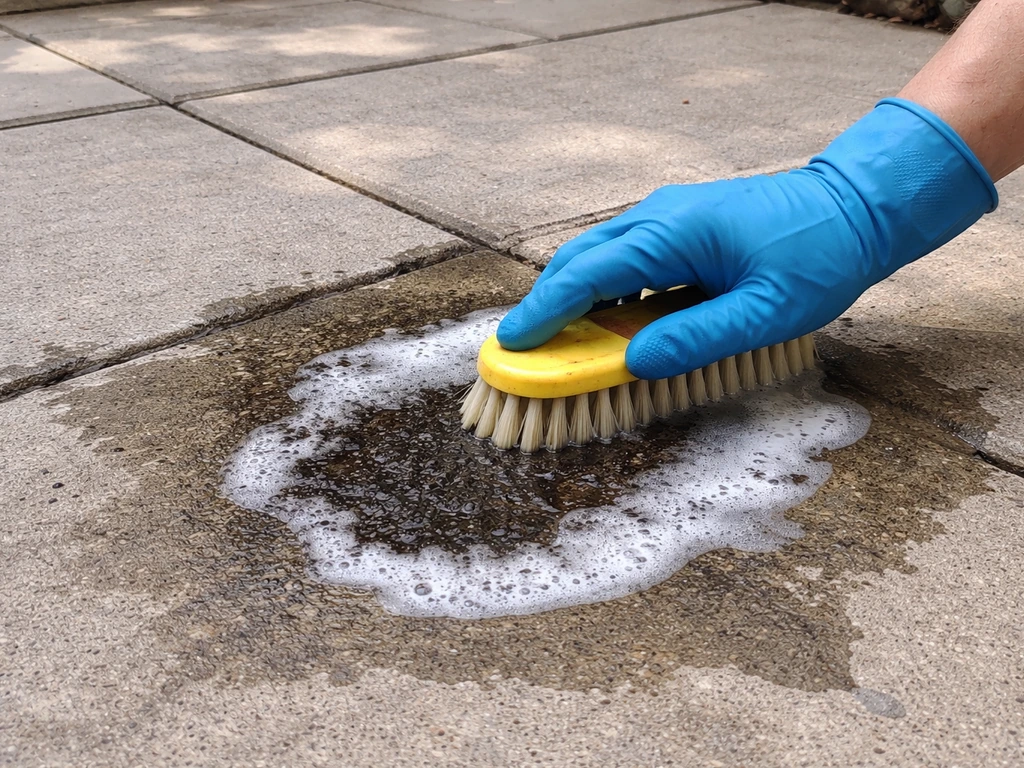
How to Remove Oil Stains From Patio Slabs Step by Step
Step-by-step methods to remove oil stains from patio slabs, from fresh grease to set-in concrete, safely and effectively
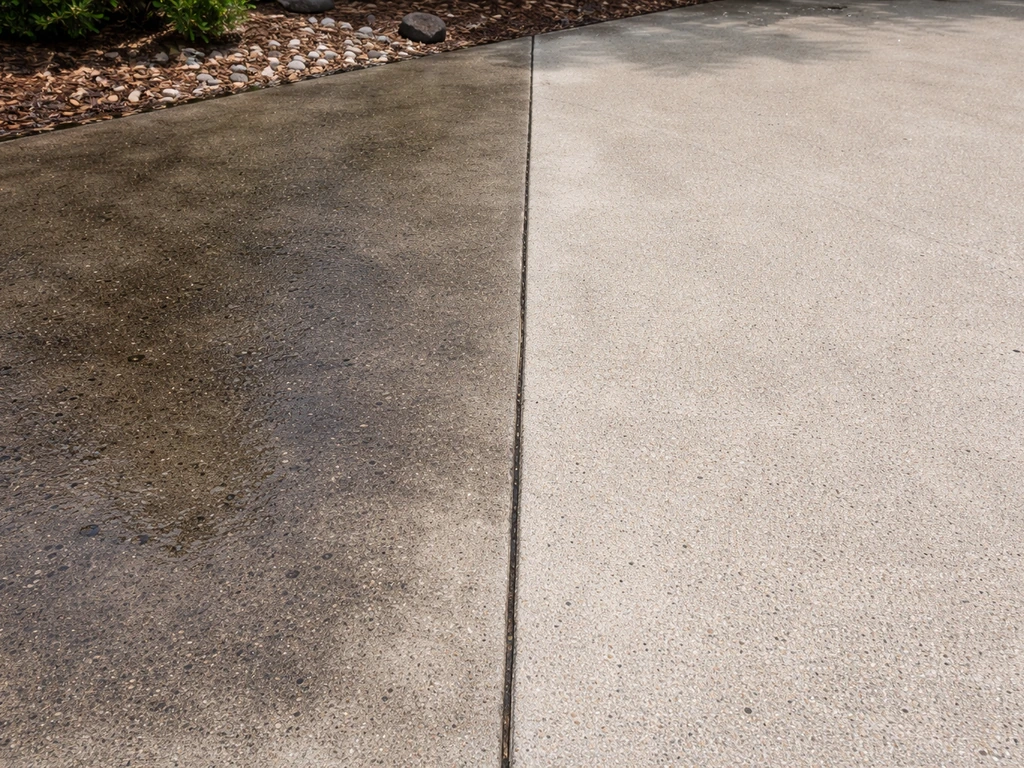
Oil Stains on Patio: How to Remove Them Step by Step
Step-by-step methods to remove oil stains from patios by material, using safe degreasers, poultices, and pressure where
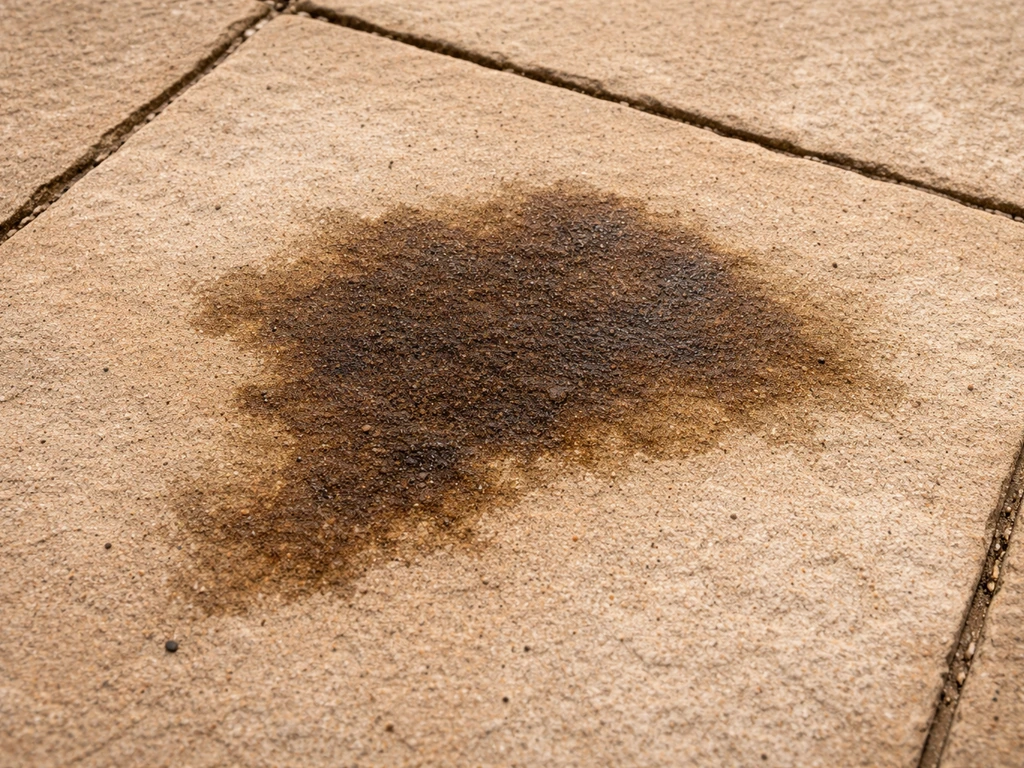
How to Remove Oil Stains From a Sandstone Patio
Step-by-step guide to remove oil and rust stains from sandstone patio safely with cleaners, poultices, and rinse tips.