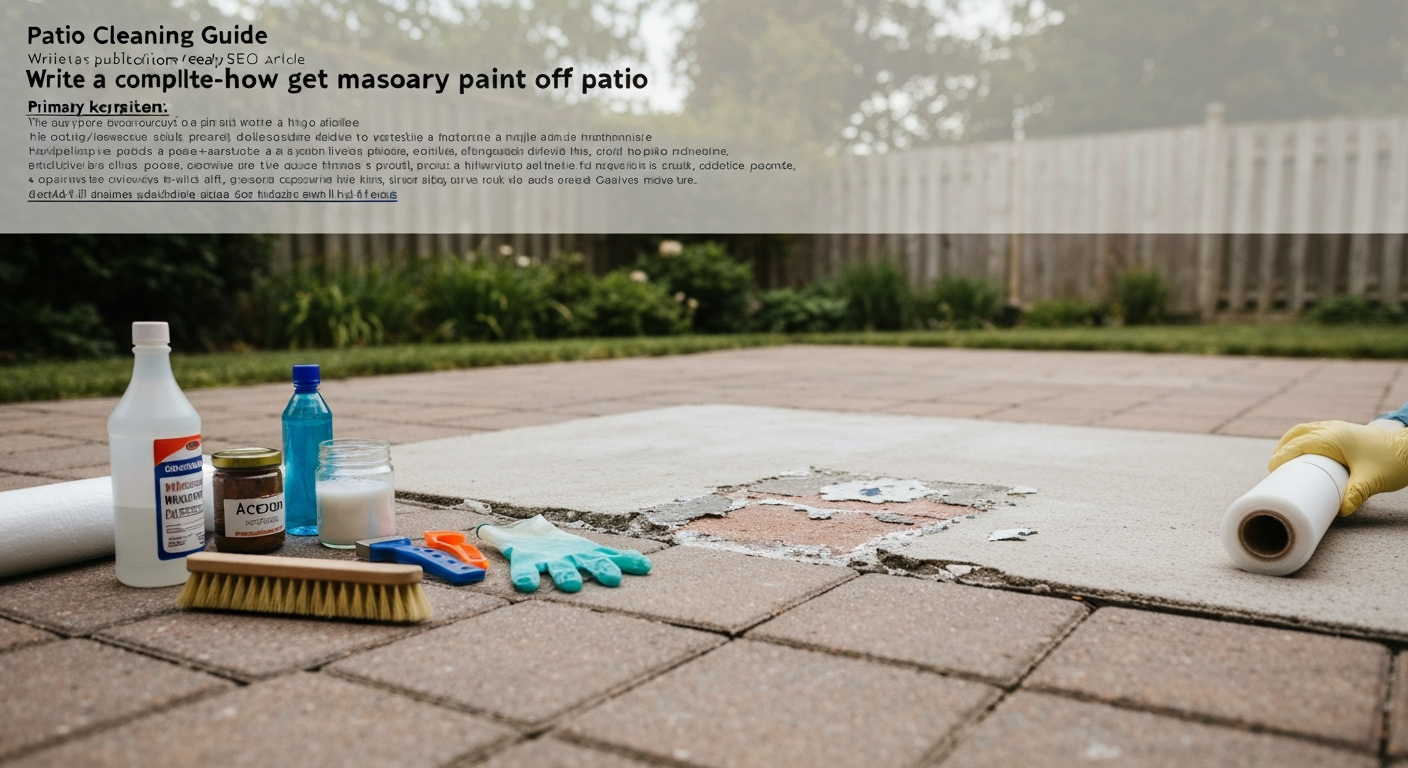
Masonry paint can come off a patio, but the right method depends on two things: what the paint actually is and what your patio is made of. Fresh latex splatter on concrete? Warm soapy water and a stiff brush is often enough. Dried oil-based masonry paint on brick? You'll need mineral spirits or a gel stripper. Thick coats on porous stone or travertine? That calls for a poultice or professional-grade stripper, handled carefully. This guide walks you through the whole process from diagnosis to aftercare, so you don't waste time or money on the wrong product.
How to Get Masonry Paint Off Patio: Step-by-Step Removal Guide
Dylan Hale
10 Aug 2026
What this guide covers and who it's for
Whether you're a renter trying to restore a patio before moving out, a homeowner dealing with a DIY paint job gone wrong, or someone who's inherited a badly painted outdoor space, this guide is built for you. I've put together a full removal framework that starts with the gentlest options and scales up to stronger chemical methods only when needed. You don't need a pressure washer or professional tools to get through most of the scenarios here, though I'll tell you when they genuinely help. The focus is strictly on masonry paint removal from outdoor patio surfaces: concrete, brick, natural stone, pavers, travertine, flagstone, and patio tiles. If you're dealing with paint on other patio surface types like pavers or decorative stone specifically, there's related guidance on those surfaces worth checking out too.
Check this before you do anything
Running through a quick diagnostic before you start saves you from making the situation worse. I've seen people reach straight for muriatic acid on travertine and end up with permanent etching. Spend five minutes on this checklist first.
- Is the paint fresh (wet or tacky) or fully cured and dry? Fresh paint responds to water and soap; cured paint needs solvents or strippers.
- Do you know the paint type? Check any leftover tins, or note whether the paint cleans up with water (latex/acrylic) or requires solvents (oil-based).
- What is your patio surface? Identify whether it's concrete, brick, natural stone (limestone, sandstone, travertine, flagstone), ceramic/porcelain tile, or manufactured pavers.
- Is the surface calcareous (contains calcium carbonate)? Limestone, travertine, and some mortar joints are acid-sensitive — muriatic acid and even vinegar can etch them.
- How large is the paint area? A small splatter is a different job from a full painted surface.
- Are there nearby plants, drains, or water features? Chemical runoff can harm vegetation and contaminate storm drains.
- Are you renting? Some aggressive methods (grinding, wire brushing, pressure washing at high PSI) can damage surfaces you're legally responsible for.
- Is the paint old enough to potentially contain lead? Properties built before the 1980s may have legacy coatings — if in doubt, use a lead test kit before sanding or grinding.
- Do you have basic PPE? At minimum, nitrile gloves and safety glasses before applying any chemical product.
How to identify the paint type
Getting this right is the single most important step. Using the wrong solvent on the wrong paint is how you end up with a worse mess than you started with.
Latex and acrylic masonry paint
This is the most common type used on patios and exterior walls. It's water-based, cleans up with water when wet, and dries to a flexible film. When cured, it won't dissolve in water anymore, but it tends to sit on the surface of dense substrates rather than penetrating deeply. Look for a slightly rubbery feel if you scratch at a thin edge with a fingernail. Brands marketed as masonry paint, elastomeric coating, or exterior latex usually fall here.
Oil-based and alkyd paint
Oil-based paints feel harder and more brittle when cured. They originally required mineral spirits or turpentine for cleanup. If you have a leftover tin and the cleanup instructions say 'white spirit' or 'mineral turpentine,' it's oil-based. These bond more tenaciously to porous masonry because they penetrate during application. Mineral spirits will soften them; a stiff gel stripper will usually lift them.
Chalk paint and tempera
True chalk paint (the decorative matte furniture-style paint) and tempera are both water-soluble and relatively easy to remove, especially if they haven't been sealed with wax or varnish. On outdoor masonry, chalk paint is less common as a deliberate coating, but chalk-based marks from children's activities are very common. These usually respond to warm water and scrubbing alone. There's a more detailed look at chalk specifically on patios in a companion article if that's your main issue.
Masonry stains and penetrating sealers
Some products sold as 'masonry paint' are actually penetrating stains or reactive sealers that bond chemically with the substrate rather than forming a surface film. These are the hardest to remove because they've become part of the stone or concrete. Grinding or controlled acid treatment may be the only option, and full removal isn't always possible without surface damage.
Know your patio surface before you apply anything
Every surface behaves differently under chemical attack. Porosity is the key variable: highly porous materials absorb liquids deep into their pore structure, which means paint penetrates further and chemicals can cause subsurface damage if left too long. Dense, low-porosity surfaces like glazed ceramic tiles keep paint closer to the surface and are generally easier to clean. Research into masonry microstructure confirms that pore sizes range from nanometre-scale voids in hardened cement paste to millimetre-scale voids in some natural stones, and that variation directly controls how aggressive your cleaning approach should be.
| Surface | Porosity | Acid-safe? | Pressure wash OK? | Main risk |
|---|---|---|---|---|
| Concrete | Medium to high | Generally yes (diluted) | Yes, with care | Pitting at high PSI; acid can etch unsealed concrete |
| Brick | Medium | Fired clay: yes (diluted) | Yes | Mortar joint damage; caustic swelling |
| Limestone / Travertine | High (travertine especially) | No — acid etches | Low PSI only | Permanent etching from acid or vinegar |
| Sandstone / Flagstone | High | Avoid strong acids | Low PSI only | Softening and surface loss |
| Manufactured pavers | Low to medium | Usually yes | Yes | Sealant stripping |
| Ceramic / porcelain tiles | Very low (glazed surface) | Yes (diluted) | Yes, gently | Grout damage; glaze scratching |
| Granite / hard stone | Very low | Yes (diluted) | Yes | Minimal — most durable surface |
If you're unsure whether your stone is calcareous (limestone-based), drop a small amount of white vinegar on a hidden spot. If it fizzes, the surface reacts to acid and you must avoid vinegar, muriatic acid, and any alkaline stripper without neutralization precautions. Travertine in particular is extremely vulnerable, I never use anything acidic on it.
Renter vs. homeowner: choosing how aggressive to go
Not every situation calls for the same level of intervention. I use a simple least-to-most-aggressive sequence and only move down the list when the previous step hasn't worked. If you're renting, you have an additional constraint: any method that could permanently alter the surface texture, color, or structure creates liability. Stick to the first three levels unless you have landlord permission in writing.
- Level 1 — Manual + water-based: warm water, dish soap, stiff nylon brush, plastic scraper. Safe on all surfaces, no damage risk, suitable for renters.
- Level 2 — Gentle chemical: white vinegar solution (avoid on calcareous stone), biodegradable detergents, enzymatic cleaners. Still low-risk but check surface compatibility.
- Level 3 — Solvent-based: mineral spirits, acetone (patch-test first). Effective on oil-based and some alkyd paints. Flammable, requires ventilation.
- Level 4 — Commercial gel/paste strippers: slower-acting, lower-fume, gel formulations (e.g., citrus-based, dibasic ester, or Sherwin-Williams Smart Strip Pro type products). Good balance of effectiveness and surface safety.
- Level 5 — Poultice system: absorbent carrier (kaolin, diatomaceous earth, or paper pulp) combined with a solvent or alkaline agent. Best for porous surfaces and deep penetration. Preferred by conservators for sensitive masonry.
- Level 6 — Mechanical: plastic scraper, stiff wire brush on brick/concrete only, orbital floor grinder with fine disc. Removes surface-sitting paint but risks scratching or altering texture. Homeowner only.
- Level 7 — Pressure washing: 1,000–1,500 PSI for stone and brick; up to 3,000 PSI for dense concrete. Combine with a stripping agent for best results. Can damage soft stone, grout, and mortar at high pressure.
- Level 8 — Strong chemical: muriatic acid (diluted) on brick/concrete only; sodium hypochlorite for biological staining. Full PPE required, neutralization and safe disposal mandatory.
- Level 9 — Call a professional: multiple coats of old paint on sensitive stone, possible lead content, or no progress after Levels 1–7.
Removal methods from gentlest to strongest
Fresh paint splatter: act within the first hour
If the paint is still wet or tacky, you're in luck. For latex or acrylic: blot (don't smear) with a damp cloth, then scrub with warm water and dish soap using a stiff nylon brush. How to Remove Paint From Common Home Surfaces (BobVila) advises that warm water with a low‑foaming detergent (dish soap) and a stiff nylon brush, plus agitation and repeated rinsing, often removes uncured or thin latex/acrylic splatter from concrete, pavers, and glazed tiles, test on an inconspicuous area first. Rinse thoroughly. For oil-based paint when still wet: wipe with a rag soaked in mineral spirits, then follow up with soapy water to remove the solvent residue. The faster you act, the less effort this takes, uncured latex on a glazed tile or dense concrete can often be fully removed with just water in the first 30 minutes.
Dried latex or acrylic masonry paint
- Wet the area thoroughly with clean water. Pre-wetting porous surfaces before applying any cleaner helps limit how deep chemicals penetrate.
- Apply a generous amount of dish soap or a low-foaming biodegradable detergent directly to the paint.
- Work it in with a stiff nylon brush using circular scrubbing motions. For concrete and brick, you can use a wire brush on the painted area, but avoid wire brushes on natural stone.
- Let the soap dwell for 5 to 10 minutes.
- Scrub again, then rinse with a garden hose or pressure washer at low PSI (under 1,500 PSI for most surfaces).
- Repeat if needed. Thin or lightly bonded latex often lifts in one or two passes. Thick, sealed coats may need a gel stripper (see below).
- For stubborn dried acrylic on concrete or pavers, try softening the film with an acetone-dampened cloth on a small area first, then scrape with a plastic scraper. Test on a hidden patch — acetone can lighten some colored concrete sealers.
Oil-based masonry paint
- Ventilate the area well before using any solvent.
- Apply mineral spirits to a cloth or brush and work it directly into the paint. Allow 10 to 15 minutes of dwell time.
- Scrub with a stiff brush. The paint should begin to soften and break up.
- Wipe away the loosened paint with rags, then rinse thoroughly with soapy water to neutralize the solvent residue.
- For thicker coats, move to a commercial gel stripper. Apply per product directions (typically spread 3–5mm thick), cover with the provided blanket or plastic sheeting to slow evaporation, and leave for the recommended dwell time — often 1 to 24 hours depending on the product.
- Remove the blanket and scrape the softened paint with a plastic scraper. Rinse from the bottom upward to avoid re-depositing removed paint onto clean areas below.
- Do not use mineral spirits on travertine, limestone, or sandstone without careful testing. On those surfaces, switch directly to a citrus-based or dibasic ester gel stripper.
Chalk marks and chalk paint
Standard chalk marks (from chalk sticks) are water-soluble and usually disappear with a garden hose and a scrub brush. If they've been on the surface through rain and dried-in cycles, warm water plus dish soap handles them almost every time. Chalk paint that has been sealed with wax or varnish behaves more like an acrylic paint and needs a gel stripper or acetone to break the sealer before the chalk paint beneath will lift. More detail on chalk marks specifically is in a companion piece on the site.
Deep stains and porous surfaces: the poultice method
When paint has soaked into a highly porous surface like travertine, sandstone, or old brick, surface scrubbing alone won't shift it because the paint is inside the pores, not just on top. This is where a poultice approach, favored by stone conservators and endorsed by preservation guidelines, genuinely works. The principle is simple: you pack an absorbent material mixed with a dissolving agent against the stain, cover it to slow evaporation, and let capillary action draw the paint back out into the poultice as the solvent works.
- Choose your carrier: kaolin clay, diatomaceous earth, or even paper towels (for small areas) all work. For latex paint, mix the carrier with a small amount of acetone or commercial latex paint remover to a peanut butter consistency. For oil-based paint, use mineral spirits as the solvent in the mix.
- Pre-wet the stained area with water (especially important on calcareous stone — this limits deep penetration of the solvent).
- Apply the poultice about 1 cm thick over the stained area.
- Cover immediately with plastic sheeting and tape the edges to seal. This slows evaporation and keeps the chemical in contact with the substrate.
- Leave for 12 to 24 hours, or per the product's instructions if using a commercial poultice system like Peel-Away.
- Remove the plastic, then the poultice with a wooden or plastic scraper. The paint residue should have been drawn up into the paste.
- Rinse the area thoroughly with clean water.
- Expect to repeat the process two to three times for deeply penetrated paint. Each pass removes more of the embedded material.
Mechanical removal: when scraping and grinding are the right call
On hardwearing surfaces like dense concrete, a plastic or metal scraper used at a low angle can lift thick paint films with minimal surface damage. On brick, a stiff wire brush after a chemical softening step helps clear paint from the textured face. I avoid wire brushes on natural stone entirely, they leave scratch marks that are very visible. For large painted areas on concrete, an orbital floor grinder fitted with a fine abrasive disc removes surface paint efficiently, but this is a homeowner-level method because it permanently alters the surface texture and generates significant dust. Always wear a properly fitted P100 particulate respirator (not a paper dust mask) when grinding, and test for lead paint first if the property is older.
Pressure washing
A pressure washer speeds things up considerably when combined with a stripping agent, but pressure alone rarely removes cured masonry paint completely. Use it as a rinse and agitation tool after applying a stripper rather than as the primary removal method. Keep the nozzle at least 30 cm from the surface on brick and natural stone, use a fan-tip nozzle rather than a zero-degree tip, and always rinse from the bottom of the treated area upward to prevent dirty runoff streaking already-clean sections. For sensitive surfaces like travertine or sandstone, limit pressure to under 1,000 PSI.
Renter-friendly and gentle methods
If you're renting, or just want to start with the safest possible approach, these methods carry almost no risk of surface damage and are fine around pets, children, and garden plants.
- Warm water and dish soap: the first thing to try on any paint type. Effective on fresh or thin latex films on non-porous surfaces.
- Stiff nylon brush: won't scratch glazed tiles, concrete, or pavers; safe for brick face. Pair with any of the cleaning solutions below.
- Plastic scraper: works well on peeling or thick paint that has already lost adhesion. Use at a low angle to avoid gouging.
- Biodegradable detergents: products based on plant-derived surfactants clean effectively and are safe for storm drain runoff in most areas. Look for labels that specify 'biodegradable' and 'phosphate-free.'
- White vinegar (diluted 50: 50 with water): useful for light organic marks, some mold residue, and chalk marks. DO NOT use on limestone, travertine, or any calcareous stone — it will etch. Also not effective on fully cured acrylic or oil-based paint films.
- Enzymatic cleaners: designed primarily for biological stains but can help with organic paint pigments; very safe and low-harm.
- Warm water soaking: for chalk and tempera on dense surfaces, simply saturating the area and letting it sit for 20 minutes before scrubbing often works without any additional product.
Solvents and commercial products: what to use and when to stop
Mineral spirits
Mineral spirits (also sold as white spirit) are the go-to for oil-based and alkyd paints. They soften the binder in the paint film, making it easier to scrub and scrape away. They have limited effect on fully cured acrylic or latex paint unless you combine them with significant mechanical agitation. Mineral spirits are flammable: keep away from open flames, work in ventilated outdoor conditions, and dispose of solvent-soaked rags in a sealed metal container. They're relatively low-toxicity compared to stronger solvents but still require nitrile gloves and eye protection.
Acetone
Acetone dissolves many water-based coatings and some alkyds quickly and is readily available in hardware stores. It evaporates fast, which limits dwell time, so work in small sections. It's highly flammable and produces vapor that concentrates quickly in enclosed spaces, so outdoor use only. Always do a patch test on an inconspicuous area first, acetone can lighten or strip some concrete sealers and may affect colored paver finishes.
Commercial gel and paste strippers
These are my preferred tool for thick or multi-layer masonry paint. Gel formulations stay in place on vertical and uneven surfaces, maintain contact longer than liquid strippers, and are available in several chemical classes: citrus or terpene-based (green chemistry, lower fume, longer dwell needed), dibasic ester-based (moderate fume, effective on multiple paint types), and caustic/alkaline (fast-acting but can swell some substrates and require thorough neutralization). Products in the 'Smart Strip Pro' category from professional paint brands are formulated specifically for masonry and list compatible substrates on their technical data sheets, always check those before applying to natural stone. Avoid methylene chloride (DCM)-based strippers for DIY use. DCM is highly effective but has caused fatal inhalation incidents in enclosed or poorly ventilated spaces, and OSHA requires a written respiratory protection program with supplied-air systems for professional use. This is not a product for a weekend DIY job.
Poultice-blanket systems (Peel-Away type)
Products like Peel-Away use a thick alkaline paste applied with a blanket overlay that traps loosened paint as it lifts, reducing airborne particles and liquid runoff. These systems are used by conservation professionals on historic masonry and listed buildings, which tells you they're designed for surfaces where you cannot afford damage. Dwell times range from a few hours to over 24 hours depending on paint thickness and substrate. Follow the test-patch requirement strictly: apply to a 30 cm square, wait the full dwell period, and assess before committing to a large area.
Sodium hypochlorite (bleach)
Standard household bleach removes biological stains, mold, and can lighten chalk residue, but it is not a paint stripper and will not dissolve cured paint films. Where it's useful here is in the cleanup phase after paint removal, when you're dealing with discoloration or organic growth exposed beneath old paint. Dilute to no more than 1 part bleach to 10 parts water for most surfaces. Never mix bleach with acidic products (including muriatic acid or vinegar) because the combination releases toxic chlorine gas. Keep runoff away from drains and garden beds, bleach kills vegetation and is harmful to aquatic life in storm water systems.
Muriatic acid
Diluted muriatic (hydrochloric) acid is sometimes used on dense concrete and fired clay brick to remove mortar smears, rust, and efflorescence, and it can etch the surface lightly enough to remove surface paint layers. However, it will permanently damage calcareous stones (limestone, travertine), some glazed tiles, and colored concrete. If you use it, dilute to a maximum of 1 part acid to 10 parts water (always add acid to water, never water to acid), apply with a plastic brush, allow no more than 2 to 3 minutes of contact, then neutralize thoroughly by scrubbing with a baking soda and water solution (approximately 1 cup baking soda per 5 litres of water) before a final rinse. Wear acid-resistant gloves, a full face shield, and old clothing. Dispose of spent acid solution by neutralizing it to a pH above 6 before pouring down a utility sink drain, never into a storm drain or onto soil near plants.
Full tools and products list
| Item | Purpose | Renter-safe? |
|---|---|---|
| Nitrile gloves | Hand protection for all chemical work | Yes |
| Safety glasses / face shield | Eye and face protection | Yes |
| P100 respirator (half-mask) | Required for grinding, recommended for solvents | Yes |
| Stiff nylon brush | Scrubbing paint on all surfaces | Yes |
| Stiff wire brush | Scrubbing on concrete and brick only | Yes — avoid stone |
| Plastic scraper | Lifting softened or peeling paint film | Yes |
| Metal scraper | Heavier paint removal on concrete | Yes — careful on tile/stone |
| Dish soap / biodegradable detergent | First-pass cleaner for fresh and light paint | Yes |
| White vinegar (diluted) | Light marks on non-calcareous surfaces | Yes — not on travertine/limestone |
| Mineral spirits | Oil-based paint softening | Yes — ventilate |
| Acetone | Acrylic softening, poultice solvent | Yes — flammable, patch-test |
| Citrus/terpene gel stripper | Multi-layer latex and acrylic on masonry | Yes |
| Caustic gel/paste stripper | Heavy paint on concrete and brick | Homeowner — needs neutralization |
| Poultice-blanket system (e.g., Peel-Away) | Deep paint penetration in porous stone/brick | Yes with care |
| Kaolin or diatomaceous earth | DIY poultice carrier | Yes |
| Plastic sheeting and tape | Covering poultice to slow evaporation | Yes |
| Baking soda solution | Neutralizing acid after muriatic acid use | Yes |
| Sodium hypochlorite (bleach, diluted) | Biological staining after paint removal | Yes — ventilate, no drains |
| Muriatic acid (diluted) | Efflorescence and stubborn marks on brick/concrete | Homeowner only — full PPE |
| Pressure washer (500–1,500 PSI) | Rinsing and agitation after stripping | Check lease — 1,000 PSI for stone |
| Garden hose with spray nozzle | Rinsing on all surfaces | Yes |
Safety, runoff, and disposal
This part matters. I've seen people skip PPE on 'just a small area' and regret it. Chemical splashes to eyes from strippers are a genuine emergency. Here's what you need to know before opening any product.
- Always wear nitrile gloves and safety glasses as a minimum. For caustic strippers and muriatic acid, use a full face shield and acid-resistant gloves.
- A standard paper dust mask provides no protection against organic vapors from solvents. For solvent work in confined or low-wind conditions, use a half-mask respirator fitted with organic vapor cartridges (OV/P100 combination). For grinding, P100 particulate filtration is required.
- Work in well-ventilated conditions. Outdoors is generally fine for most solvents, but avoid using volatile solvents like acetone on windless hot days when vapor buildup increases.
- Protect nearby plants by wetting them down before you start and covering with plastic sheeting if using strong chemicals. Rinse them off again after you've finished.
- Block or cover patio drains before applying chemical strippers, acid, or bleach. Chemical runoff into storm drains is an environmental violation in most jurisdictions and harms aquatic life.
- Neutralize muriatic acid residue before rinsing. Apply a baking soda and water solution, allow it to react (it will fizz), then rinse thoroughly with a hose.
- Dispose of solvent-soaked rags in a sealed metal tin away from heat sources. Many areas have household hazardous waste collection days for solvent disposal — check your local authority's guidelines.
- Do not mix bleach with any acid product. The reaction produces chlorine gas, which is acutely toxic.
- If you suspect lead paint (properties built or painted before the 1980s), use a lead test kit before sanding, grinding, or scraping. If it tests positive, stop and consult a lead-safe certified contractor.
Aftercare: repairing, resealing, and getting the surface right
Once the paint is off, the job isn't quite done. Stripping and chemical treatment can leave the surface more porous and more vulnerable than before. On concrete and pavers, I always apply a penetrating masonry sealer after thorough drying (allow at least 48 to 72 hours of dry weather). This protects against new staining and makes future cleanup much easier. On brick, check mortar joints for softening or erosion from caustic products and repoint any damaged sections with matching mortar before resealing. On natural stone, consult the stone supplier or a conservation specialist before sealing, some stones need breathable impregnating sealers rather than film-forming ones, and the wrong product can trap moisture and cause spalling in winter.
If the surface has been mechanically abraded or acid-treated to the point where texture or color has changed visibly, matching the original finish is difficult. In some cases, especially on decorative patterned concrete or colored pavers, the best cosmetic fix is a uniform resurface coat or a fresh thin color-matched masonry paint applied over the whole area. That's a homeowner decision, but it's worth knowing it's an option rather than living with a patchy result.
When to stop and call a professional
Most masonry paint removal is genuinely DIY-able if you work through the methods in the right order. But there are situations where calling in a professional is the right call, not a failure.
- The paint tests positive for lead: professional lead-safe removal is legally required in many jurisdictions and the health risk is real.
- You've completed three or more poultice applications and paint is still deeply embedded in porous stone: a professional conservator has access to heated pressurized rinse equipment and industrial-strength gel strippers that aren't available to consumers.
- The patio surface is a listed or heritage material (e.g., original Victorian tiles, reclaimed flagstone, historic brick): consult a conservation professional before applying any chemistry.
- The painted area is very large (over 20 square metres of thick, multi-coat masonry paint): professional crews with industrial equipment will do this faster, more safely, and often more cheaply per square metre than a DIY process.
- You've caused visible etching, color change, or surface loss from acid or abrasive treatment: a professional may be able to resurface or restore the damage before it worsens.
For paint on specific surface types like individual pavers or a stone patio rather than a general masonry surface, the removal approach has some differences worth reading up on separately. For a step-by-step walkthrough specific to stone patios, see how to get paint off stone patio. For step-by-step instructions on cleaning paint from individual patio pavers, see our guide on how to get paint off patio pavers. The diagnostic logic here carries over, but the material-specific steps are worth checking in the dedicated articles on those surfaces.
FAQ
How do I diagnose the paint type and patio material before attempting removal?
Diagnostic checklist: 1) Identify substrate: concrete, brick, natural stone (travertine, limestone, flagstone), pavers, or glazed patio tile. Look for calcareous stone (light, soft, reacts to acid) vs dense siliceous stone. 2) Test paint age/type: scrape a small edge with a putty knife — flexible film that flakes likely = acrylic/latex; hardened, tacky or varnish-like = oil/alkyd; soft tacky splatter = fresh wet paint. 3) Solvent test (hidden spot): dab small amount of water + dish soap (latex dissolves poorly when cured), then mineral spirits (softens oil/alkyd) and acetone (strong solvent). If mineral spirits softens, paint likely oil-based; if acetone affects it but water doesn’t, it may be alkyd or another solvent‑sensitive film. 4) Porosity check: sprinkle water — if it soaks in quickly substrate is porous (high absorption) and may have deep penetration. 5) Risk/constraints: Are you a renter (need non‑destructive, renter‑friendly methods), are there nearby plants/drains, and can you use a pressure washer or heavy chemicals? Perform all tests in an inconspicuous area and note reactions before choosing a method.
What is the prioritized list of removal methods (least to most aggressive) and when should I use each?
Priority list (least→most aggressive): 1) Mechanical/soap + water: warm water, biodegradable dish soap, stiff nylon brush — use for fresh splatter, chalk marks, thin uncured latex on most substrates. 2) Alkaline cleaners and manual scraping: high-alkaline masonry cleaners or trisodium phosphate alternatives plus scraping for thicker latex/aged stains on robust concrete/brick (avoid on calcareous stone). 3) Solvents (mineral spirits, acetone): use for oil‑based or alkyd paints on non‑calcareous substrates; test first. 4) Commercial gel/peelable strippers (biobased or professional gels): for multiple layers or stubborn latex/oil on durable masonry; choose product per substrate compatibility and follow dwell times. 5) Poultices/Peel‑Away systems: for porous stone/brick and deep‑penetrated stains to draw out pigment/paint with minimal runoff. 6) Pressure washing (controlled) and wire brushing: effective on concrete/pavers/brick but avoid high PSI on soft stone or thin tile — use lowest effective pressure and test. 7) Chemical caustic or acid treatments (diluted sodium hypochlorite, muriatic acid) and professional-grade strippers (caustic/chlorinated): only for very stubborn coatings on durable fired clay or dense concrete; avoid on calcareous stone and follow neutralization. 8) Mechanical grinding or shot‑blasting: last resort for durable substrates where surface profile loss is acceptable; use professionals for even removal. Choose the least aggressive that is effective; on porous or historic masonry prefer poultice/gels (conservation guidance).
What are per‑material notes and expected results for each major surface?
Concrete & concrete pavers: Accepts mechanical and pressure methods well; soap/brush removes fresh latex; solvents help oil‑based; expect some surface etching with acids. Brick (fired clay): Durable to gels, solvents, pressure washing if done carefully; avoid strong acids on glazed finishes; porous mortar joints may trap residues. Natural stone (travertine, limestone, calcareous stone): Highly sensitive — avoid acids and strong alkalis; prefer poultices, gel strippers formulated for stone, and conservation methods; expect color change or etching if acids/strong cleaners used. Sandstone, flagstone (siliceous): More tolerant of alkali and pressure washing than calcareous stone; still test first. Patio tiles (glazed ceramics): Soap/brush, solvents for oil paints; avoid abrasive grinding that will scratch glaze. Porous pavers and aggregate finishes: Paint can penetrate deeply — poultices or repeated poultice/gel cycles are often needed; expect incomplete removal of deeply embedded pigment and possible need to refinish or reseal.
What tools and products do I need (complete list)?
Tools: stiff nylon brushes, brass or plastic scrapers, putty knife, plastic razor scrapers, wire brush (stainless or brass for tougher jobs), shop vacuum, buckets, absorbent cloths, plastic sheeting, painter’s tape, plastic tarps for runoff containment, garden hose with spray nozzle, adjustable pressure washer (with fan tip), poultice application tools (trowel), disposable mixing containers, disposable gloves. Personal protective equipment (PPE): nitrile gloves, chemical-resistant gloves for solvents/acid, eye protection, face shield for splashes, longsleeves, chemical-resistant apron, NIOSH‑approved respirator appropriate to vapors if using strong solvents (organic vapor cartridges) or supplied air where required. Products: biodegradable dish soap, white vinegar (only for limited uses), mineral spirits (white spirit), acetone (for testing/use with ventilation), commercial gel/peelable paint strippers (product matched to substrate), poultice materials (kaolin clay, diatomaceous earth, cellulose pulp or PeelAway system), sodium hypochlorite (bleach) for biological stains, diluted muriatic acid for mortar/rust smears on dense brick/concrete (use with caution), neutralizers (baking soda slurry for acids), plant‑safe absorbents, and sealers/repair mortars for aftercare. Disposal supplies: absorbent pads, sealable chemical waste containers, and access to local hazardous waste disposal guidance.
What safety, runoff control and disposal precautions should I follow?
PPE and ventilation: use chemical‑appropriate gloves, eye protection, and NIOSH‑approved respirators for organic vapors or methylene chloride (do not rely on dust masks). Work in daylight and with cross‑ventilation. Protect people and pets by cordoning off area. Runoff protection: cover nearby plants with plastic, wet soil to reduce uptake, and use tarps or containment to prevent chemicals entering storm drains. For poultices/peel systems, contain and collect residues; avoid washing concentrated chemicals into drains. Neutralize acids immediately with baking soda slurry, then rinse from bottom→top to reduce streaking. Disposal: follow product SDS — many solvent‑soaked rags are flammable and must be sealed and disposed of as hazardous waste; used caustic or solvent waste often requires local hazardous‑waste facility drop‑off. Never mix bleach with acids (chlorinated gas hazard). Environmental preference: choose biodegradable detergents and gel strippers with lower toxicity when possible.
Step‑by‑step: How to remove fresh latex/acrylic splatter (renter‑friendly)?
1) Act fast — uncured paint is easiest. 2) Gather: bucket, warm water, dish soap, stiff nylon brush, plastic scraper, absorbent rags. 3) Wet the area with warm water; add dish soap and agitate with brush to lift paint. 4) Use plastic scraper to lift softened splatter; avoid metal scrapers on delicate tile. 5) Rinse frequently; repeat until removed. 6) For stubborn thin film, apply a poultice of water + mild detergent, cover 30–60 minutes, then brush and rinse. 7) Rinse thoroughly and allow to dry. If paint is cured or only partially removed, escalate to gel stripper or test a solvent patch per substrate and landlord permission.
Next Articles
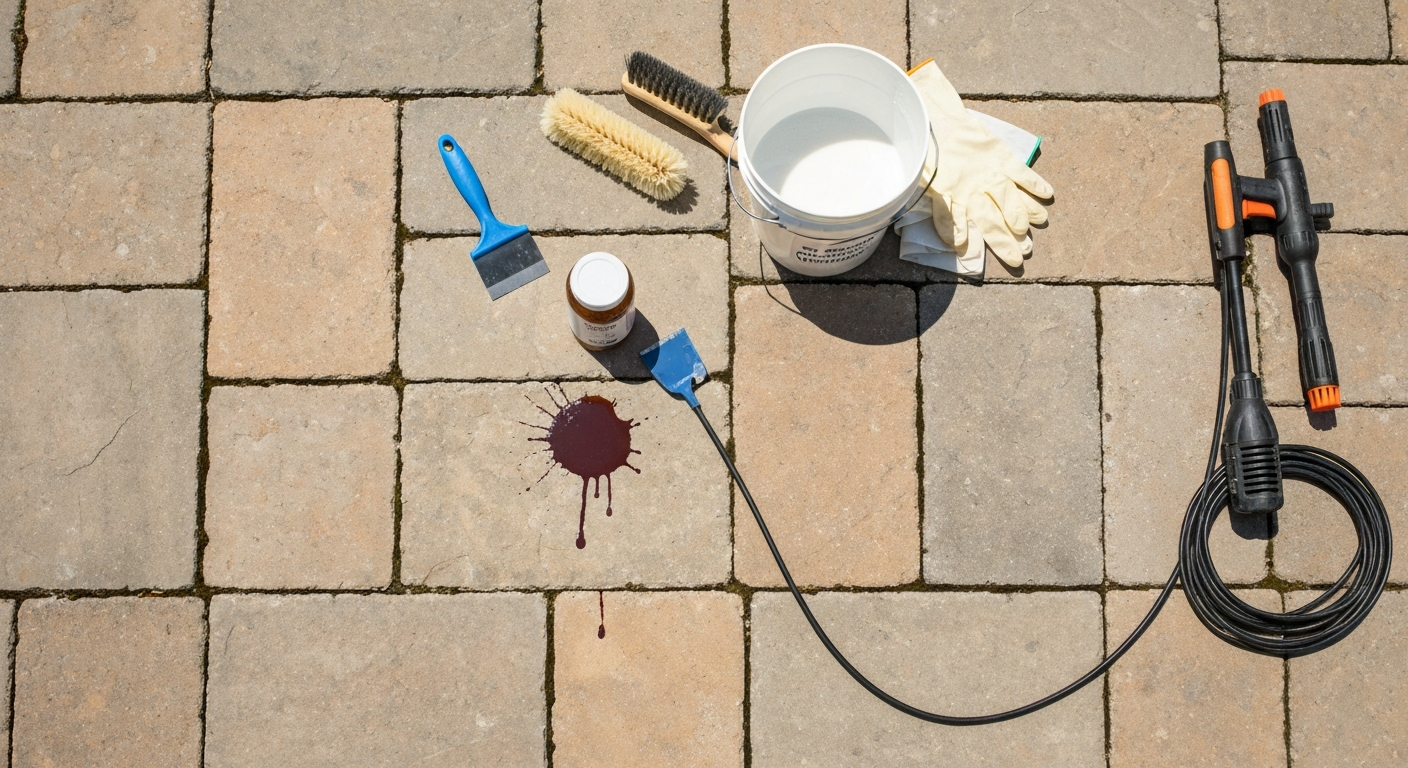
How to Get Paint Off Stone Patio: Step-by-Step Guide
Safe, step-by-step ways to remove paint from stone patios (flagstone, travertine, pavers) with renter-friendly options.
How to Remove Paint from Patio Tiles: Step-by-Step Guide
Learn how to remove paint from patio tiles and hardscape: step-by-step fixes, safe cleaners, and renter-friendly options
Does Chalk Wash Off Patio? Removal Guide for Every Surface
Does chalk wash off patio? Learn quick answers, material-specific cleaning steps, renter-safe and stronger options.