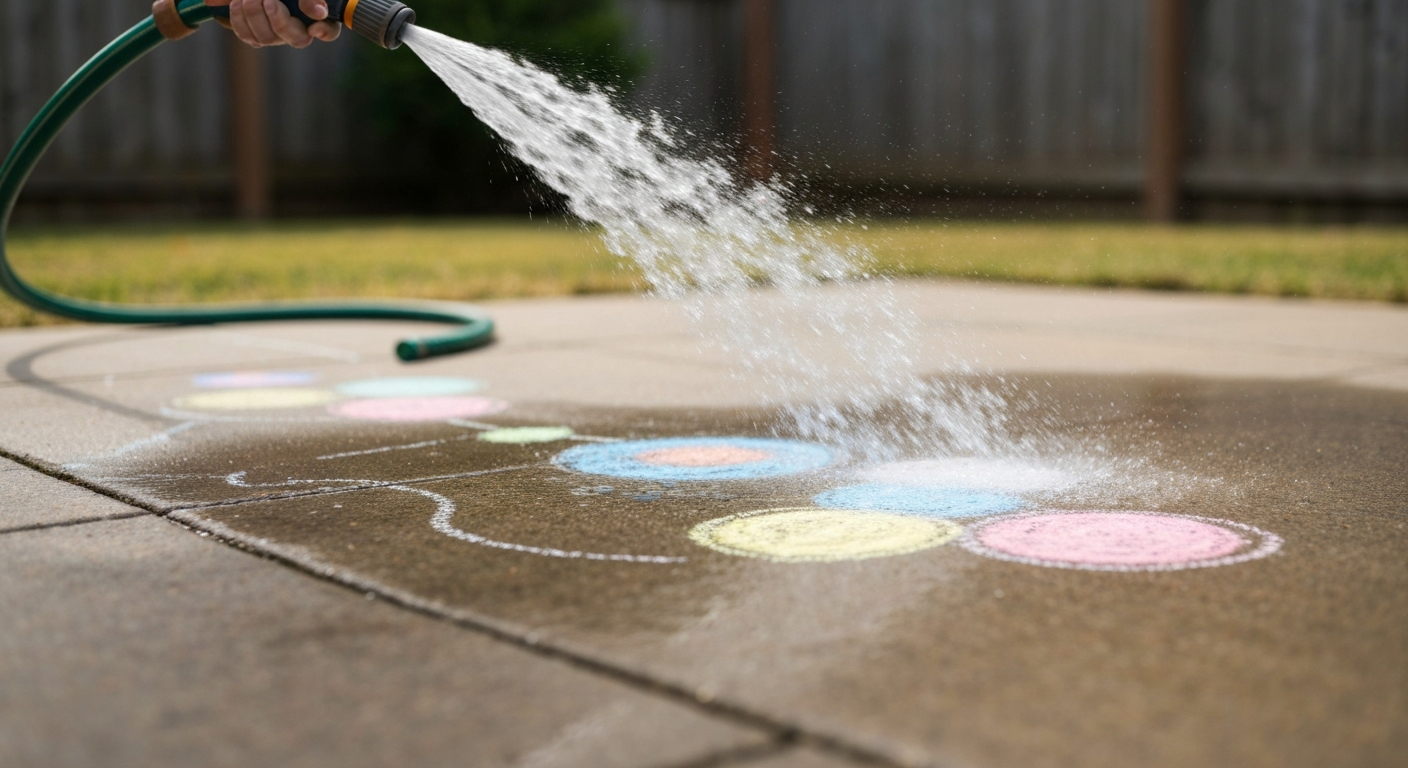
Yes, chalk washes off most patios with nothing more than a garden hose or a quick scrub with warm soapy water. Standard sidewalk chalk is made from gypsum or calcium carbonate pressed with pigments and water-soluble binders, so it breaks down fast when it gets wet. The catch is material porosity: dense, sealed surfaces shed chalk almost instantly, while highly porous concrete, old brick, unfilled travertine, and rough flagstone can hold a faint ghost stain that needs a couple of scrub cycles to fully clear. The good news is that with the right approach, even stubborn chalk ghost stains on porous surfaces are gone without calling a professional or spending money on specialist cleaners.
Does Chalk Wash Off Patio? Removal Guide for Every Surface
Dylan Hale
18 Jul 2026
Quick answer: will chalk wash off your specific patio material?
Here is the short version by surface type, based on porosity and how each material reacts to moisture and mild cleaners. Use this as your starting point before diving into the step-by-step methods below.
| Patio Material | Will chalk wash off? | Typical method needed | Risk of ghost stain? |
|---|---|---|---|
| Concrete (sealed) | Yes, easily | Hose rinse or light scrub | Low |
| Concrete (unsealed/porous) | Yes, with scrubbing | Warm soapy water + stiff brush, repeat if needed | Moderate |
| Brick | Yes, with scrubbing | Warm soapy water + brush; avoid acid on mortar joints | Moderate (old/porous brick) |
| Concrete pavers (sealed) | Yes, easily | Hose or soapy scrub | Low |
| Clay/terracotta pavers (unsealed) | Yes, takes effort | Soapy scrub + repeat; protect joint sand | Moderate to high |
| Natural stone (flagstone/slate) | Usually yes | Neutral-pH soap + soft brush; no acid | Moderate |
| Travertine | Yes, but be careful | Neutral-pH cleaner only; poultice for ghost stains | High (very porous, acid-sensitive) |
| Limestone | Yes, but be careful | Same as travertine; never use vinegar | High |
The single biggest factor is whether the surface is sealed. A quality sealant acts like a barrier between the chalk pigments and the stone or concrete beneath, which is why chalk on a freshly sealed paver patio rinses off with a hose while the same chalk on bare, porous travertine soaks in and leaves a tinted shadow. If you are not sure whether your surface is sealed, drip a few drops of water on it: if the water beads up, it is sealed; if it soaks in within 30 seconds, it is not.
Chalk vs paint: how to tell which one you are actually dealing with
Before you start cleaning, it is worth confirming that what you are looking at is actually chalk and not a paint or coating. If you discover it's paint rather than chalk, see a short guide on how to remove paint from patio tiles for safe, material-specific removal steps. I have seen plenty of homeowners scrub for an hour on what they assumed was leftover chalk art, only to discover it was spray paint, masonry paint, or alkyd-based deck paint. Getting the diagnosis right saves a lot of wasted effort. If you discover paint rather than chalk, see our guide on how to get paint off stone patio for safe removal methods.
What chalk looks like
- Powdery, slightly dusty texture when dry
- Colors are bright but flat, not glossy
- Edges are soft and blurred, not sharp lines
- Rubs off onto your finger when you drag across it dry
- Visibly dissolves or runs when you drip water on it
What paint looks like
- Smooth or semi-gloss film sitting on the surface
- Sharp, defined edges
- Does not rub off dry onto your finger
- Does not dissolve or run when you drip water on it
- May show cracking, peeling, or a skin-like texture
Field solvent test (do this on a hidden 1–2 inch patch)
- Water rub: Press a damp cloth on the mark for 30 seconds and rub gently. If color transfers to the cloth or the mark smears and dissolves, it is chalk or a water-soluble binder. You are done diagnosing.
- Isopropyl alcohol (rubbing alcohol) swab: If water does nothing, wet a cotton swab with 70–90% isopropyl alcohol, hold on the mark for 30–60 seconds, and rub lightly. Color transfer means water-based latex or acrylic paint.
- Mineral spirits swab: If alcohol does nothing, try mineral spirits with a 30–120 second dwell. Softening or color pickup means an oil-based, alkyd, or solvent-based coating.
- If none of the above react, the mark is likely cured alkyd paint, masonry paint, or polymeric spray chalk, and you will need a dedicated paint stripper or mechanical removal. At that point, guides on removing masonry paint and removing paint from patio pavers become more relevant than chalk-cleaning steps.
Use a fresh swab or cloth for each step and always test in an inconspicuous spot, not in the middle of the stain you are trying to fix. One 10-minute field test can prevent you from using the wrong product and damaging the surface.
Decision flow: try gentle first, escalate step by step
I always work through this sequence. Jumping straight to a pressure washer or bleach is almost never necessary for chalk and risks damaging joint sand, stone finish, or brick mortar. Start at Step 1 and only move forward if the previous step fails on a test patch.
- Step 1 — Hose rinse: Use a garden hose on a standard spray setting. For fresh chalk on sealed or low-porosity surfaces, this is often all you need. Wait 5 minutes and assess.
- Step 2 — Warm soapy water + stiff brush: Mix 1–2 tablespoons of mild dish soap per gallon of warm water. Pre-wet the area, apply the solution, scrub with a stiff nylon brush, and rinse thoroughly. Repeat this cycle up to 2–3 times before escalating.
- Step 3 — Targeted paste or poultice: For a ghost stain after 2–3 soapy scrubs, apply a baking soda and water paste (peanut butter consistency) to the stain, cover with plastic wrap, and leave for 24–48 hours. Remove, scrub, and rinse. On natural stone, use this instead of any acidic cleaner.
- Step 4 — Pressure washer (if you own or rent one): Use a 25–40 degree nozzle. Keep pressure conservative: under 1,200 PSI for travertine and soft natural stone, 1,200–1,800 PSI for brick and pavers, up to 2,500 PSI for unsealed concrete. Always test a hidden area first and keep the nozzle moving.
- Step 5 — Alkaline biodegradable degreaser: If ghost stains persist on concrete or pavers after pressure washing, an alkaline cleaner diluted per label instructions can break down waxy binders. Rinse thoroughly to avoid residue.
- Step 6 — TSP (trisodium phosphate) solution: A last resort for unsealed concrete and brick only. Mix 1/2 cup TSP per gallon of warm water, apply with a brush, scrub, and rinse very thoroughly. Do not use on natural stone, travertine, or near plants. Wear gloves and eye protection.
- Stop and call a pro if: (a) the surface shows etching, color change, or finish loss after any cleaning step on a test patch; (b) solvent tests confirm paint rather than chalk; (c) ghost stains remain after 3 gentle cycles on travertine or marble. Continuing past this point risks permanent damage.
Safety, PPE, and protecting your garden and drains
Even gentle cleaning products need some respect. Dish soap runoff is harmless to most plants, but TSP, bleach, and alkaline degreasers can burn foliage and harm soil pH if they drain directly onto garden beds. Here is what I do before starting any patio cleaning job.
PPE by product
| Product | Gloves | Eye protection | Ventilation needed? |
|---|---|---|---|
| Dish soap + water | Optional | No | No |
| Vinegar (undiluted) | Recommended | Recommended | Outdoors only |
| Baking soda paste | Optional | No | No |
| Alkaline degreaser | Yes (nitrile) | Yes (splash goggles) | Yes |
| TSP solution | Yes (rubber) | Yes (splash goggles) | Yes, outdoors only |
| Bleach solution (10% or less) | Yes (rubber) | Yes (splash goggles) | Yes, outdoors only |
| Mineral spirits / acetone (testing only) | Yes (nitrile) | Yes | Yes, outdoors only |
Plant and drain protection
- Before using anything stronger than dish soap, water garden beds and grass around the patio thoroughly first. Wet soil dilutes chemical runoff and reduces plant uptake.
- Cover adjacent plants with plastic sheeting when using TSP, bleach, or alkaline degreasers.
- Rinse the entire patio surface generously after cleaning — not just the treated patch — to dilute any runoff before it reaches drains or garden areas.
- Check local regulations before using TSP or phosphate-based cleaners: many municipalities restrict phosphate discharge into storm drains.
- For bleach: a 10% sodium hypochlorite dilution (roughly 1 part standard household bleach to 9 parts water) is sufficient for biological stains; do not exceed this concentration on patio surfaces.
- Pets and children should stay off the patio until the area has been rinsed and allowed to dry completely.
Renter-safe and eco-friendly cleaners: what to use and how to mix them
If you rent, the last thing you want is to damage the patio surface trying to remove chalk art. Every method in this section is low-risk, leaves no permanent marks on patio materials when used correctly, and involves products you can buy at any grocery store for a few dollars. I lean on these first for any chalk job, even when I have a pressure washer available.
Dish soap solution
Mix 1 to 2 tablespoons of mild liquid dish soap (Dawn or equivalent) into 1 US gallon (3.8 litres) of warm water. Apply to the pre-wetted stain, scrub with a stiff nylon brush for 2–3 minutes, and rinse with clean water. This is the method Crayola recommends for removing washable sidewalk chalk from pavement, and in my experience it handles 80% of chalk stains on its own. Safe on all patio surfaces including travertine and flagstone.
Baking soda paste
Mix baking soda (sodium bicarbonate) with just enough water to form a thick paste with a peanut butter consistency. Spread it about 1/4 inch thick over the ghost stain, cover loosely with plastic wrap, and leave it for 24 to 48 hours. The paste draws pigment and waxy chalk binders out of porous surfaces through absorption. Remove the dried paste with a plastic scraper, then scrub the area with the soapy water solution and rinse. Safe on all patio surfaces. Particularly useful on travertine and flagstone where acid cleaners are off-limits.
White vinegar (concrete, brick, pavers only)
Undiluted white vinegar (5% acetic acid) can help loosen chalk residue on concrete, brick, and concrete pavers. Apply it to the stain, let it sit for 5–10 minutes, scrub with a stiff brush, and rinse thoroughly. Do not use vinegar on travertine, limestone, marble, or any calcareous natural stone. The acid permanently etches these surfaces and dulls the finish, something that cannot be reversed without professional re-honing. For flagstone, check the stone type first: slate and sandstone tolerate vinegar, but limestone-based flags do not.
Recommended tools
- Stiff nylon scrubbing brush (best all-around choice; safe on all surfaces including stone)
- Natural bristle brush (good for brick and rough concrete where a softer touch is needed in mortar joints)
- Plastic scraper (for removing dried baking soda paste or softened chalk build-up)
- Garden hose with adjustable nozzle (a fan or shower spray setting is gentler than a jet)
- Microfibre cloths or rags (for solvent field tests and wiping down small areas)
- Plastic wrap and tape (to seal baking soda or baking soda poultice applications)
- Bucket (1–2 gallon capacity is enough for manual cleaning solutions)
Concrete patios: will chalk come off, and how to clean it
Will it come off?
Yes. Concrete is one of the more forgiving surfaces for chalk removal. Sealed concrete is the easiest: chalk sits on top of the sealant and a hose often does the entire job. Unsealed or rough-textured concrete is more absorbent and chalk pigments can penetrate slightly into the surface pores, leaving a ghost stain after the first rinse. That ghost stain usually clears with 2–3 soapy scrub cycles. Very old, badly weathered concrete with open pores may hold a faint tint that only a pressure washer or TSP treatment will fully clear.
Step-by-step method for concrete
- Dry sweep the area to remove loose chalk dust and debris before wetting.
- Pre-wet the stained area with a garden hose to prevent the chalk from spreading as a slurry when you add soap.
- Apply your dish soap solution (1–2 tablespoons per gallon of warm water) directly to the stain.
- Scrub vigorously with a stiff nylon brush in overlapping circles for 2–3 minutes.
- Rinse thoroughly with the hose, flushing from the centre of the stain outward.
- Check the result. If a ghost remains, repeat Steps 2–5 up to twice more. Most chalk ghosts clear by the third cycle.
- Escalation — pressure washer: If soap scrubbing does not fully clear the stain after 3 cycles, use a pressure washer with a 25–40 degree fan nozzle. Keep the nozzle 12–18 inches from the surface and move steadily. For unsealed concrete, 1,500–2,500 PSI is appropriate. Pre-wet first and rinse thoroughly after.
- Escalation — TSP: For a very stubborn ghost on rough, unsealed concrete, mix 1/2 cup of TSP per gallon of warm water, apply with a brush, scrub, and rinse very thoroughly. Wear rubber gloves and splash goggles. Keep runoff away from plants and drains.
Testing tips and when to stop
Always test your cleaning method on a small inconspicuous patch, such as a corner near a wall or under furniture, before treating the full stain area. If the test patch shows bleaching, surface texture change, or a new discoloration after rinsing and drying, stop and switch to a gentler approach. A small test prevents a large problem. If sealant on your concrete has been stripped by scrubbing or chemicals, consider resealing the surface once it is clean and fully dry (usually 48–72 hours after cleaning in dry weather).
Brick patios: will chalk come off, and how to clean it
Will it come off?
Yes, chalk comes off brick, but brick presents two specific complications that concrete does not. First, older or softer brick is quite porous and can absorb chalk pigments more deeply than modern dense brick. Second, the mortar joints between bricks are fragile, especially in older patios, and aggressive cleaning methods, particularly high-pressure washing from a close distance or acid-based cleaners, can erode or damage them. Work gently around joints and check for crumbling mortar before you start scrubbing.
Step-by-step method for brick
- Sweep the area dry first, paying attention to chalk dust sitting in the mortar joints.
- Inspect the mortar joints visually. If mortar is crumbling or soft, avoid directing a hose jet or brush pressure directly into the joint.
- Pre-wet the brick with a gentle hose spray (fan setting, not jet).
- Apply the dish soap solution (1–2 tablespoons per gallon of warm water) and let it sit for 2 minutes to penetrate.
- Scrub the brick faces with a stiff natural bristle or nylon brush. Use a smaller grout brush for the mortar joints themselves, and scrub lightly — mortar is softer than brick.
- Rinse thoroughly from the top down, flushing chalk and soap out of joints and off the surface.
- Repeat the scrub-and-rinse cycle up to 2 more times for ghost stains.
- Escalation — baking soda paste: For persistent ghost stains on brick faces (not joints), apply baking soda paste, cover with plastic, leave 24 hours, scrape off, and rinse.
- Escalation — pressure washer: For dense, modern brick, a pressure washer at 1,200–1,500 PSI with a 40-degree nozzle held 12 inches from the surface is effective. Keep the nozzle moving and avoid directing spray into mortar joints at close range. Do not exceed this pressure on old soft brick or you will erode the face.
- Tougher treatment — diluted bleach: For chalk stains with an organic component (mould, algae mixing with the chalk residue), a 10% bleach solution (1 part standard household bleach to 9 parts water) applied with a brush, left for 10 minutes, and rinsed thoroughly can help. Cover nearby plants beforehand. Do not use bleach on glazed or painted brick.
Mortar joint care
Mortar joints are the most vulnerable part of a brick patio during cleaning. I avoid TSP on mortar-jointed surfaces because prolonged acid or alkaline exposure can weaken the lime binder in old mortar over time. If your mortar joints are already loose or crumbling before you start, cleaning is not going to fix that and may accelerate the damage. Tuck-pointing (re-pointing the joints with fresh mortar) should happen before any heavy cleaning on old brick, not after.
Pavers (concrete and clay): will chalk come off, and how to clean it
Will it come off?
Chalk comes off paver patios reliably, and sealed concrete pavers are actually the easiest patio surface to clean of all the options in this guide. Clay and terracotta pavers are more porous when unsealed and behave similarly to old brick, absorbing pigment and holding ghost stains until you scrub them out. The main complication with any paver patio is joint sand: aggressive pressure washing or excessive water flow through the joints can displace the sand, which then needs to be replenished and compacted. Going gently preserves your joint sand and saves you a repair job. If you're dealing with paint rather than chalk on pavers, see a step-by-step guide on how to get paint off patio pavers.
Step-by-step method for pavers
- Dry sweep the entire area, removing loose chalk dust from paver faces and joints.
- Pre-wet the pavers with a gentle hose spray.
- Apply dish soap solution (1–2 tablespoons per gallon of warm water), let it sit for 2 minutes.
- Scrub with a stiff nylon brush using circular motions on the paver faces. Avoid driving the brush hard into the joints.
- Rinse with a fan-spray hose setting, working across the surface rather than flushing directly along the joint lines.
- Inspect: if the chalk is gone, you are done. If a ghost remains, repeat up to 2 more times.
- Escalation — pressure washer: On concrete pavers, 1,200–1,500 PSI with a 25–40 degree fan nozzle works well. Hold the nozzle at 12–18 inches from the surface and move in the direction of the joint lines rather than across them to minimise sand displacement. On clay or terracotta pavers, stay at the lower end (1,000–1,200 PSI).
- Joint sand check: After any pressure washing, check whether the joint sand level has dropped. If joints look open or sand has been displaced, sweep kiln-dried jointing sand back into the joints and compact by tamping or running a vibrating plate compactor over the area. On polymeric sand joints, check for any disruption of the surface crust.
- Renter-safe note: If you are renting and cannot use a pressure washer, 3 rounds of the dish soap scrub method will clear chalk from sealed or lightly porous concrete pavers without any risk to the surface or joint sand. For clay or terracotta pavers with stubborn staining, the baking soda poultice method (24–48 hours) is a safe, no-equipment option.
A note on stone and travertine patios
Flagstone, slate, sandstone, and travertine need a dedicated approach because of their porosity and, in the case of travertine and limestone-based flagstones, their acid sensitivity. Never use vinegar, lemon juice, TSP, or any acidic cleaner on travertine or limestone: the acid etches the surface at a microscopic level, dulling the finish permanently. Stick to a neutral-pH dish soap solution, a nylon or soft-bristle brush, and thorough rinsing. For ghost stains on travertine, the baking soda poultice (1/4 to 1/2 inch thick, covered with plastic, 24–48 hours) is the professional-standard escalation and is genuinely effective on organic and chalk-based pigments. Marble Institute poultice guidance recommends carriers such as kaolin, fuller’s earth, diatomaceous earth, or baking soda and matching liquids for the stain (acetone/mineral spirits for oil, ~12% hydrogen peroxide for organic stains, diluted bleach for biological), applied 1/4–1/2" thick, extended beyond the stain margin, covered with plastic, left 24–48 hours, then removed and rinsed. If a ghost stain persists on travertine or unfilled natural stone after two poultice applications, that is the point to stop and bring in a stone restoration professional, because continued DIY attempts are more likely to cause permanent etching or discoloration than solve the problem.
Prevention: making future chalk removal even easier
The single most effective thing you can do to make chalk cleanup effortless in the future is to seal your patio surface. A good penetrating sealer on concrete, pavers, brick, or natural stone fills the surface pores and creates a barrier that keeps chalk pigments from soaking in. After sealing, chalk wipes away with a wet cloth or a quick hose rinse. Sealers need reapplying every 2–5 years depending on traffic and weather exposure, but the reduction in cleaning effort between applications is significant. Beyond sealing, rinsing chalk off your patio the same day it is used, before it dries and sets, eliminates ghost stains entirely. Fresh chalk on any surface clears with just water.
FAQ
Will chalk markings wash off my patio surface?
Most sidewalk/play chalk (pressed calcium sulfate/carbonate with water-soluble binders) will wash off patios with gentle cleaning if removed promptly. Denser, sealed concrete, pavers and brick shed chalk more easily; highly porous surfaces (old brick, unfilled travertine, flagstone) may absorb pigments and retain a faint "ghost." If marks transfer with water or soapy scrubbing they are removable; if they resist water and react only to solvents they may be paint or a chalk-like permanent product and need stronger treatment.
How do I diagnose whether a mark is chalk, water‑based paint, or oil/alkyd paint?
Do a 1–2" inconspicuous spot test in order (least to most aggressive): 1) Water rub: wet cloth + scrub 30s — transfer/cleanup indicates chalk or water‑soluble pigment. 2) Isopropyl alcohol swab 30s–1min — transfer suggests water‑based (latex/acrylic) binders. 3) Acetone/nail‑polish remover 5–15s — softening indicates tougher polymers. 4) Mineral spirits 30s–2min — dissolving indicates oil/alkyd coatings. If none react, mark may be cured alkyd or specialty coating and will need mechanical or chemical paint‑stripper approaches.
What is the general decision flow for removing chalk or chalk-like marks?
Follow: 1) Try gentle first (dry sweep → pre‑wet → warm water + mild dish soap + stiff nylon brush → rinse). 2) If residue remains, repeat gentle cycles. 3) If faint ghost persists: use poultice (for natural stone) or baking‑soda paste / alkaline biodegradable degreaser (for pavers/concrete). 4) If solvent tests indicate paint, use appropriate stripper/solvent or mechanical removal. 5) If any test or treatment causes surface change (etching, loss of finish), stop and consult a pro.
What renter‑safe, eco‑friendly first‑step method should I use on any patio material?
Renter‑safe approach (all materials): 1) Dry sweep loose chalk. 2) Pre‑wet area with garden hose. 3) Mix warm water with 1–2 tablespoons (15–30 mL) mild dish soap per US gallon (3.8 L). 4) Scrub with a stiff nylon brush (not wire) in short passes. 5) Rinse thoroughly and allow to dry; repeat if needed. Test a small inconspicuous area first. Avoid acids (vinegar) on calcareous stone (travertine, limestone, some flagstone).
How do I remove chalk from concrete (step‑by‑step)?
Concrete (dense or unsealed) — gentle → escalate: 1) Sweep and hose. 2) Warm water + mild dish soap (1–2 tbsp/gal), scrub with stiff nylon brush. 3) Rinse. Repeat up to 2–3 times. 4) If stain persists, use an alkaline concrete cleaner or biodegradable degreaser per label; dilute conservatively and test. 5) For heavy set marks, a pressure washer can be used: start ≈1,200–1,500 PSI with a 25°–40° nozzle at 2–3 ft distance; increase carefully up to ~2,500–3,000 PSI only on durable, unsealed concrete and after testing. PPE: gloves, eye protection. Environmental caution: capture/redirect rinse water if using heavy cleaners.
How do I remove chalk from brick or pavers (step‑by‑step)?
Brick and pavers — gentle → escalate: 1) Sweep and pre‑wet. 2) Warm water + mild dish soap, scrub with stiff nylon brush across joints. 3) Rinse. 4) If ghost remains, use baking‑soda paste or an alkaline paver cleaner (follow label). For oilier binders, apply baking‑soda poultice (paste, cover, 24–48h), then scrub and rinse. 5) If necessary, pressure‑wash at ~1,200–1,800 PSI using a moderate nozzle and keep distance to avoid washing out joint sand. PPE and rinse containment recommended. Avoid strong acids on mortar/brick.
Next Articles
How to Remove Thompson’s Patio Sealer Step by Step
Step-by-step removal of Thompson’s patio sealer on concrete, brick, pavers, and stone, with safety, tests, and cleanup.
Can You Remove Patio Sealer? How to Strip It Safely
Learn if you can remove patio sealer and how to strip it safely by type, material, and method.
How to Remove Resin From Patio Safely by Surface Type
Step by step guide to remove resin from patio by surface type with safe scraping, softening and solvent methods.