Mix one-third cup of household bleach (5.25–6.15% sodium hypochlorite) into a gallon of room-temperature water, apply it to pre-wetted slabs, let it sit for at least 1–5 minutes while keeping the surface visibly wet, scrub with a stiff brush, then rinse thoroughly. That dilution handles algae, mold, mildew, and most organic staining on concrete without etching or bleaching out the surface. The catch is that not every patio material handles bleach the same way, and there are a handful of prep steps that make the difference between a clean patio and a dead garden or a ruined stone.
How to Clean Patio Slabs With Bleach Safely and Effectively
Dylan Hale
10 Jul 2026
What bleach actually is and when it's the right tool
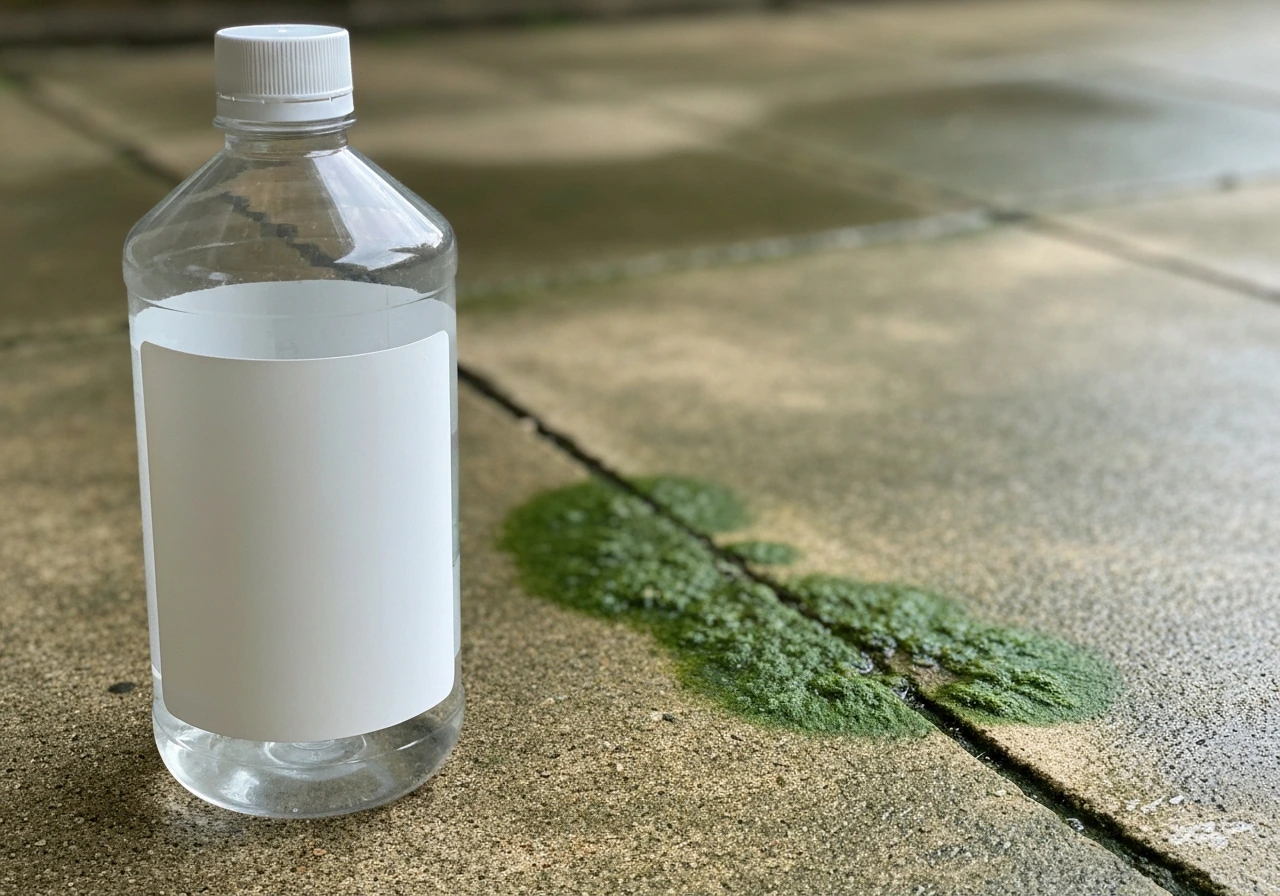
Household bleach is a water-based solution of sodium hypochlorite, typically sitting at around 5.25% to 6.15% concentration in most brands sold in the U.S. That active ingredient is what kills algae, mold spores, mildew, and bacteria on contact. It also breaks down the pigments in organic staining, which is why it's so effective on the green and black marks that build up on outdoor slabs over a wet season.
Bleach is genuinely the right choice when you're dealing with algae, green mold, black mildew, lichen, or general organic grime that won't shift with a brush and water alone. It works fast, costs almost nothing, and you don't need specialist equipment. I've found it handles these problems better than anything else at this price point.
But bleach has real limits you need to know before you start. It will not remove rust stains. Chlorine bleach actually has no effect on rust, and applying it to a rust stain can even set it further. It also won't lift oil or grease. For those problems, you need a different cleaner entirely. Bleach is also not ideal on every patio material, as covered below, so knowing what your slabs are made of matters before you mix anything.
Prep: protect plants, yourself, and the surrounding area first
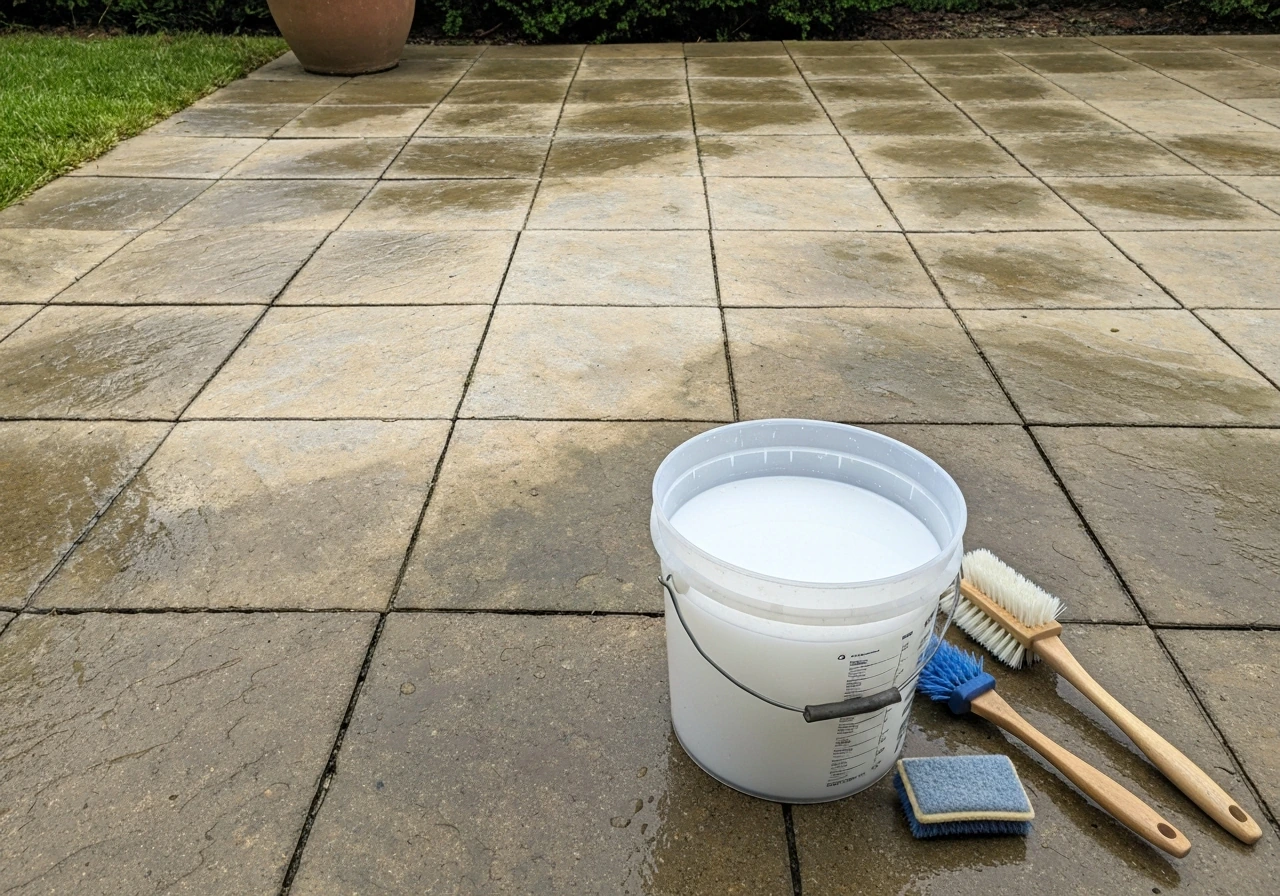
Good prep saves you from a lot of regret. Bleach is toxic to plants, and runoff into garden beds or lawn edges will kill or brown them fast. Before you do anything else, soak any nearby plants, grass, or borders with plain water. The existing moisture dilutes any bleach that reaches them and gives them a buffer. I also lay old towels or plastic sheeting along the edges of planting beds right next to the patio.
Keep children and pets off the patio while you're working and until the surface is fully rinsed and dry. Sodium hypochlorite fumes can irritate airways, and a dog walking through undiluted bleach solution will lick their paws. For your own protection, wear rubber or nitrile gloves, safety glasses, and old clothes you don't mind staining. Work in open air, and if you're using a sprayer, stand upwind.
One rule you cannot break: never mix bleach with ammonia or any acid-based cleaner. This combination creates chlorine gas, which has caused real poisoning incidents. If you've previously used any acid cleaner (including some stone cleaners or rust removers) on this patio, rinse the surface thoroughly before applying bleach and let it dry first.
Once your protection is in place, sweep or blow off all loose debris: leaves, dirt, and grit. Grit left on the surface will just absorb bleach without it reaching the stains underneath. Then pre-wet the entire patio with plain water from a hose. Pre-wetting serves two purposes: it stops the bleach from soaking into the slab surface too quickly (especially important on porous concrete), and it reduces the concentration at the edges so it's gentler on adjacent surfaces.
How to mix and apply bleach safely
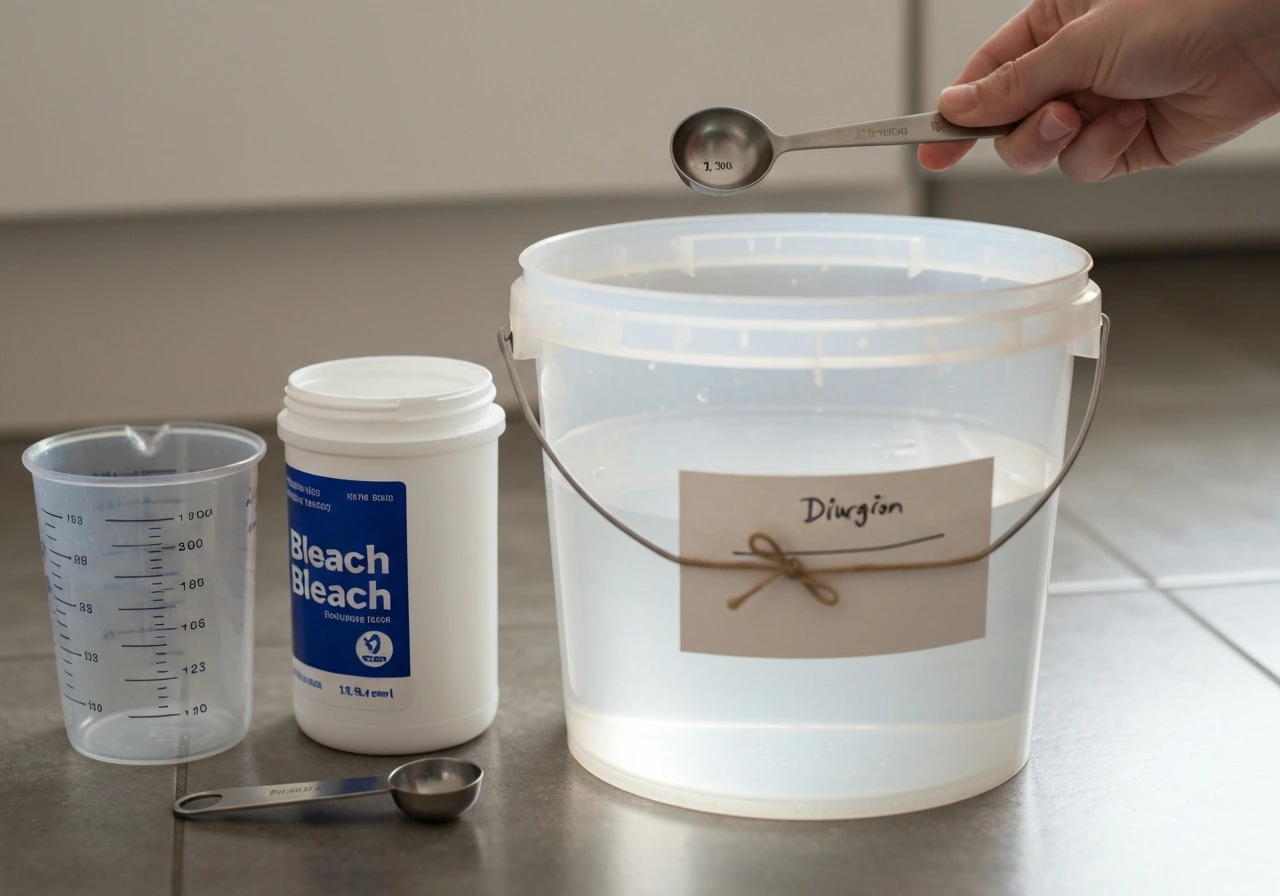
Getting the dilution right
The CDC's general dilution guidance is about 5 tablespoons (roughly one-third of a cup) of household bleach per gallon of room-temperature water. That gives you a working solution that's strong enough to kill mold and algae without being unnecessarily aggressive. For badly fouled concrete or thick algae buildup, you can go up to a 1:10 ratio (about 12 tablespoons per gallon), but start with the weaker mix and only step up if needed.
For badly fouled concrete or thick algae buildup, you can go up to a 1:10 ratio (about 12 tablespoons per gallon), but start with the weaker mix and only step up if needed.
If you’re wondering how to bleach patio surfaces safely, follow the dilution ratios, prep the area, and keep the patio wet during the dwell time. Always mix in a plastic bucket, not metal.
Never use hot water to mix bleach. Heat accelerates the breakdown of sodium hypochlorite and can increase fume production. Room temperature or cool water is what you want.
Brush or sprayer?
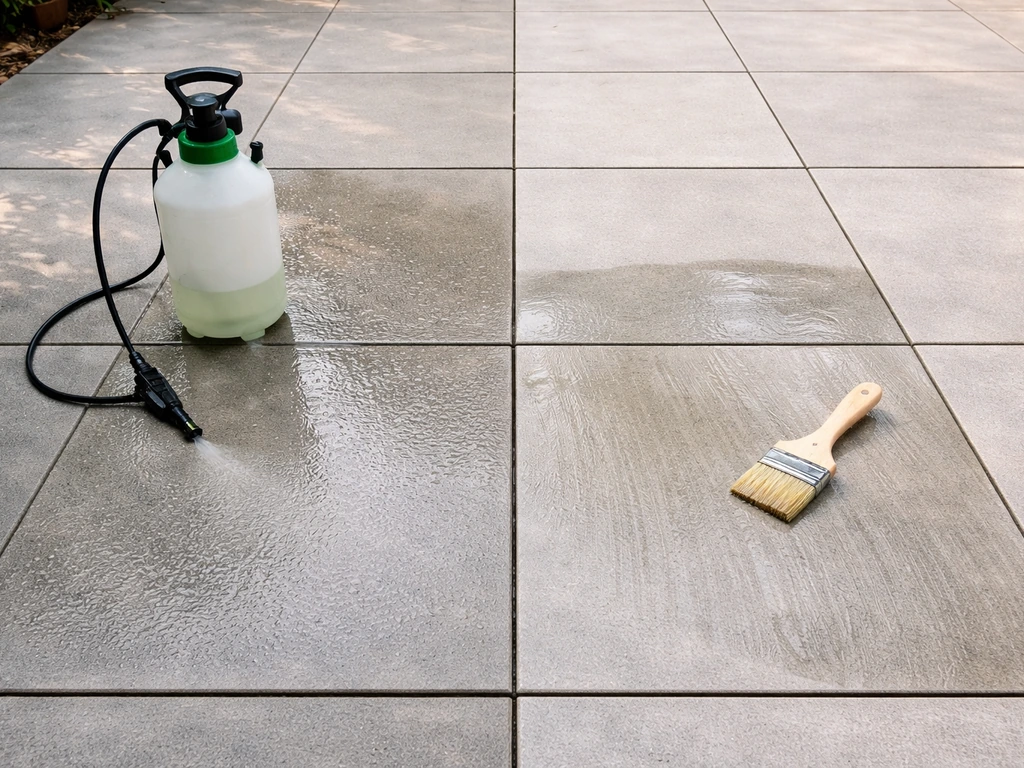
For most homeowners doing a section at a time, a plastic watering can or a brush-applied method works well and gives you good control. If you're covering a large patio, a garden pump sprayer speeds things up considerably. With a sprayer, apply the solution evenly, work in sections of about 2–3 square meters at a time, and don't let any section dry out before you rinse it. Dried bleach on a surface is harder to rinse clean and increases the risk of streaking.
Dwell time and agitation
The minimum dwell time is 1 minute for basic disinfection, but for killing mold and algae on outdoor surfaces, I'd give it at least 5 minutes. Keep the surface visibly wet throughout that time by reapplying if needed. After dwell time, scrub with a stiff-bristled deck brush or a hand brush for stubborn spots. This mechanical action breaks up the softened organic matter and gets the bleach into texture and surface pores. Then rinse thoroughly while the surface is still wet from the bleach solution.
Material-specific guidance: what you can and can't do
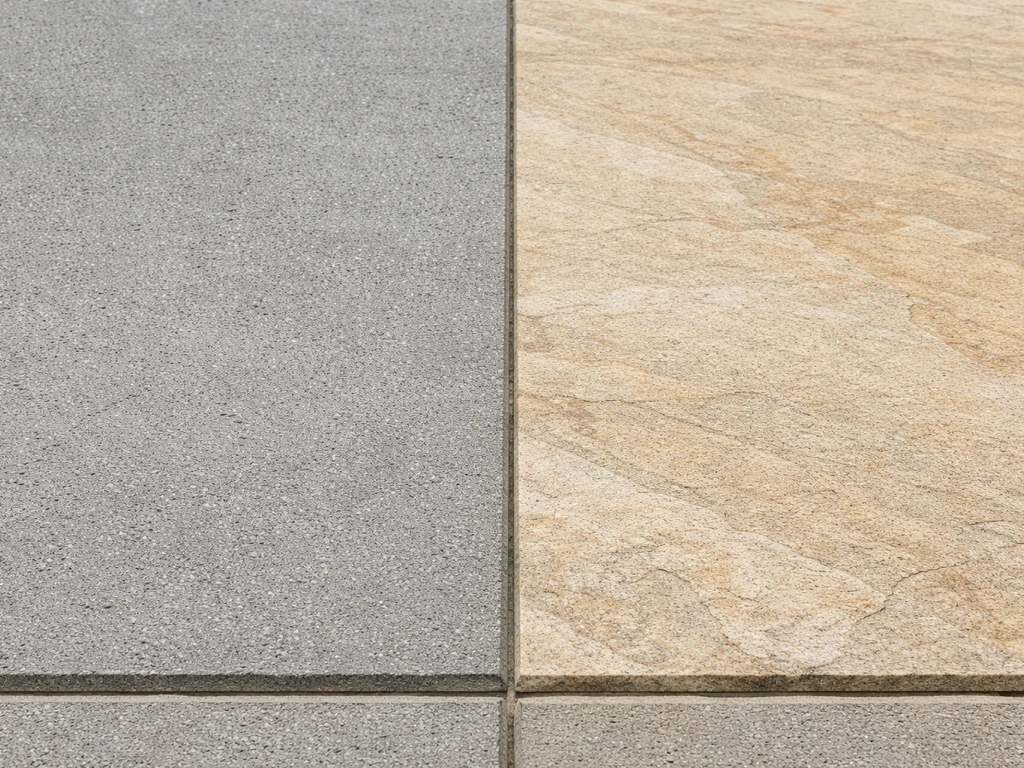
This is the section most guides skip, and it's the one that prevents you from damaging your patio. Different slab materials react differently to bleach, so your approach needs to match the surface.
| Material | Bleach Safe? | Recommended Dilution | Key Caution |
|---|---|---|---|
| Concrete | Yes | 1/3 cup per gallon (standard) up to 1:10 for heavy fouling | Pre-wet thoroughly; avoid letting solution pool and dry |
| Brick / Clay Pavers | Yes, with care | 1/3 cup per gallon; avoid stronger mixes | Can cause efflorescence or lighten mortar joints over time with repeated use |
| Concrete Pavers | Yes | 1/3 cup per gallon | Check jointing sand after cleaning; bleach can degrade organic polymeric sand |
| Natural Stone (sandstone, slate, flagstone) | Use very diluted or avoid | Highly diluted (1 tbsp per gallon) or switch to oxygen bleach | Bleach can discolour, etch, or strip sealers from natural stone |
| Travertine / Limestone | Avoid | Do not use chlorine bleach | Acid and bleach both etch calcium-based stone; use pH-neutral cleaner instead |
| Grout Lines | Yes, briefly | Standard 1/3 cup per gallon | Prolonged contact weakens grout over time; limit dwell time and rinse well |
Concrete slabs
Concrete is the most bleach-tolerant patio material, and this is where bleach really earns its place. The standard dilution works well for surface mold, algae, and grime. On textured or rough concrete, use a stiff brush to work the solution into the surface grain. You can also use a pressure washer on the rinse stage, which speeds things up significantly and clears out the loosened material from surface texture. If you do use a pressure washer, keep it at a moderate pressure (around 1,500–2,000 PSI) and a wide fan nozzle to avoid etching.
Brick and clay pavers
Brick and clay pavers handle the standard bleach dilution reasonably well for occasional cleaning, but repeated or concentrated applications will gradually lighten the mortar joints and can cause white salt deposits (efflorescence) to appear. Stick to the lower-end dilution, don't leave it sitting longer than 5–10 minutes, and rinse completely. If you're dealing with pavers specifically, it's worth checking out more targeted advice on cleaning patio pavers with bleach for how to handle the jointing material. You’ll also want to follow the right dilution and dwell time so you don’t damage mortar joints or finish check out more targeted advice on cleaning patio pavers with bleach.
Natural stone: sandstone, flagstone, and slate
Natural stone is where I'd urge real caution. Some sandstone and slate can handle a very diluted bleach solution applied briefly, but many natural stones are porous, sealed, or chemically sensitive in ways that chlorine bleach can damage. Bleach can strip sealers, cause uneven lightening, or react with mineral content in the stone. If your stone is sealed, bleach will likely degrade the sealer.
My honest recommendation: use oxygen bleach on natural stone unless you've tested the standard dilution on a completely hidden area first and seen no reaction after 24 hours. More detail on this material is covered in guidance specifically on cleaning patio stone with bleach. More detail on this material is covered in guidance specifically on cleaning patio stone with bleach.
Travertine and limestone: don't use bleach here
Travertine and limestone are calcium carbonate-based stones, and bleach (particularly if it has any acidic component, or if you inadvertently mix with another cleaner) will etch the surface and leave permanent dull marks. For these materials, use a pH-neutral stone cleaner or a very diluted oxygen bleach solution instead. The risk of permanent damage is just too high to justify standard chlorine bleach on these surfaces.
Grout lines
Bleach is effective at whitening and disinfecting grout, but repeated soaking breaks down grout over time. Apply it precisely to the grout lines rather than flooding the whole area, let it sit for no more than 5 minutes, scrub with a grout brush or an old toothbrush for detail work, then rinse thoroughly. This is particularly relevant if your slabs are set in a mortared pattern.
Tackling specific problems: algae, mold, mildew, and organic staining
Green algae and black algae
Green algae is the most common patio problem and also the most satisfying to fix with bleach. It visibly disappears within a few minutes of bleach contact. Apply the standard dilution to a pre-wetted surface, wait 5 minutes, and most green algae will have turned grey or white, meaning it's dead. Scrub with a stiff brush and rinse. Thick black algae (the darker, more stubborn type common in shaded corners) may need a second application or a slightly stronger 1:10 mix on concrete.
Mold and mildew
Black mold and mildew patches on patio slabs respond very well to bleach. The dwell time matters here: give the solution at least 5 minutes and keep it wet. For thick colonies in cracks or textured surfaces, scrub during the dwell time to break up the growth before rinsing. If mold keeps returning quickly (within weeks), you likely have a persistent moisture or shade issue and may want to apply a patio sealant after cleaning to reduce future colonisation.
Organic staining: leaf tannins, moss, lichen
Tannin stains from wet leaves, berry drops, or composting organic matter all respond to bleach because the active ingredient breaks down the organic pigment molecules. Apply to a wet surface, let it sit for 5–10 minutes, and scrub. Lichen (the crusty, flat growth that bonds tightly to stone and concrete) is tougher: it takes longer to respond and may need a second application after the first has dried and been rinsed away. For lichen on natural stone, switch to an oxygen bleach treatment rather than chlorine bleach.
General grime and weathering
General greying and surface grime on concrete slabs often comes from a combination of airborne particles, pollution, and biological growth. A thorough bleach wash followed by a pressure rinse makes an impressive difference here. Work in sections, keep the solution wet, and do your final rinse in the same direction each time to push loosened grime off the slab rather than redistributing it.
Rinsing, neutralising, and drying the right way
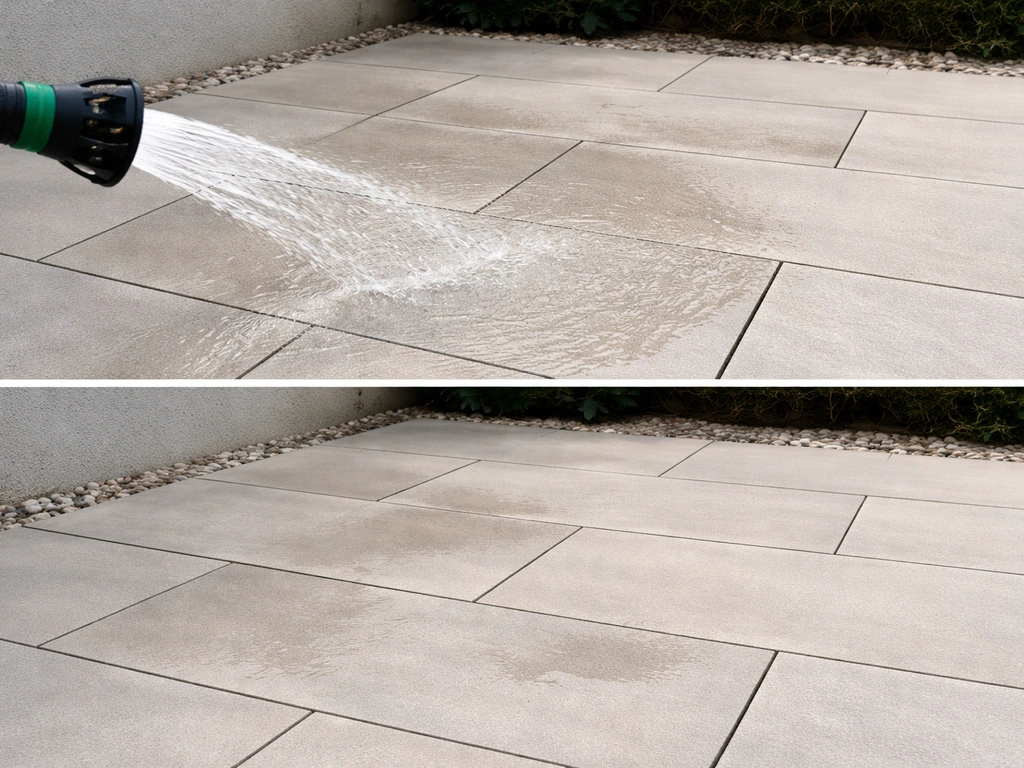
Thorough rinsing is not optional. Bleach residue left on the surface will continue to act, leading to patchy discolouration or white streaking as it dries. Rinse each section with plenty of clean water immediately after scrubbing, working from the top of any slope toward the drainage edge. If you're working on a flat patio, use a broom to push rinse water across and off the surface.
To neutralise any remaining bleach residue, especially on porous surfaces, you can apply a diluted baking soda solution (about 1 tablespoon per litre of water) after your final rinse, then rinse once more with plain water. This is optional on concrete but worth doing on brick or pavers where residue can contribute to efflorescence.
To avoid streaking, always rinse a section before the bleach solution dries on it. If you're working in direct sunlight or warm weather, work in smaller sections and reapply solution if needed to keep the surface wet until you rinse. Once rinsed, let the patio dry fully before walking on it with anything that could track bleach indoors.
After the patio is clean and dry (usually 24–48 hours), consider applying a patio sealer appropriate to your material. Sealing concrete and pavers significantly reduces future algae and mold growth by closing off the porous surface that organic matter colonises. It also makes future cleaning much faster.
When to skip bleach and what to use instead
There are situations where chlorine bleach isn't the right move, and it's better to know before you start than to find out after.
- You have rust stains: bleach won't touch these. Use an oxalic acid-based cleaner or a dedicated rust remover for outdoor stone and concrete.
- You have oil or grease stains: bleach won't lift these either. Use a degreaser or dish soap applied with a brush, or a specialist patio degreaser.
- Your slabs are travertine, limestone, or highly polished natural stone: switch to a pH-neutral stone cleaner or an oxygen bleach product (sodium percarbonate) instead.
- You have pets or children who regularly use the patio and you can't fully rinse: oxygen bleach (sodium percarbonate) is a safer alternative that degrades into water and oxygen and has much lower toxicity.
- The stain hasn't responded after two bleach applications: you're likely dealing with something bleach can't affect (mineral deposits, rust, oil). Stop and identify the stain type before trying again.
Oxygen bleach: the gentler alternative
Oxygen bleach (sold as sodium percarbonate powder, or in products like OxiClean Outdoor) works by releasing oxygen rather than chlorine. It's slower, typically needing 15–30 minutes of dwell time, but it's safer for natural stone, sealed surfaces, and nearby plants. Mix according to the product instructions (usually 1–2 scoops per litre of warm water), apply to a wet surface, scrub, and rinse. I use this by default on any natural stone or when I know the area drains directly into a planted border.
White vinegar: useful but limited
White vinegar (5% acetic acid) is a popular DIY alternative for mild mildew and surface grime on concrete. Apply undiluted, leave for 30–60 minutes, scrub, and rinse. It won't kill mold or algae as effectively as bleach, and it's too acidic for use on natural stone (it can etch limestone and travertine just like bleach can). But for readers who want to avoid any chlorine-based product entirely, it's a reasonable starting point for light maintenance cleaning on concrete or brick. Do not use vinegar directly before or after bleach, as mixing the two reduces the effectiveness of both.
A quick comparison
| Cleaner | Best For | Avoid On | Dwell Time | Pet/Plant Safety |
|---|---|---|---|---|
| Chlorine bleach (sodium hypochlorite) | Algae, mold, mildew on concrete/brick | Travertine, limestone, natural stone, sealed surfaces | 1–5 minutes | Low: keep pets/plants away until fully rinsed |
| Oxygen bleach (sodium percarbonate) | Organic stains, mold on most surfaces including stone | Polished marble | 15–30 minutes | Higher: safer around plants once diluted and rinsed |
| White vinegar (5% acetic acid) | Light mildew, surface grime on concrete/brick | Natural stone, travertine, limestone | 30–60 minutes | Low risk once rinsed; avoid contact with soil in high volume |
The bottom line: chlorine bleach is the fastest and most effective option for algae, mold, mildew, and organic staining on concrete and brick patio slabs. Use it with the right dilution, keep the surface wet during dwell time, protect everything nearby, and rinse it off completely. For natural stone or travertine, make oxygen bleach your default instead. Those two options cover the vast majority of patio cleaning problems you'll actually encounter.
FAQ
Can I clean patio slabs with bleach if my patio is sealed concrete or has a sealer already on it?
Be careful, bleach can degrade some sealers or leave dull patches. Do a spot test in a hidden area, after letting it dry fully for 24 hours. If the finish turns lighter or looks blotchy, switch to oxygen bleach or a pH-neutral cleaner designed for sealed surfaces.
What if it keeps growing back, can I bleach it again the next weekend?
You can re-clean, but repeated chlorine treatments won’t fix the root cause if shade and moisture persist. If algae or mold returns within a few weeks, address drainage, improve airflow (trim plants), and consider applying a patio sealant after the surface is completely dry.
Is it safe to use bleach on painted concrete, stamped concrete, or concrete with a coating?
Chlorine bleach can strip pigments and damage coatings, even when concrete itself tolerates it. Treat these like “not bleach safe” until you spot-test. Apply the weaker dilution to a small hidden patch, keep dwell time short, then rinse thoroughly and check for discoloration or tackiness after drying.
How do I handle bleach around nearby plants if my patio drains toward my garden bed?
The safest approach is to block the flow before you start, for example using plastic sheeting to redirect rinse water and runoff away from beds. Water the plants first as described, but assume some runoff will still occur, especially during rinsing and during heavy dwell-time rewetting.
Can I use pool bleach or bleach with a higher concentration (like “concentrated” household bleach) in the same way?
Only if the product is similar in strength and you adjust the dilution. Pool and splashless concentrates may be far stronger or contain additives. Confirm the sodium hypochlorite percentage on the label and scale the dilution so you do not exceed the intended strength.
Should I apply bleach with a sprayer or brush, and how do I prevent streaks?
Brush or watering can gives better control on small areas and reduces uneven coverage. For sprayers, apply evenly and rinse each section immediately after the dwell time, working consistently from the top of a slope toward the drain. Streaking usually happens when patches dry while you are still treating other areas.
Can I use a pressure washer for the bleach step or only for rinsing?
Use it for rinsing, not for applying bleach. Blasting bleach into cracks can spread contamination and increase runoff. Keep the washer at moderate pressure with a wide fan on rinse, then follow with a final rinse to remove loosened residue.
Does bleach remove efflorescence or white salt deposits on pavers?
Not reliably. Efflorescence is salt coming from moisture and mortar, and repeated bleach can sometimes worsen it by changing how residue accumulates. If you see persistent white deposits, focus on correcting moisture, use lower bleach strength if you must clean, rinse thoroughly, and wait to see if it recurs before sealing.
How soon can I let kids and pets back on the patio after using bleach?
Wait until the surface is fully rinsed and dry, and ideally until it is no longer wet enough to transfer residue. If bleach smell remains strongly, re-rinse with plain water and give it more time to dry before allowing contact or barefoot use.
What’s the safest way to test whether my patio material can handle chlorine bleach?
Pick a hidden 1 by 1 foot area (or similar), pre-wet, apply the standard dilution, keep dwell time on the low end (about 1 to 5 minutes), scrub lightly, and rinse well. Wait 24 hours and check for lightening, dull patches, surface softening, or changes around joints before treating the full patio.
Can I use bleach to remove rust stains on patio slabs?
No, chlorine bleach generally won’t remove rust and can make the stain more set. If rust is the issue, use a rust-specific remover instead, then avoid bleach afterward on that area until you have thoroughly rinsed and dried.
Next Articles
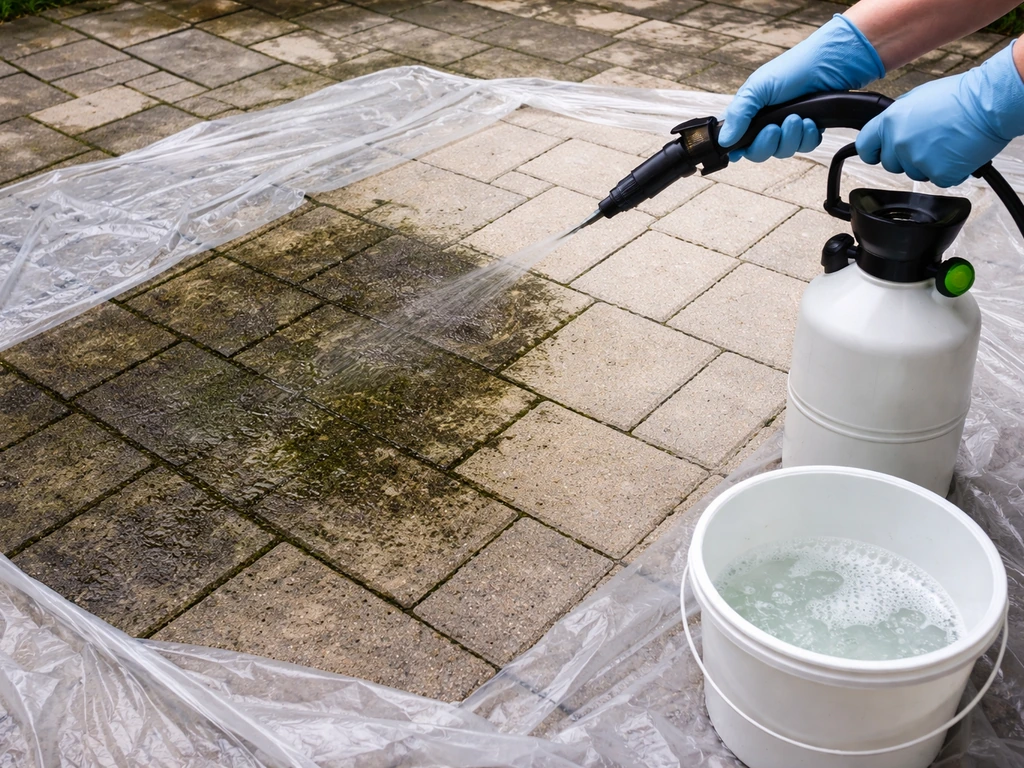
How to Bleach a Patio Safely: Step-by-Step Guide
Step-by-step how to bleach a patio safely, remove mold and algae, and avoid damage on concrete, brick, pavers, and trave
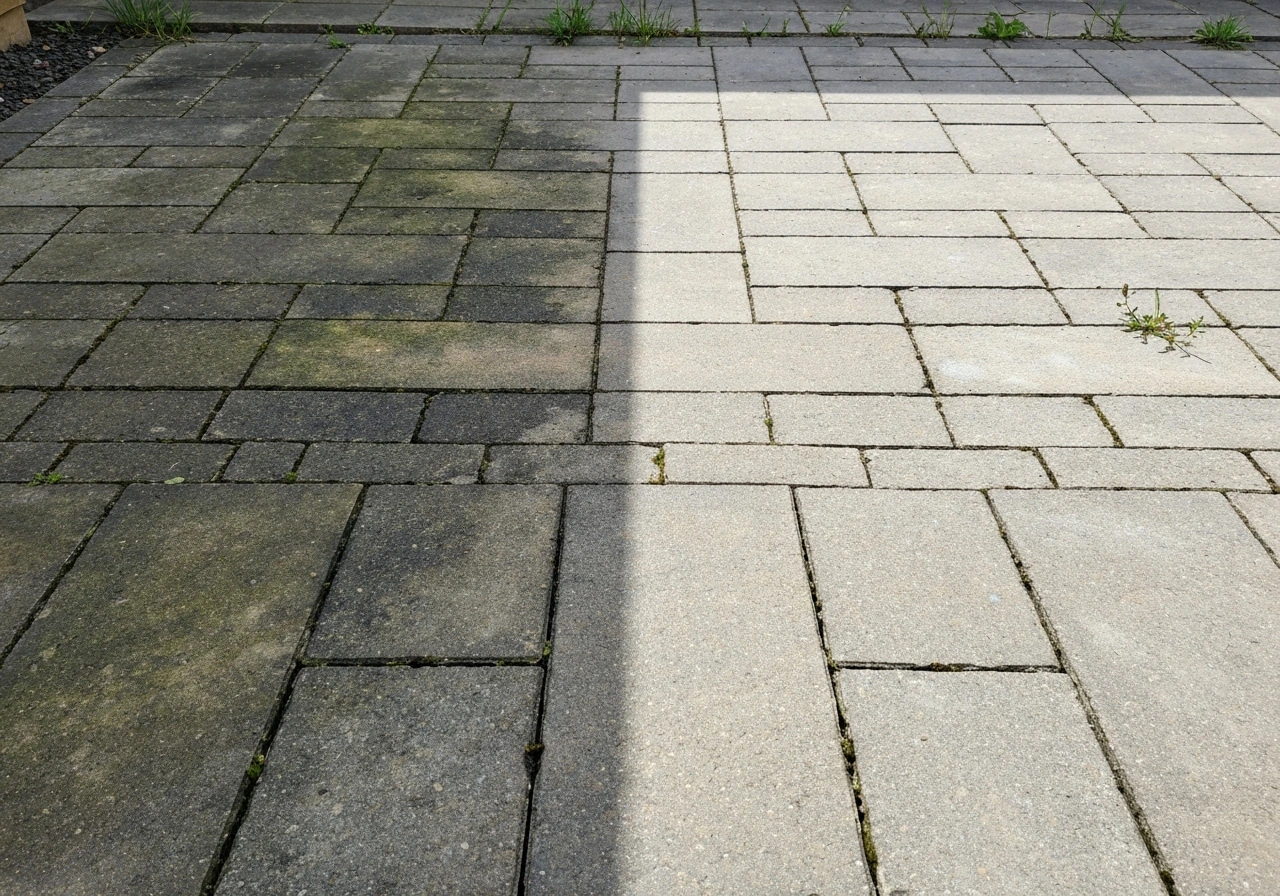
How to Clean Patio Stone With Bleach Step by Step
Step-by-step bleach cleaning for patio stones, including dilution, scrubbing, rinsing, safety, and when to avoid bleach.
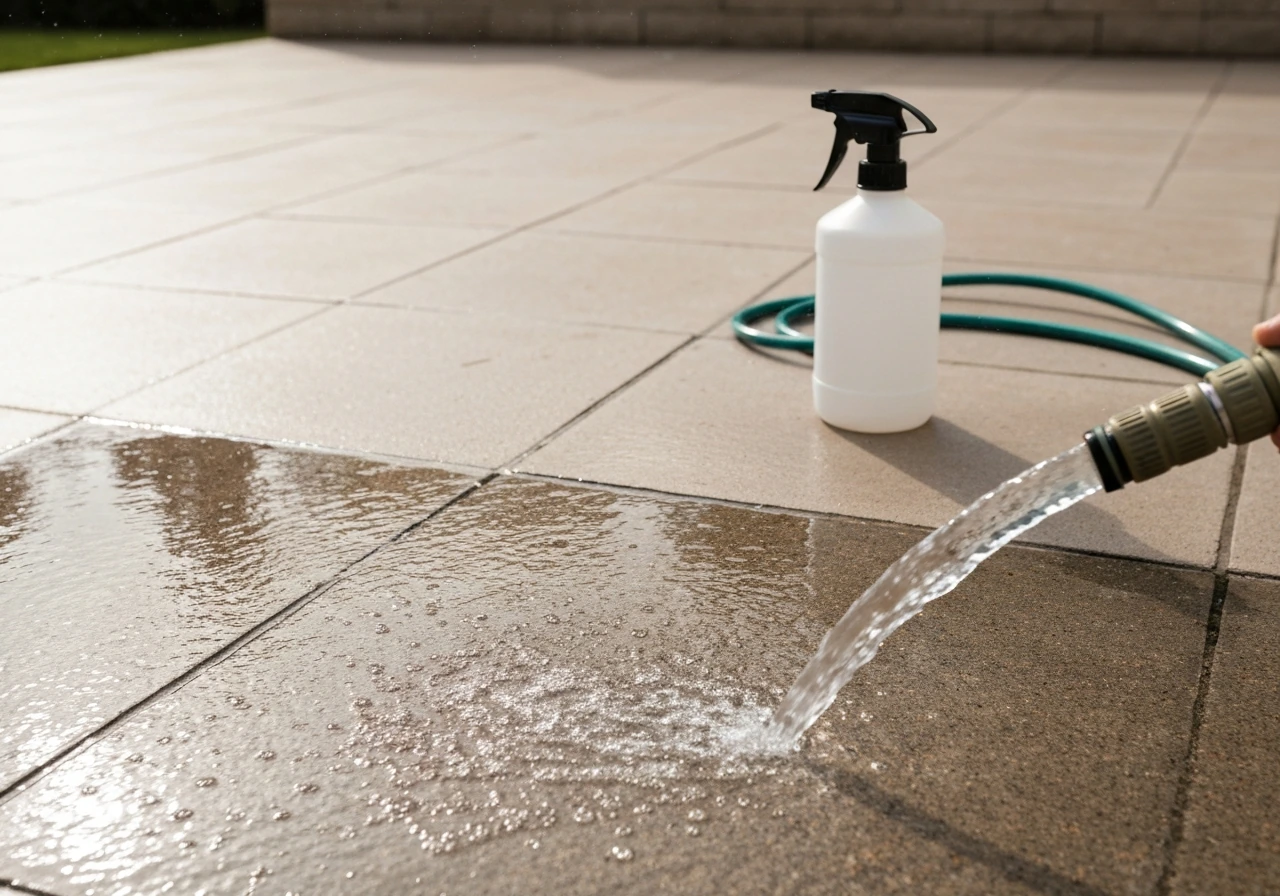
How Long to Leave Bleach on a Patio for Cleaning
Get exact bleach contact times for patio mold and stains, with safe dilution, rinse steps, and alternatives to prevent d