Muriatic acid (hydrochloric acid) works fast on concrete patios when you're dealing with efflorescence, mortar smear, lime deposits, or whitewash residue. Mix it at a 1:10 ratio (one part acid to ten parts water), pre-wet the surface, apply the solution, wait for the fizzing to stop, then immediately neutralize with a baking-soda-and-water solution and rinse thoroughly. That's the core process. But getting it right, and doing it safely, requires some preparation that's worth doing properly.
How to Apply Muriatic Acid to Concrete Patio: Safety Guide
Dylan Hale
16 Jul 2026
When to reach for muriatic acid (and when to skip it)
I want to be upfront: muriatic acid is not a first response for every dirty patio. It's a specialist tool for mineral-based problems. Before you open that yellow jug, it helps to match the stain to the right cleaner, because using acid on the wrong problem wastes your time and introduces unnecessary risk.
| Problem | Best first choice | Does muriatic acid help? |
|---|---|---|
| Efflorescence (white chalky crust) | Muriatic acid (diluted) | Yes, primary use case |
| Mortar smear or laitance | Muriatic acid (diluted) | Yes, dissolves mineral binder |
| Lime or whitewash residue | Muriatic acid (diluted) | Yes, reacts with calcium compounds |
| Light rust staining | Oxalic or phosphoric acid rust remover | Partial; dedicated rust removers work better |
| Algae, mold, mildew | Sodium hypochlorite (bleach) or oxygen bleach | No, acid does not kill biological growth |
| Grease or oil | Degreaser + hot water | No, acid does not break down hydrocarbons |
| General grime and dirt | Pressure washer or oxygen bleach | Overkill; try gentler options first |
| Concrete etching before sealer/coating | Muriatic acid (diluted) | Yes, opens concrete pores |
For algae and biological growth, I've had much better results starting with a diluted bleach or sodium percarbonate (oxygen bleach) solution and a stiff brush. For step-by-step guidance on using household bleach effectively on brick patios, see how to clean brick patio with bleach. Acids react with mineral deposits; they don't kill organisms or lift oils. If the patio has a mix of problems, tackle the biological growth first, let it dry, then address any mineral staining with acid. And if your concrete is already sealed, peeling, or coated, test a hidden spot before doing anything else, because acid will strip coatings. For step-by-step guidance on how to get rid of algae on a brick patio, see our guide on how to get rid of algae on brick patio.
Safety first: PPE, ventilation, and acid-handling rules
Muriatic acid sold at hardware stores typically contains 10 to 30 percent hydrochloric acid (HCl). That range is enough to cause severe skin burns, permanent eye damage, and respiratory irritation from fumes alone. NIOSH and OSHA both set a ceiling exposure limit of 5 ppm for hydrogen chloride gas, which even a briefly open bottle outdoors can approach in your breathing zone. Take this seriously.
Required PPE checklist
- Splash goggles (not safety glasses, which have open sides): acid splashing into unprotected eyes can cause permanent damage
- Full face shield over the goggles for added protection when pouring or mixing
- Chemical-resistant gloves: neoprene, butyl rubber, or heavy-duty PVC/nitrile; check the manufacturer's compatibility chart for HCl before buying
- Long-sleeve shirt, long pants, and rubber boots: if acid soaks through cotton clothing to skin, the exposure is ongoing until you remove the clothing
- NIOSH-approved acid-gas respirator cartridges (such as 3M 6002 acid-gas cartridges, or a combined acid-gas/P100 type) if you are working in an enclosed or partially enclosed space, or if you feel any throat irritation outdoors
For outdoor patio work on a calm day, fresh air usually keeps fume levels manageable, but I still wear a half-face respirator as a habit. If you feel any burning in your throat or nose, stop immediately, move upwind, and give the area at least 10 to 15 minutes to air out before returning. Work on days with light, steady breeze, never in still, humid conditions that let vapors pool at ground level. Avoid working in direct hot sun, which increases fuming.
Everything you'll need before you start
- Muriatic acid (standard hardware-store product, 10–30% HCl)
- Two plastic buckets (5-gallon capacity): one for mixing the acid solution, one for the baking-soda neutralizer
- Garden hose with a strong flow, or a pressure washer (if available)
- Acid-resistant plastic or nylon scrub brush (never metal bristles: acid reacts with metal and can leave rust streaks on the concrete)
- Plastic watering can or low-pressure garden sprayer rated for acids (check the product label)
- Baking soda (sodium bicarbonate): plan on at least 1 lb (approximately 454 g) per 5 gallons of water for the neutralizer
- pH test strips (pool test strips work fine): to confirm the concrete surface is neutralized before rinsing stops
- Chemical-resistant PPE as listed above
- Old plastic sheeting or tarps for plant and fixture protection
- Painter's tape and plastic bags for protecting metal fixtures or drains you cannot move
- Permanent marker: to mark your test patch area
Preparing the patio and everything around it
Preparation is where most DIY acid jobs go wrong. Acid runoff will damage plants, stain adjacent brick or stone (if you have nearby brick work, be extra careful, because acid can etch mortar joints and cause staining), and corrode metal furniture legs, drain grates, and downspout extensions. If you're unsure whether acid is safe for nearby brickwork, see a guide on how to clean a brick patio with vinegar for a gentler alternative. For step-by-step instructions specific to brick surfaces, see how to clean brick patio with muriatic acid. Spend 15 minutes on prep and you'll avoid several hours of follow-up problem-solving.
- Clear the patio completely: remove all furniture, planters, rugs, grills, and toys. Acid mist travels farther than you expect.
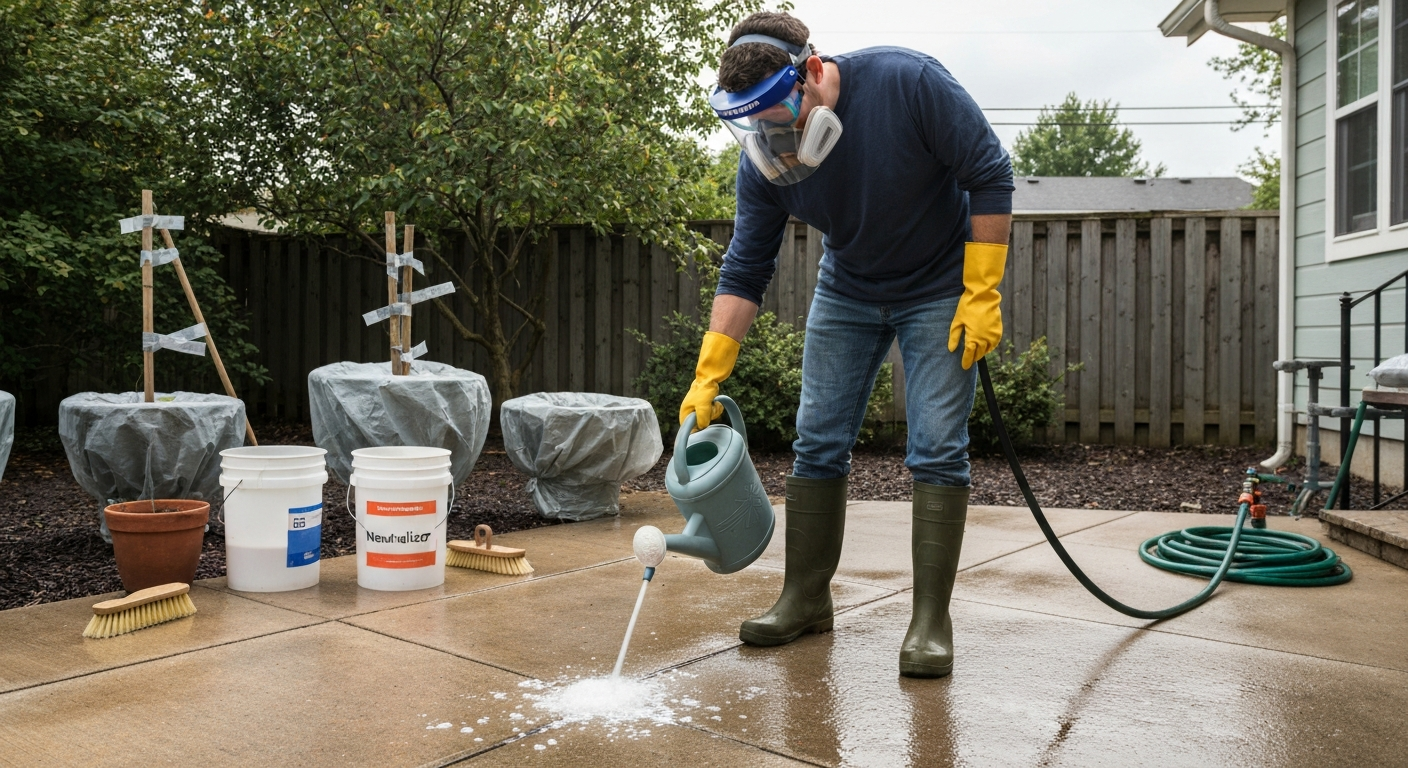
- Move potted plants at least 10 feet away, or cover them with plastic sheeting secured at the base so runoff cannot reach the soil.
- Wet any plants, grass, or garden beds immediately adjacent to the patio with plain water before you start. Diluting the soil before any acid runoff arrives reduces damage.
- Cover or block nearby floor drains with a folded wet rag or a drain plug if your local code and situation allow. Many municipalities prohibit acid runoff from entering storm drains; check local regulations before you start, and plan to neutralize thoroughly so nothing acidic reaches the drain.
- Tape plastic bags or wrap metal fixtures, downspout bases, and any aluminum or iron edging that you cannot move. HCl reacts aggressively with most metals.
- If the patio is adjacent to brick or natural stone surfaces (a garden wall, a step edge, or a brick border), apply a thin layer of petroleum jelly or mask them with plastic sheeting. Acid does not distinguish between the patio concrete and the mortar in your garden wall.
- Pre-wet the entire patio surface with plain water. This slows the acid's penetration, reduces fuming on contact, and prevents the dry concrete from absorbing the solution unevenly.
Always do a spot test first
I never skip the spot test, even on patios I've worked on before. Concrete mix designs vary, some have colorants or surface treatments, and older slabs can have repaired sections that react differently. A spot test takes five minutes and tells you a lot.
- Choose a small, inconspicuous area about 1 square foot, ideally near a corner or edge that won't be prominently visible.
- Mix a small test batch at your intended dilution ratio (start at 1: 10 acid to water) in a plastic cup.
- Apply a small amount to the wet surface and watch for 2 to 3 minutes. You should see mild fizzing where the acid contacts mineral deposits, which is normal and expected.
- Look for signs of excessive pitting, deep etching, color change (unexpected darkening or whitening beyond the mineral deposit area), or rapid, aggressive bubbling. These are signs to dilute further or consider a gentler product.
- After the test, pour your baking-soda neutralizer on the spot, wait for fizzing to stop, rinse with water, and check the pH with test strips. Aim for a pH of 7 or slightly above before proceeding.
- If the surface looks good and the pH neutralizes cleanly, you're ready to move to the full application.
Mixing the acid solution: ratios, dilutions, and the one rule you can't break
The one rule: always add acid to water, never water to acid. Pouring water onto concentrated acid causes a violent exothermic reaction that can splash hot, corrosive liquid. Fill the bucket with water first, then slowly pour the acid into it while stirring gently with a plastic stick. Do this while wearing full PPE and with your face well away from the bucket.
| Cleaning task | Dilution ratio (acid:water) | Approx. HCl in mix | Notes |
|---|---|---|---|
| Light efflorescence, pre-coat etching | 1:10 | ~1–3% HCl | Good starting point for most DIY jobs; the standard industry recommendation |
| Moderate efflorescence, mortar smear | 1:6 to 1:8 | ~2–4% HCl | Use only after confirming 1:10 is insufficient on a spot test |
| Heavy lime/whitewash deposits, stubborn laitance | 1:3 to 1:4 | ~4–8% HCl | Use with extra caution; increase ventilation, apply in small sections |
For most homeowners cleaning a typical concrete patio with efflorescence or mortar residue, the 1:10 ratio handles the job without excessive surface attack. Moving to a stronger mix should be a deliberate decision based on spot test results, not a shortcut. Stronger mixes increase fuming, risk of pitting, and the amount of neutralizer needed.
Step-by-step: applying muriatic acid to your concrete patio
Work in sections of roughly 10 to 20 square feet at a time, especially on your first attempt. Smaller sections are easier to control, rinse completely, and neutralize before the acid dries into the surface. On a warm, dry day, the solution can start drying faster than you expect.
- Pre-wet the section you're about to treat with plain water from your garden hose until the surface is uniformly damp. Don't leave puddles, just visibly wet concrete.
- Put on all your PPE before opening the acid container. Gloves, goggles, face shield, long clothing, boots. Do this before you need it.
- Pour or apply the pre-mixed acid solution (in water, at your chosen dilution) using a plastic watering can or a low-pressure garden sprayer rated for acids. Apply evenly across the wet section. Do not use a high-pressure sprayer; it creates acid mist.
- Watch for fizzing. Gentle bubbling is the acid reacting with calcium carbonates and mineral deposits, which is what you want. Heavy, dramatic bubbling on clean concrete means you may be going too strong.
- Allow the solution to dwell on the surface for 3 to 5 minutes, or until the fizzing largely subsides. Do not let it dry. If it starts to dry before the fizzing stops, mist it lightly with water to keep it active and wet.
- Scrub with your acid-resistant nylon or plastic brush. For stubborn efflorescence or mortar smear, firm circular scrubbing helps lift the dissolved material. Avoid metal brushes.
- Do not leave the acid sitting for more than 5 to 10 minutes. Once the fizzing has stopped and you've scrubbed, move immediately to neutralization. Prolonged contact risks surface pitting.
- Move to the next section only after you've neutralized and done a preliminary rinse of the previous one. Work systematically across the patio so no section is left with active acid while you're distracted.
Neutralizing and rinsing: the step you cannot rush
Neutralizing the acid before the final rinse is not optional. Residual HCl in the concrete surface will continue to react with the cement paste, weaken the surface over time, and lower the pH of your drain and soil runoff. The chemistry is straightforward: baking soda (sodium bicarbonate) reacts with hydrochloric acid to produce table salt, carbon dioxide (the bubbling you'll see), and water. Sodium bicarbonate neutralizes hydrochloric acid in a 1:1 mole ratio (NaHCO3 + HCl → NaCl + CO2 + H2O), which you can use to estimate required baking‑soda mass; see PubChem, Sodium Bicarbonate (reaction with HCl, reference data) PubChem — Sodium Bicarbonate (reaction with HCl, reference data).
Baking-soda neutralizer recipe
- For large-area work: dissolve approximately 1 lb (454 g) of baking soda into 5 gallons (19 L) of water in a plastic bucket.
- For spot work or small sections: use approximately 1 cup of baking soda per 1 gallon of water.
- Mix until the baking soda is fully dissolved before applying.
- Apply the baking-soda solution generously over the treated section while the acid is still wet. You will immediately see fizzing and bubbling as neutralization occurs.
- Spread the solution with a broom or brush to make sure it contacts the entire treated area.
- Wait until the fizzing completely stops. Once there's no more bubbling, the acid in that area has been neutralized.
- Rinse the section thoroughly with a strong flow from your garden hose (or pressure washer if you have one). Flush toward a drain or permeable area that won't pool, and direct runoff away from plants and storm drains.
- Test the surface and the runoff water with pH test strips. You're looking for a reading of 7 (neutral) or slightly above. A reading below 6 means you need more baking-soda solution and another rinse cycle.
- Once the pH tests neutral, do a final heavy rinse to flush any residual salt (sodium chloride is the byproduct of neutralization) from the surface.
- Repeat the neutralize-and-rinse process for each section before moving on.
On a full patio job, I typically prepare two full 5-gallon buckets of baking-soda solution before I start. Running out of neutralizer mid-job while acid is active on the concrete is a situation you want to avoid entirely.
Stain-specific approaches: mortar residue, rust, algae, and whitewash
Mortar residue and laitance
Muriatic acid is one of the most effective tools for removing mortar smear or cement laitance (that cloudy, hazy film left by fresh concrete work). The 1:10 dilution and a firm scrub is often enough for fresh residue. For cured mortar that has been sitting for weeks or months, I move to a 1:6 ratio and give it slightly longer dwell time, watching carefully for any aggressive pitting in the base concrete. Spot-test first, especially on older slabs.
Rust stains
Muriatic acid will remove rust stains, but it is not the best tool for the job. Oxalic acid or phosphoric acid-based rust removers work more selectively on iron oxide without attacking the concrete surface as aggressively. I use commercial masonry rust removers (most are oxalic or phosphoric acid-based) first, following the manufacturer's dwell time and rinse instructions. If the stain persists after two treatments, then I consider a very dilute muriatic acid application as a last resort.
Algae, mold, and biological growth
Acid does not kill algae or mold; it just moves it around. For biological growth on a concrete patio, start with a sodium hypochlorite solution (1 cup of household bleach per gallon of water as a starting point) or an oxygen bleach (sodium percarbonate) product. UMass Extension, sodium carbonate peroxyhydrate and bleach guidance for algae control recommends chlorine (sodium hypochlorite) or sodium‑carbonate‑peroxyhydrate (oxygen bleach) treatments, applied at proper dilution with sufficient contact time and thorough rinsing, as first‑line options for algae, mold, and biological growth on exterior concrete UMass Extension — sodium carbonate peroxyhydrate and bleach guidance for algae control. Apply, let it dwell for 10 to 15 minutes, scrub, and rinse. This kills the organisms at the root. If you treat algae with acid first, you risk etching the surface and leaving a rough texture that actually attracts more biological growth in future seasons.
Lime and whitewash deposits
Lime and whitewash are calcium-based and react directly with hydrochloric acid, making muriatic acid an effective removal tool. Start at 1:10 and work in small sections, since thick whitewash deposits produce aggressive fizzing and consume the acid solution quickly. You may need to apply two rounds in heavily coated areas. Between applications, neutralize, rinse, and let the surface dry briefly before reapplying.
Disposal, post-cleaning care, and sealing
Leftover acid disposal
Do not pour leftover muriatic acid solution down a household drain or storm drain. The SDS for retail products like Klean-Strip Green Muriatic Acid explicitly states disposal must comply with local, state, and federal regulations. Contact your municipal hazardous waste disposal program; most areas have drop-off days for household hazardous materials. If you have a very small amount of heavily diluted, neutralized solution (pH-tested to 7 or above and confirmed neutral), check with your local water authority about drain disposal, but when in doubt, treat it as hazardous waste.
Sealing after acid washing
Acid washing opens the pores of the concrete surface, which is actually ideal if you plan to apply a sealer or decorative coating: the coating bonds better to an etched surface. Wait at least 24 hours after the final rinse and pH confirmation before applying any sealer, and confirm the surface is fully dry. Applying sealer to damp or still-acidic concrete will cause adhesion failure. If the patio is for general use without a coating, sealing with a penetrating concrete sealer is still a good idea after acid washing, since the opened pores will absorb water and contaminants more readily until sealed.
Repeat treatments
Efflorescence in particular tends to recur because it's driven by moisture moving through the slab and bringing dissolved salts to the surface. Acid washing removes the visible deposit but does not fix the underlying moisture issue. If you clean the same white crust off your patio every season, the long-term fix is addressing the source of moisture intrusion, whether that's grading, drainage, or a missing vapor barrier under the slab. A single acid wash followed by a good penetrating sealer often slows the recurrence significantly.
Renter-friendly options and working without specialty equipment
You do not need a pressure washer to acid-wash a concrete patio. A strong garden hose with a pistol-grip nozzle set to a jet or fan spray setting delivers enough water volume to rinse effectively. The critical thing is water volume and coverage, not pressure. I've done full patio jobs with nothing but a hose, a watering can, a scrub brush, and two 5-gallon buckets. The process takes a little longer without a pressure washer, but the results are the same.
If you're a renter, check your lease before using muriatic acid. Some rental agreements prohibit chemical treatments to outdoor surfaces, and any damage caused by improper application could come back to you. A safer starting point for renters is oxygen bleach (sodium percarbonate powder dissolved in water), which handles biological growth and light mineral deposits without the legal and safety complexity of mineral acids. If the concrete genuinely needs acid treatment and your landlord approves it, have the conversation in writing first.
Troubleshooting common outcomes
| What you're seeing | Likely cause | What to do |
|---|---|---|
| Stain is still there after treatment | Stain is not mineral-based (could be organic, oil, or rust) | Identify stain type; try bleach for biological, rust remover for rust, degreaser for oil |
| Surface looks pitted or rough after washing | Acid was too strong, left too long, or surface was dry when applied | Neutralize and rinse thoroughly; consider a skim coat or reseal; dilute more on future applications |
| White haze returned within weeks | Efflorescence from ongoing moisture movement through slab | Address moisture source; apply penetrating sealer after next cleaning |
| Metal fixtures or furniture legs have new rust spots | Acid mist or runoff contacted metal | Remove rust with oxalic acid remover; protect metal fixtures before future acid applications |
| Runoff killed nearby plants | Acid solution reached plant roots | Drench affected soil with baking-soda solution and water; in future, pre-soak soil and use plastic sheeting barriers |
| Fizzing is very aggressive and instant on clean concrete | Dilution is too strong for this surface | Dilute further; the reaction should be mild and focused on visible mineral deposits, not the clean concrete itself |
When to consider a gentler acid or call a professional
Sulfamic acid and phosphoric acid-based masonry cleaners are commercially available alternatives to unbuffered muriatic acid. They are formulated to reduce fuming, are less aggressive on surrounding metals and plants, and still dissolve efflorescence and mortar residue effectively. I use them as my first choice when the patio is adjacent to a garden or when I'm working in a space with limited airflow. They cost more per treatment than muriatic acid but offer meaningful safety advantages.
Call a professional if the concrete shows signs of structural damage (cracks, spalling, or crumbling edges), if efflorescence covers the entire slab heavily and repeatedly returns, or if you're dealing with a large commercial area. Professionals have industrial-grade neutralization and containment setups for high-volume jobs, and they can identify whether the problem is surface-level or a sign of deeper concrete deterioration that acid washing won't fix.
FAQ
When should I choose muriatic (hydrochloric) acid to clean a concrete patio versus gentler alternatives?
Choose diluted muriatic acid only for mineral problems: efflorescence (white salt deposits), mortar smear/laitance, heavy lime/whitewash buildup, or when light etching is needed before sealing. Avoid acid for organic stains or biological growth (algae, moss, mildew) — use bleach/oxygen‑bleach or a biocide and scrubbing or pressure washing instead. Always try gentler options (soap and water, mechanical scraping, pressure washing, specialty masonry cleaners such as sulfamic/phosphoric‑based products) and perform a small spot test first.
What PPE and tools do I need to use muriatic acid safely as a homeowner or renter?
Required PPE: chemical splash goggles or face shield, acid‑resistant gloves (neoprene/butyl/PVC recommended), long sleeves and pants, rubber boots, and an apron if possible. Have a supply of clean water nearby for flushing, and consider an NIOSH‑approved acid‑gas respirator with appropriate cartridges if fumes are noticeable (be aware respirator programs and fit testing apply in workplaces). Tools: plastic watering can or low‑pressure plastic pump sprayer, plastic or acid‑resistant mixing container (never metal), stiff nylon or natural‑fiber brush, baking soda for neutralizing, garden hose or pressure washer for rinsing, pH test strips or meter for runoff check, and plastic sheeting/tape to protect plants and nearby surfaces.
What dilution ratios are recommended for DIY patio acid‑washing?
A common starting dilution is 1 part muriatic acid to 10 parts water (1:10) for light efflorescence or mortar residue. For light etching or very mild deposits, weaker mixes such as 1:20 may be sufficient. Stronger mixes (1:5 or higher concentration) are for heavy buildup but increase risk of damage, staining, and fuming — avoid unless experienced. Always err on the weaker side and perform a spot test.
What is the correct procedure for mixing muriatic acid safely?
Always add acid to water — never add water to acid. In a well‑ventilated outdoor area, pour the measured water into a plastic container, then slowly add the acid while stirring gently with a plastic or wooden stick. Mix only the quantity you will use within a short time; keep children and pets away; never mix with bleach, ammonia, or other household chemicals.
Step‑by‑step: how do I apply the acid to a concrete patio?
1) Clear the area of furniture and cover/shiftable items; protect plants, metal, wood, and nearby masonry with plastic sheeting. 2) Pre‑wet the concrete with plain water to reduce deep penetration. 3) Do a small inconspicuous spot test using the chosen dilution and wait to evaluate color change and damage. 4) Wearing PPE, apply the acid solution with a plastic watering can or low‑pressure sprayer in a controlled manner — avoid splashing. 5) Let it react briefly; you’ll see fizzing where it dissolves deposits. Do NOT let it dry on the surface. 6) When fizzing slows or after the specified dwell time (usually a few minutes), immediately apply a baking‑soda neutralizer solution until fizzing stops. 7) Rinse thoroughly with lots of water or a pressure washer to remove residue. 8) Repeat spot treatment only if necessary after surface dries and you re‑evaluate.
How do I neutralize and rinse after using muriatic acid?
Neutralize with a sodium bicarbonate (baking soda) solution — common DIY ratio is about 1 lb (≈454 g) per 5 gallons (≈19 L) of water (or ~1 cup per gallon for small jobs). Apply the neutralizer until fizzing stops; this indicates neutralization. Then rinse thoroughly with copious water (use a pressure washer or hose) until pH test strips on runoff read near neutral (pH ~6–8). Collect runoff where possible and avoid sending concentrated acidic or neutralizer wastes into sensitive drains or storm sewers per local regulations.
Next Articles
How to Whitewash Brick Patio: Step-by-Step Guide
Step-by-step how to whitewash a brick patio, prep, apply lime-style or tinted mixes, fix blotches, and seal for lasting
How to Get Rid of Algae on a Brick Patio Safely
Step-by-step safe ways to remove algae from a brick patio, from scrubbing and vinegar to bleach or oxygen and pressure w
How to Remove Thompson’s Patio Sealer Step by Step
Step-by-step removal of Thompson’s patio sealer on concrete, brick, pavers, and stone, with safety, tests, and cleanup.