Leaf stains on patio pavers are almost always organic, caused by tannins, sap, and decomposing leaf matter sitting wet on the surface. The good news is that most of them lift completely with an oxygen bleach solution and a stiff scrub brush, no pressure washer required. The exact approach depends on how deep the staining has gone, whether mildew or algae has moved in alongside the leaf residue, and what your pavers are actually made of. Get those two things right and you'll have a clean patio in an afternoon.
How to Remove Leaf Stains From Patio Pavers Safely
Dylan Hale
3 May 2026
Identify the stain type and your paver material first
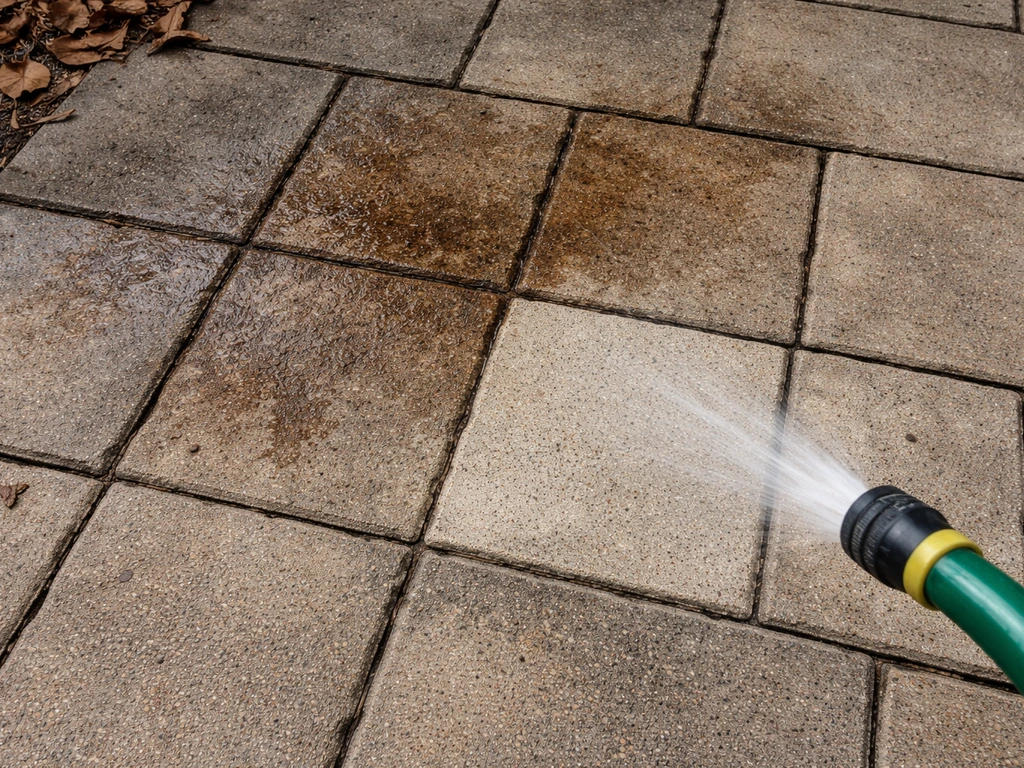
Not all dark marks on pavers come from the same thing, and treating the wrong stain type with the wrong cleaner wastes time at best and damages your surface at worst. Before you grab anything from the shed, take two minutes to figure out what you're actually dealing with.
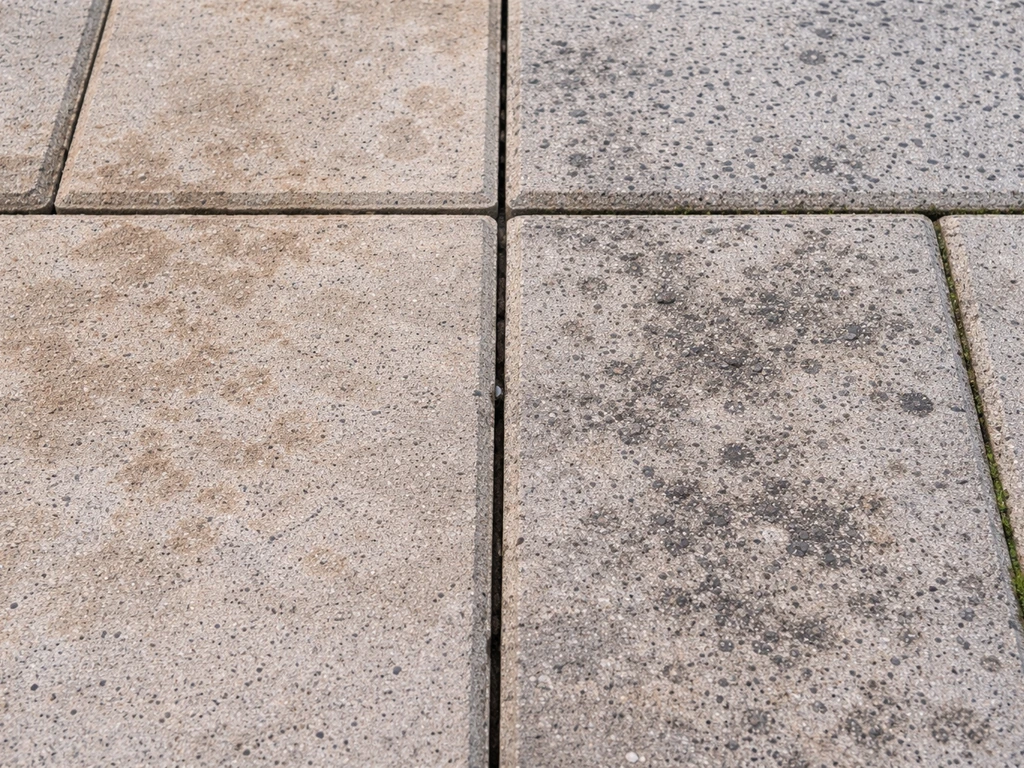
Leaf stains typically fall into one of four categories. Tannin staining looks brownish or yellowish-brown and comes from the natural compounds in leaves, especially oak, walnut, and maple. It's flat, dry-looking, and embedded in the paver surface. Black or dark gray patches that feel slightly slimy or fuzzy are usually mildew or algae that has taken hold in the organic matter left by wet leaves. Sap staining is sticky or glossy, often appears near pine or ornamental trees, and sits more on top of the surface than in it. Finally, if you see white or chalky patches appearing at the same time as the dark staining, that's efflorescence (mineral salt migration), which is a separate issue requiring a different cleaner entirely.
Your paver material matters just as much as the stain type. Concrete pavers are the most forgiving and can handle a wider range of cleaners including diluted bleach and even mild acids in extreme cases. Brick pavers are more porous and more prone to absorbing stains deeply but also more sensitive to high-pressure washing, which can erode the face of older clay bricks. Natural stone pavers (flagstone, travertine, slate, sandstone) are the most sensitive category and require the gentlest approach. The rule you absolutely must remember: never use vinegar or any other acidic cleaner on natural stone. Acid etches calcareous stones like travertine and limestone, dulling the surface permanently. This applies even to gentle household acids like lemon juice.
| Stain Type | Appearance | Likely Cause | Starting Approach |
|---|---|---|---|
| Tannin stain | Brown, yellow-brown, flat | Leaves sitting wet (oak, maple, walnut) | Oxygen bleach or dish soap scrub |
| Mildew/algae | Black, dark gray, slightly slimy | Organic growth in leaf residue | Diluted household bleach |
| Sap stain | Sticky, glossy, resinous | Pine or ornamental tree sap | Dish soap + warm water, then oxygen bleach |
| Efflorescence | White/chalky patches | Mineral salt migration | Efflorescence-specific cleaner (not bleach) |
Quick prep before you start cleaning
Good prep makes everything that follows work better and prevents you from making avoidable mistakes. This whole step takes about ten minutes.
- Clear the surface completely. Sweep or blow all leaves, debris, and loose dirt off the patio. You can't clean through a layer of fresh leaves.
- Wet the pavers down with plain water first. This stops dry pavers from instantly absorbing your cleaning solution before it has a chance to work, and it keeps any runoff from being too concentrated if it reaches planted areas.
- Protect nearby plants and lawn edges. If you're using bleach or any chemical cleaner, wet the surrounding soil and plants beforehand and rinse them again after cleaning. Bleach runoff in high concentrations can damage grass and plants.
- Do a spot test in a small, inconspicuous area. Apply your chosen cleaner to a hidden corner, wait the full dwell time, scrub lightly, and rinse. Check for color change, etching, or any surface damage before committing to the whole patio.
- Check the joints. If your pavers have polymeric sand joints, be careful with high-pressure washing and avoid letting strong acids sit in or near the joints. Regular jointing sand is more vulnerable to washout.
For fresh or mild stains: soap and scrubbing
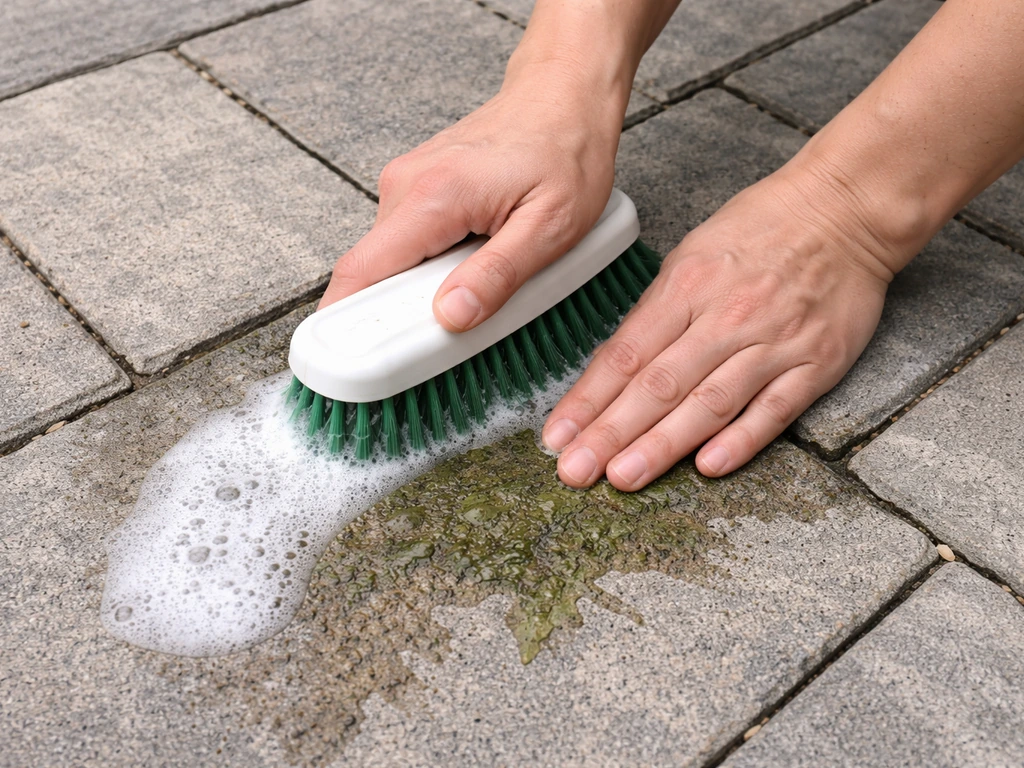
If the leaves came down recently and the staining is light, plain dish soap and a stiff-bristled scrub brush will often do the job without any chemicals. This is the right starting point for natural stone pavers and for anyone who wants to keep it simple.
- Mix a few generous squirts of dish soap (or a pH-neutral stone cleaner for natural stone) into a bucket of warm water.
- Pour the solution over the stained area and let it sit for 5 minutes.
- Scrub firmly with a stiff brush or deck brush. Use circular motions on heavy spots.
- Rinse thoroughly with a garden hose. Make sure no soapy residue is left behind, as it can attract dirt.
- Repeat if needed. Fresh tannin stains often lift on the second scrub.
If you have clay or brick pavers, I'd recommend sticking to hand scrubbing with a bucket and brush rather than using pressure for mild stains. Clay pavers respond well to gentle hand cleaning, and you avoid the risk of eroding the surface face or disturbing joint sand. For concrete pavers with mild staining, a garden hose on a strong spray setting after scrubbing is usually enough.
DIY chemical options: vinegar and oxygen bleach
Oxygen bleach (the one I reach for first)
Oxygen bleach (sodium percarbonate, sold as OxiClean, Sodium Percarbonate, or similar products) is my go-to for leaf tannin and light organic staining on concrete and brick pavers. It breaks down into water and oxygen, so it's much safer around plants and pets than chlorine bleach, and it's safe on colored concrete pavers because it doesn't strip pigment the way chlorine bleach can.
- Mix 1 scoop (about 100g) of oxygen bleach powder per 1 litre of warm water, or follow the product's label for the 'heavy stain' ratio.
- Pour or spray the solution over the stained area until well saturated.
- Let it dwell for 15 to 30 minutes. Don't let it dry on the surface, so work in the shade or mist it with water if needed.
- Scrub with a stiff-bristled brush.
- Rinse thoroughly with a hose. Check the result. Repeat for stubborn spots.
Oxygen bleach is also safe to use on brick. I've found it lifts brown tannin staining from brick surfaces really well without bleaching out the natural color the way chlorine bleach risks doing.
What about white vinegar?
White vinegar gets recommended a lot online for patio cleaning, and it can work on concrete pavers for mild organic residue. However, I want to be direct: do not use vinegar on natural stone pavers. Ever. Travertine, limestone, sandstone, and similar calcareous stones react with acetic acid and etch permanently. Even on concrete, vinegar is a mild cleaner at best, and oxygen bleach outperforms it on actual tannin staining. If you want to use vinegar on concrete pavers only, dilute it 1:1 with water, apply, let it sit for 10 minutes, scrub, and rinse very thoroughly. For the extra effort involved, I'd skip it and go straight to oxygen bleach for anything beyond the lightest marks.
Bleach for stubborn mildew and black organic growth
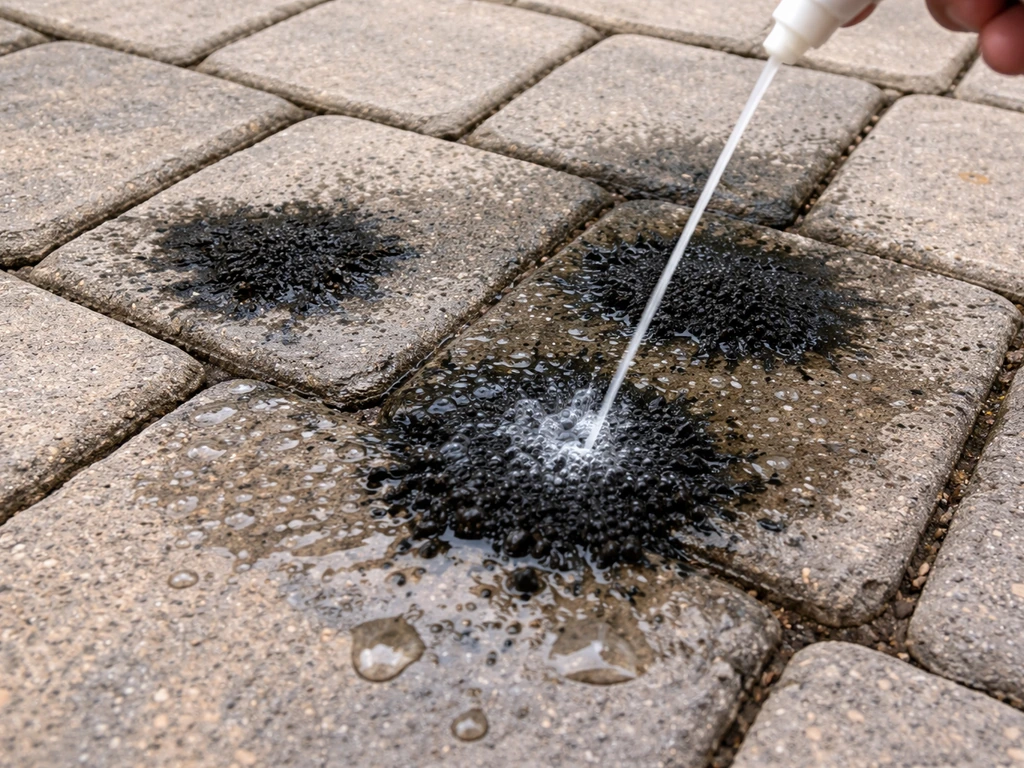
If the dark staining is slimy, fuzzy, or clearly biological (mildew, algae, or black organic growth that has developed in decomposed leaf matter), chlorine bleach is the most effective treatment for concrete and brick pavers. The CDC recommends cleaning mold with a solution of blank" rel="noopener noreferrer">1 cup household liquid bleach per 1 gallon of water. The CDC recommends 1 cup of household liquid bleach per 1 gallon of water for cleaning visible mold from hard surfaces. Clorox's own outdoor guidance suggests a slightly lighter mix of about a third of a cup per gallon for mold and mildew on exterior surfaces, applied with a scrub brush.
- Mix 1 cup of household bleach (sodium hypochlorite, around 6-8% concentration) per 1 gallon of water. Start lighter (1/3 cup per gallon) if you're unsure.
- Pre-wet the pavers with plain water first.
- Apply the bleach solution to the affected area with a scrub brush, garden sprayer, or by pouring directly.
- Let it dwell for 10 to 15 minutes (up to 30 minutes for heavy mildew growth). Don't let it dry.
- Scrub firmly with a stiff brush.
- Rinse very thoroughly with a hose. Make sure you dilute and flush all runoff away from planted areas.
A few important caveats. Do not use chlorine bleach on colored pavers unless you've done a spot test, because it can fade pigment. Do not use bleach on natural stone pavers. And never mix bleach with any other cleaning product, especially ammonia-based cleaners or vinegar. If you have pets or children who use the patio, rinse twice and allow the surface to fully dry and air out before letting them back on it. This takes longer but it's the right call.
Stronger options and what to avoid
When to consider muriatic acid (and when not to)
Muriatic acid (hydrochloric acid) is sometimes suggested for stubborn paver staining, but it's not appropriate for leaf stain removal. Leaf tannins and organic staining are broken down by oxidizing chemistry (bleach, oxygen bleach), not by acids. Muriatic acid's real job is dissolving mineral deposits: efflorescence, calcium carbonate haze, and cement residue. If you have chalky white patches alongside your leaf staining, that's where a carefully diluted acid cleaner (or a purpose-made efflorescence product like Techniseal Paver Prep) might come in. These products require diluting based on severity, must be tested in a small area first, and need immediate, thorough rinsing. Never use muriatic acid on natural stone, and keep it well away from joints that have polymeric sand.
Pressure washing: useful but not always necessary
A pressure washer speeds up rinsing and can help dislodge deeply embedded debris, but it's not a substitute for the right cleaner. If you do use one, keep the pressure between 1,000 and 1,500 PSI for most residential pavers. Starting at the lower end around 1,000 PSI lets you judge the surface response before going higher. Going above 1,800 PSI risks eroding the paver face, disturbing joint sand, or blowing polymeric sand out of the joints entirely. Use a wide fan nozzle (25 or 40 degree), keep the wand moving, and angle the spray so you're not forcing water directly into the joints. For clay or older brick pavers, hand scrubbing and a garden hose is genuinely the safer option.
What to avoid altogether
- Vinegar or any acidic cleaner on natural stone (travertine, limestone, sandstone, flagstone)
- Undiluted bleach or any cleaner applied at full concentration without a spot test
- High-pressure washing above 1,800 PSI on any pavers, or any pressure on older clay brick
- Wire brushes, which scratch and damage paver surfaces
- Mixing cleaning chemicals (never combine bleach with vinegar, ammonia, or other products)
- Leaving any chemical cleaner to dry on the surface instead of rinsing it off
- Applying sealers over stained, dirty, or damp pavers
Rinse well, check your joints, then seal
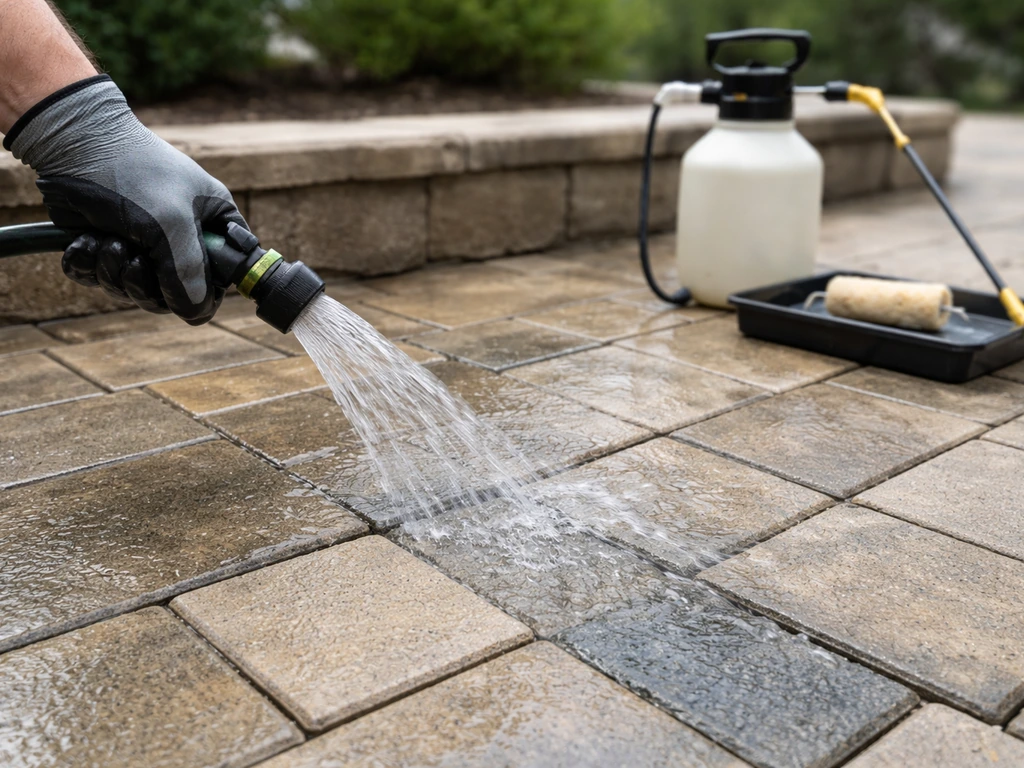
After cleaning, rinse the whole area thoroughly, not just a quick pass. A second rinse to dislodge any loosened particles from the joints and surface is worth the extra two minutes. Check the joint sand level after rinsing. If pressure washing or heavy scrubbing has displaced sand, top it up before sealing. If you used polymeric sand for repairs, give it at least 48 to 72 hours to cure before applying any cleaner, and ideally 30 days before sealing.
Sealing is the step most people skip, and it's the reason the same stains come back the following season. A good penetrating impregnating sealer (the type used on most pavers) doesn't sit on top as a film but soaks into the pore structure and acts as a repellent for water, oil, and organic material. It won't make the surface completely stain-proof, but it dramatically slows down how fast leaves can stain and makes future cleaning much easier. For concrete pavers, a film-forming sealer works well too and can enhance color. Make sure your pavers are fully clean and completely dry before applying any sealer, and always check that the joint sand is at the right level first.
One thing worth knowing: if your pavers were previously sealed and the sealer is still intact, that layer may actually be protecting them from the worst staining. If the stains are sitting on top of an old sealer coat rather than in the paver itself, a good scrub with dish soap and warm water might be all you need. Conversely, if the old sealer is flaking or yellowing, strip it before resealing rather than layering new sealer on top of failing old product.
How to stop leaf stains from coming back
The most effective leaf stain prevention is also the simplest: don't let wet leaves sit on the patio. Leaves start releasing tannins within hours of getting wet, and after a day or two of rain and moisture, the staining process is already underway. During autumn and any period with heavy leaf fall, a quick sweep every couple of days is far less work than a deep clean in spring.
- Sweep or blow leaves off the patio at least twice a week during heavy leaf-fall periods
- Rinse the patio surface down with a hose after heavy rain to prevent organic matter from sitting wet
- Keep a penetrating sealer in good condition by reapplying every 2 to 3 years, or as recommended by the product manufacturer
- Trim overhanging branches where practical to reduce the volume of leaves falling directly onto the patio
- Use a leaf blower or outdoor broom with stiff bristles rather than a soft broom, which tends to smear wet organic material instead of clearing it
- If you cover the patio over winter, ensure the cover allows airflow underneath to prevent trapped moisture and mildew growth
If you're also dealing with other types of organic staining on your patio, the approach overlaps in some useful ways. Grass stains and berry stains on patio slabs, for example, also respond well to oxygen bleach as a first step, though berry stains sometimes need a longer dwell time to fully break down the pigment. Berry stains on patio slabs often need oxygen bleach for best results, with a longer dwell time than fresh leaf marks. If you are dealing with grass stains on patio slabs, oxygen bleach is a good first step before moving on to other cleaners Grass stains and berry stains on patio slabs. Lawn feed and weed-and-feed stains are a different category altogether because they often involve iron or other mineral compounds that need a targeted treatment rather than just organic stain removal chemistry. In particular, weed-and-feed stains can require a targeted treatment because of the iron and mineral compounds involved Lawn feed and weed-and-feed stains. If you suspect fertilizer or weed-and-feed residue, the cleaner choice and dwell time are different from standard leaf stain removal Lawn feed and weed-and-feed stains.
Stick to a regular sweep and rinse routine, keep your sealer current, and most leaf staining won't get a chance to become a deep cleaning problem. When it does, you now know exactly which cleaner to reach for first.
FAQ
How long should I let oxygen bleach sit on patio pavers before scrubbing or rinsing?
Use a short dwell first, about 10 to 20 minutes, then scrub and rinse thoroughly. If the stain remains, repeat with another fresh mix rather than leaving it for hours, especially on older brick or natural stone (where you should stick to gentler methods).
What if the leaf stain is still visible after one oxygen bleach treatment?
Do a second pass after confirming you have no mildew or algae. If the surface looks dry and brownish, reapply oxygen bleach and scrub again. If it looks dark and slimy or fuzzy, switch to chlorine bleach only for concrete or brick, and avoid it on natural stone or colored pavers without a spot test.
Can I use a stiff brush attachment on a power tool for leaf stains?
Yes for concrete and brick, but keep it gentle and avoid grinding in one spot. For pavers with polymeric joint sand, don’t use aggressive attachments that can scour the joints and leave sand gaps or exposed edges.
Is it safe to clean leaf stains when it’s hot or in direct sun?
Safer in cooler conditions. In high heat, cleaners can dry too fast, which reduces dwell time and can leave residues. Aim for shade or morning, and re-wet the area lightly if the solution starts to dry.
Will oxygen bleach harm nearby plants and grass?
It’s generally much safer than chlorine bleach because it breaks down into oxygen and water, but you should still keep runoff off delicate plants when possible. If you can, water the surrounding area lightly before and after, and do not let chemical solution pool in low spots.
What should I do if I accidentally use vinegar or acid on natural stone?
Stop immediately, rinse very thoroughly with clean water, and allow it to dry fully. The etching on calcareous stone is often permanent, but you can sometimes reduce the look by cleaning gently and later resealing, using a sealer compatible with etched stone.
How do I know whether my dark stains are leaf tannins or mildew/algae?
Leaf tannins look flat and dry, often brown or yellow-brown, and they feel embedded. Mildew or algae tends to be dark gray or black with a slimy, fuzzy, or powdery look that comes back quickly if you rinse and it dries slowly.
Can I use chlorine bleach if my pavers are colored or stained?
Only with caution. Chlorine bleach can fade pigment, so do a spot test in an inconspicuous area first. If color loss appears, switch to oxygen bleach for tannin staining, and limit chlorine bleach to concrete or brick only when the stain is clearly biological.
Do I need to reseal after removing leaf stains?
Not always, but it’s a strong idea if the patio is due for maintenance. After the pavers are fully clean and completely dry, check whether water still beads. If water soaks in faster than before, resealing helps slow future tannin staining.
How soon after pressure washing can I apply a sealer?
Wait until the pavers are completely dry, and give extra time if you see moisture in joints or at the edges. In humid weather, drying can take longer than a day, so don’t seal based on surface feel alone.
What’s the right way to fix joint sand after cleaning?
After a full rinse and drying, check joint sand level and refill low areas to the manufacturer-recommended height. If you disturb polymeric sand, avoid relabeling it as “still fine,” because it can lose binding performance if washed out.
Can I mix cleaners to improve results if my first attempt fails?
No. Never mix chlorine bleach with other products, especially ammonia-based cleaners or vinegar, and don’t combine acid products with oxidizers. If the first approach fails, identify the stain category again and switch chemistry rather than stacking products.
Leaf stains are back after winter. Does that mean the sealer failed?
Not necessarily. It can mean leaves are staining through an area where the sealer is worn, or the sealer was applied before the pavers and joints were fully clean and dry. Check for flaking or uneven coverage, remove failing sealer if needed, then reseal only after thorough cleaning and drying.
Next Articles
How to Remove Thompson’s Patio Sealer Step by Step
Step-by-step removal of Thompson’s patio sealer on concrete, brick, pavers, and stone, with safety, tests, and cleanup.
Can You Remove Patio Sealer? How to Strip It Safely
Learn if you can remove patio sealer and how to strip it safely by type, material, and method.
How to Remove Resin From Patio Safely by Surface Type
Step by step guide to remove resin from patio by surface type with safe scraping, softening and solvent methods.